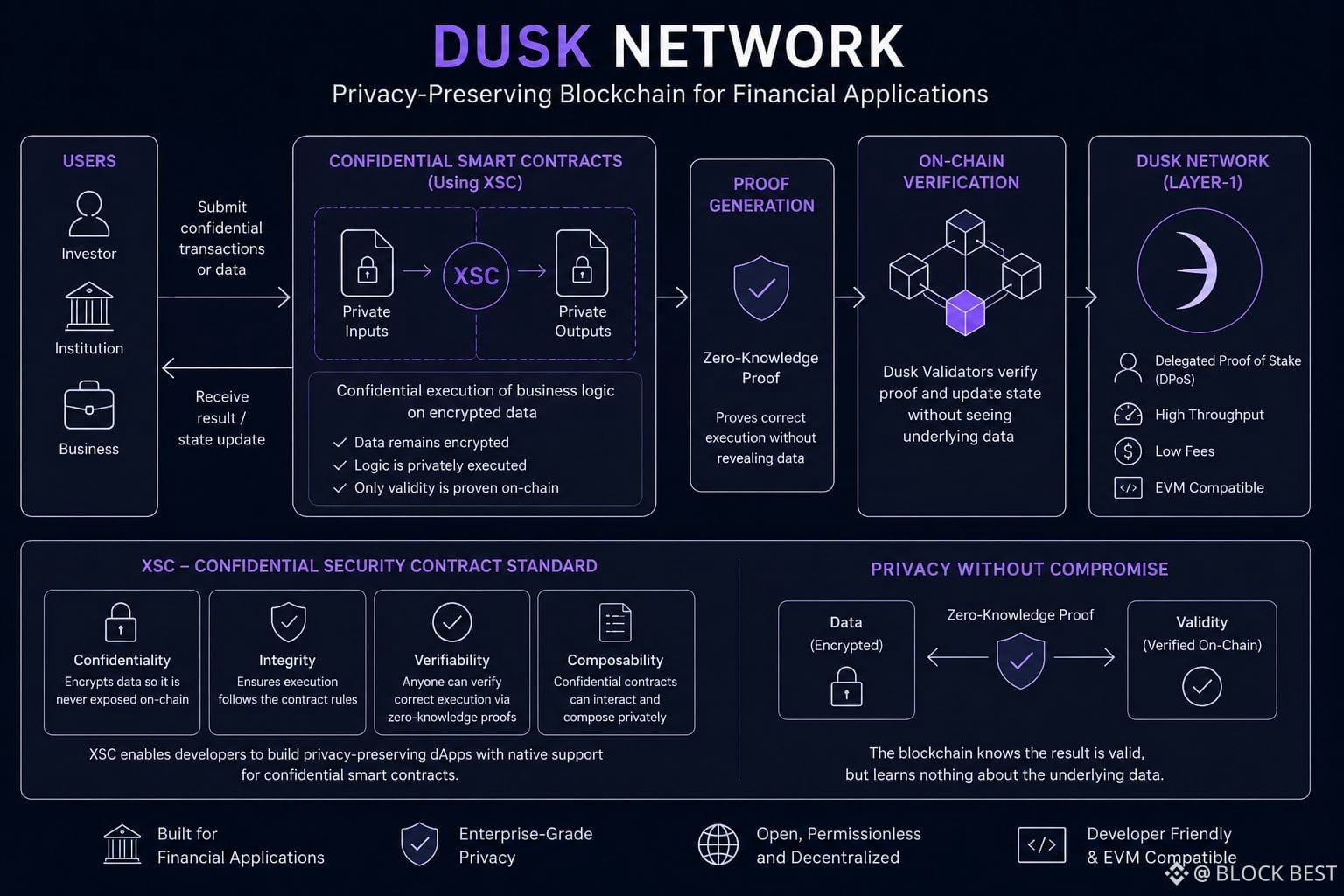
There’s one thing about Dusk I keep coming back to: privacy here isn’t really an add-on. It changes what you can safely put on the chain in the first place.
That sounds obvious until you think about financial applications.
A public blockchain makes transparency the default, which is useful for verification but awkward when the thing being verified is also commercially sensitive. Balances, transactions, counterparties, positions—sometimes revealing the data is itself the problem.
What I find more interesting about Dusk is the attempt to make confidentiality part of the contract layer rather than something applications have to awkwardly build around afterward.
That creates a different question, though.
If confidential smart contracts become normal, what becomes the new assumption for users? You no longer get the comfort of simply looking at everything yourself. You have to trust the cryptography, the execution rules, and the way the protocol proves that private computation was still performed correctly.
That tradeoff feels more important than the usual privacy narrative.
Dusk isn’t just asking whether blockchains can hide financial information.
It is quietly asking whether financial systems can become verifiable without requiring everyone to see the underlying data.
I’m still thinking about what that changes.
@Dusk #dusk $DUSK
That sounds obvious until you think about financial applications.
A public blockchain makes transparency the default, which is useful for verification but awkward when the thing being verified is also commercially sensitive. Balances, transactions, counterparties, positions—sometimes revealing the data is itself the problem.
What I find more interesting about Dusk is the attempt to make confidentiality part of the contract layer rather than something applications have to awkwardly build around afterward.
That creates a different question, though.
If confidential smart contracts become normal, what becomes the new assumption for users? You no longer get the comfort of simply looking at everything yourself. You have to trust the cryptography, the execution rules, and the way the protocol proves that private computation was still performed correctly.
That tradeoff feels more important than the usual privacy narrative.
Dusk isn’t just asking whether blockchains can hide financial information.
It is quietly asking whether financial systems can become verifiable without requiring everyone to see the underlying data.
I’m still thinking about what that changes.
@Dusk #dusk $DUSK