


Bitcoin's chart isn't the only place to look for a cycle bottom
Most traders track Bitcoin's price to figure out where the market cycle stands. Fewer are watching crypto's credit market, and that's a mistake. Lending data tends to move first, because it reflects how much risk traders and institutions are actually willing to take on, not just how they feel about price.
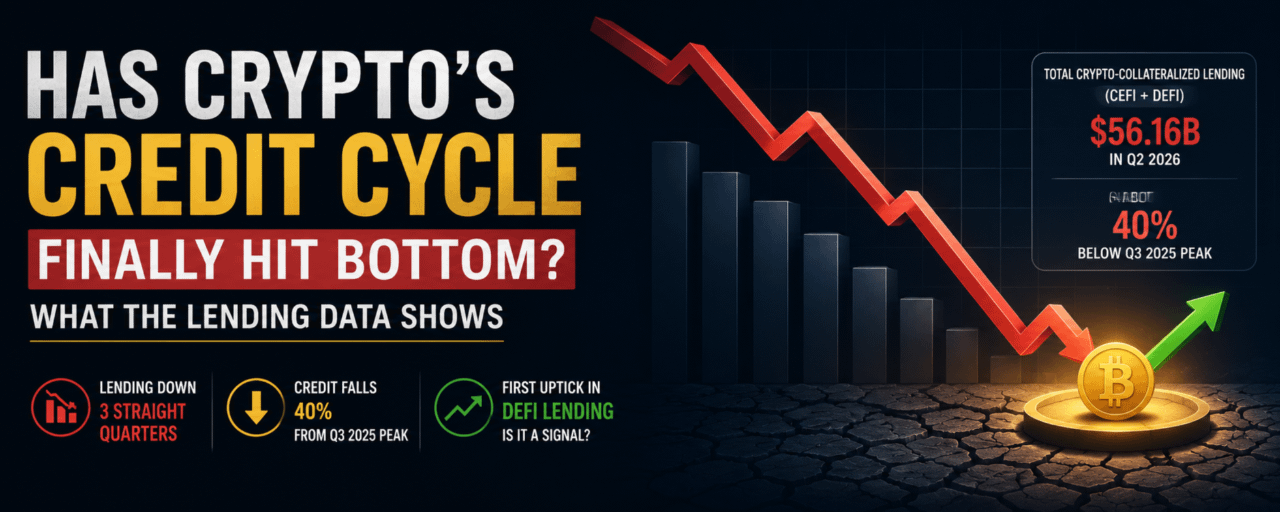
The latest numbers show that credit has been shrinking for three straight quarters. The question worth asking isn't whether it falls again. It's whether the contraction is finally running out of room.
What is crypto-collateralized lending, and why does it matter?
Crypto-collateralized lending is capital borrowed against crypto assets as collateral, used to trade, invest, build, or add leverage to an existing position. It spans two markets: CeFi lenders like Tether, Maple, and Nexo, and DeFi lending apps like Aave, where loans are issued through smart contracts instead of a company.
This market functions as crypto's credit engine. When lending expands, it usually means traders and institutions are willing to take on leverage, which tends to accompany rising risk appetite and rising prices. When lending contracts, it signals the opposite: participants are deleveraging, cutting exposure, and waiting.
The numbers: three straight quarters of contraction
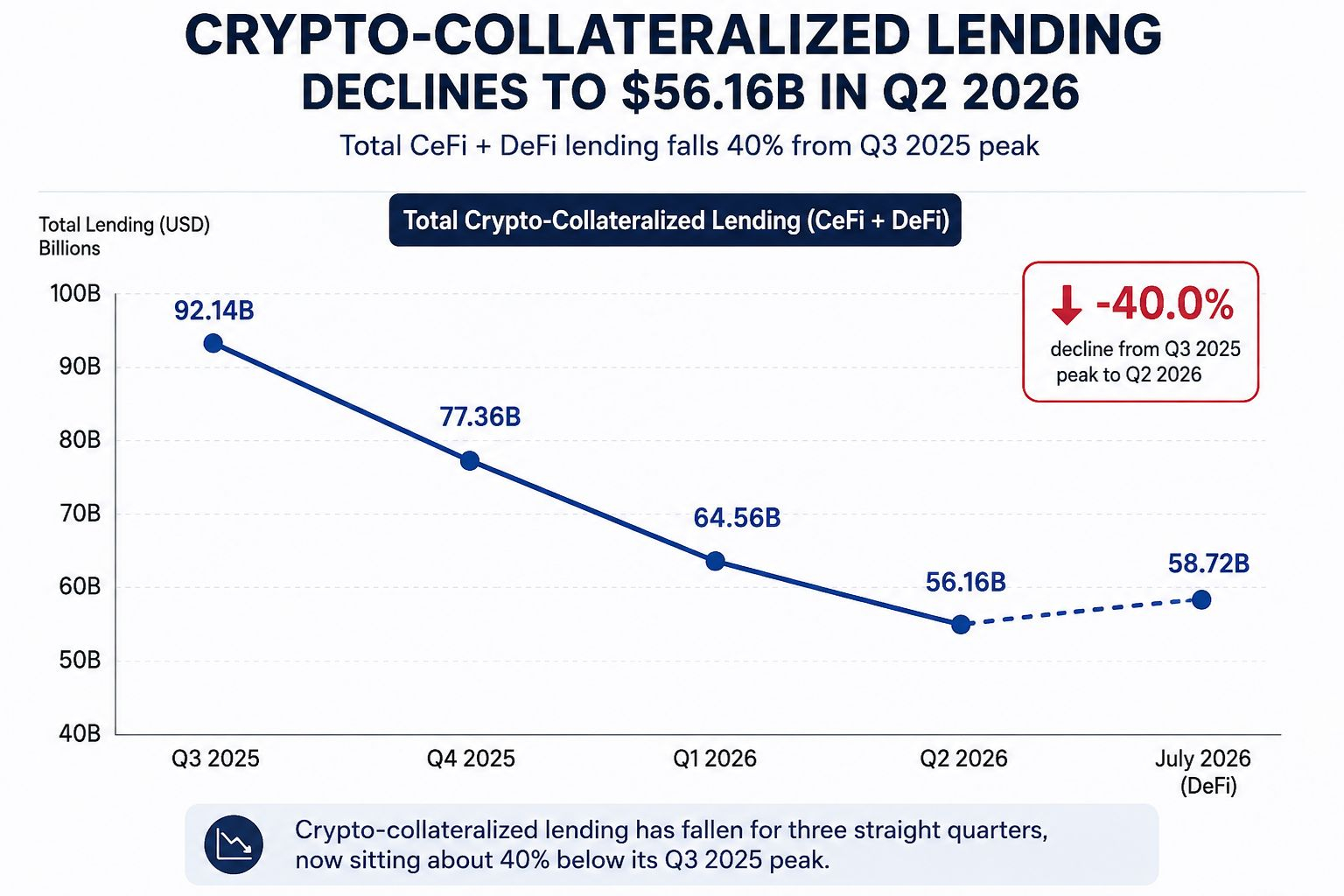
According to Galaxy Research's latest crypto leverage report, total crypto-collateralized lending fell 16.78% in Q2 2026, dropping $11.33 billion to end the quarter at $56.16 billion. That's the third consecutive quarterly decline, following drops of 10% and 5% in the two prior quarters.
The current total sits about 40% below the $78.69 billion peak reached in Q3 2025.
The pullback wasn't evenly spread across the market:
DeFi lending fell the hardest, down 27.61% to $20.43 billion.
CeFi lending declined a more modest 9.62% to $22.98 billion.
CDP stablecoin collateral (crypto-backed collateralized debt positions) dropped 7.86%.
Because DeFi contracted so much faster than CeFi, centralized lenders overtook decentralized lending apps in market share for the first time since Q3 2023. DeFi's share of the market slipped to roughly 47%, down from around 53% the quarter before.
Tether remains the dominant CeFi lender by a wide margin, holding a 58.54% share of that market. Tether, Maple, and Nexo together control close to 75% of tracked CeFi lending.
Why this contraction looks different from 2022
The size of the decline sounds alarming on its own, but the shape of it matters more than the headline number. Galaxy Research frames this as an orderly deleveraging rather than a repeat of the 2022 credit collapse.
In Q2 2022, crypto-backed lending collapsed by more than 55% in a single quarter, driven by the cascading failures of Celsius, BlockFi, and Voyager. That was a forced unwind: lenders were insolvent, collateral was liquidated all at once, and the contraction hit like a cliff.
This cycle looks stepwise instead: declines of roughly 10%, 5%, and 17% across three consecutive quarters. Borrowers appear to be proactively repaying loans and reducing exposure ahead of stress, rather than being forced out through liquidations. Lower asset valuations and tighter collateral requirements have pushed lenders toward more conservative underwriting, and major players like Galaxy and Coinbase actually grew their loan books in Q2 even as the broader market shrank.
That distinction matters for how the next phase might unfold. A controlled deleveraging can stabilize and reverse. A cascading one usually has to hit a much deeper bottom first.
Three signals that would confirm a bottom
A single quarter of stabilization wouldn't be enough to call a new cycle. Three things would need to line up together:
Total lending stabilizes. The pace of decline slows and then flattens instead of accelerating.
DeFi lending starts recovering. Since DeFi fell the fastest, a rebound there would suggest that on-chain risk appetite is returning, not just conservative CeFi growth.
Credit demand expands again. Borrowers taking on new leverage, rather than just repaying old loans, is the clearest sign that risk appetite is genuinely rebuilding.
What early July data suggests
There are early signs worth watching. Preliminary data cited in Galaxy's report shows DeFi lending climbing to roughly $21.94 billion in July, up from the Q2 low, after having fallen from around $47.13 billion back in April. Futures open interest, which dropped 3.08% during Q2 to $103.2 billion, reportedly rebounded to around $114 billion by late July.
Neither of these confirms a reversal on its own. One month of DeFi growth and rising open interest could just as easily be a temporary bounce inside a longer deleveraging cycle. But they're the kind of early data points that would need to keep building for the "credit market bottom" thesis to hold.
The bigger picture: why credit leads price
Traders often treat lending data as a lagging confirmation of price trends. It's arguably closer to the opposite. Leverage has to expand before a rally can accelerate, and it typically contracts before a downturn fully plays out in price. Watching whether borrowers are adding or cutting exposure gives a read on conviction that a price chart alone doesn't show.
That's the case for treating the credit data as a leading indicator rather than background noise. If lending stabilizes and then expands across both CeFi and DeFi over the next one to two quarters, it would be one of the more credible signals that risk appetite is genuinely returning, not just that Bitcoin bounced.
If it keeps contracting, that's a sign the deleveraging cycle still has room to run, regardless of what short-term price action suggests.
FAQ
What is crypto-collateralized lending? It's capital borrowed against crypto assets as collateral, used to trade, invest, build, or leverage positions. It includes both centralized (CeFi) lenders and decentralized (DeFi) lending protocols.
Why did CeFi lending overtake DeFi lending in Q2 2026? DeFi lending fell much faster than CeFi lending, dropping 27.61% versus CeFi's 9.62% decline, which pushed CeFi's market share above DeFi's for the first time since Q3 2023.
Does falling crypto lending mean another 2022-style collapse is coming? Not necessarily. Analysts point to the current contraction as more orderly, driven by borrowers proactively reducing leverage rather than forced liquidations, unlike the sudden 55% single-quarter collapse seen in Q2 2022.
#CryptoLending #DeFi #CeFi #CryptoMarkets #BTC