


Nvidia fell 1.26% to $210.40 on Wednesday, giving it a market capitalization of $5.09 trillion, ahead of Q2 fiscal 2027 results due after the US market close, according to BIT market data.
The market has framed this report as the AI trade's verdict for the quarter, and the framing is warranted by how wide the gap has become between demand data and equity performance.
The demand side has been consistent. Amazon posted 37% AWS growth, its fastest in 18 quarters. CoreWeave surged 16% after hours on stronger-than-expected sales. SK Hynix committed $38 billion to memory capacity expansion. HIVE signed a $350 million five-year GPU cloud deal.
The equity side has not followed. The Nasdaq fell roughly 2% last week with semiconductors down more than 4%. SK Hynix missed consensus despite 257% year-over-year revenue growth. China's DUV lithography breakthrough drove the Kospi down 40% from its June peak. Nvidia itself was, as of Tuesday, positioned to break its longest losing streak since 2022.
Energy Group Capital's Amanda Lyons identified why: the debate has shifted from whether AI demand exists to whether the extraordinary infrastructure buildout can keep generating sufficient economic returns. Demand is settled. Return on invested capital is not.
Guidance Matters More Than the Print
Nvidia's role has changed in a way that makes forward guidance the more consequential half of the release. The company has become involved in orchestrating funding across the AI ecosystem — which means its outlook is a statement about the health of its own customer base as much as its order book. Specific items to watch include Rubin chip transition progress and China operations commentary, the latter carrying added weight given this week's expansion of US sanctions on Iran's technology sector and the broader secondary-sanctions posture.
Analysts have framed a strong report and guidance as a potential catalyst for the S&P 500 to break 8,000, and a miss as the trigger for renewed technology sector pressure.
The Crypto Read-Through
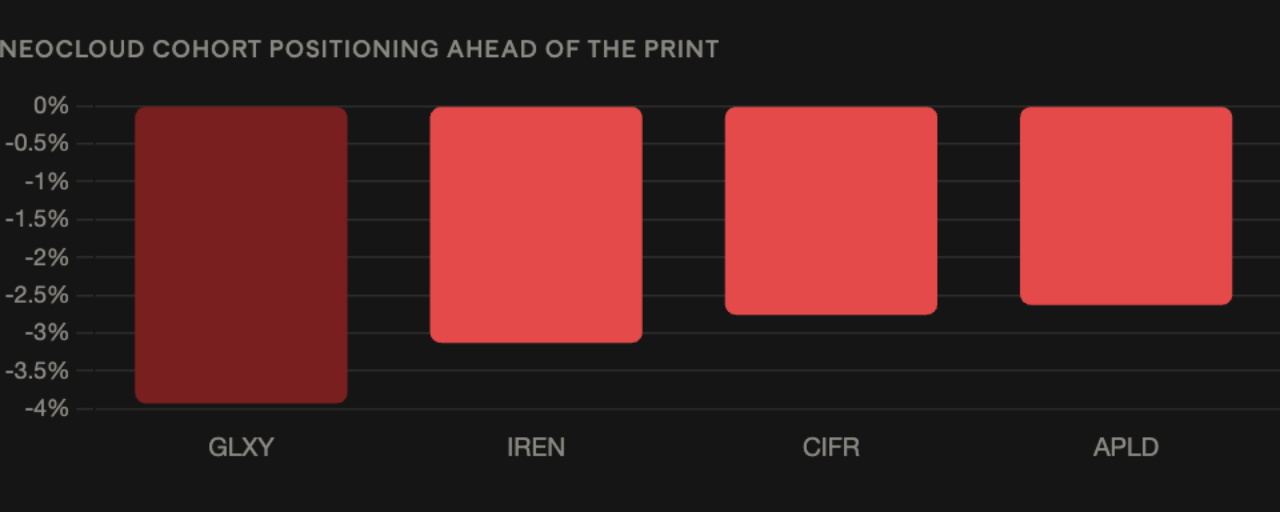
For crypto, the relevant channel runs through miners that pivoted to AI compute rather than through price correlation. Neocloud names fell broadly at Wednesday's open — Galaxy Digital down 3.93%, IREN 3.13%, Cipher Mining 2.76% and Applied Digital 2.63% — with IREN reporting Thursday post-market. Those valuations are built on contracted AI compute revenue persisting at current rates: IREN holds $2.8 billion in contracts across Microsoft, Nvidia, Perplexity and Figure AI.
The price correlation channel has weakened considerably. Bitcoin gained 23.6% last week while the Nasdaq fell 2%, driven by ETF inflows and Treasury buyback dynamics rather than semiconductor sentiment. Bitcoin has held near $80,000 after being rejected at its 50-week moving average at $81,085.