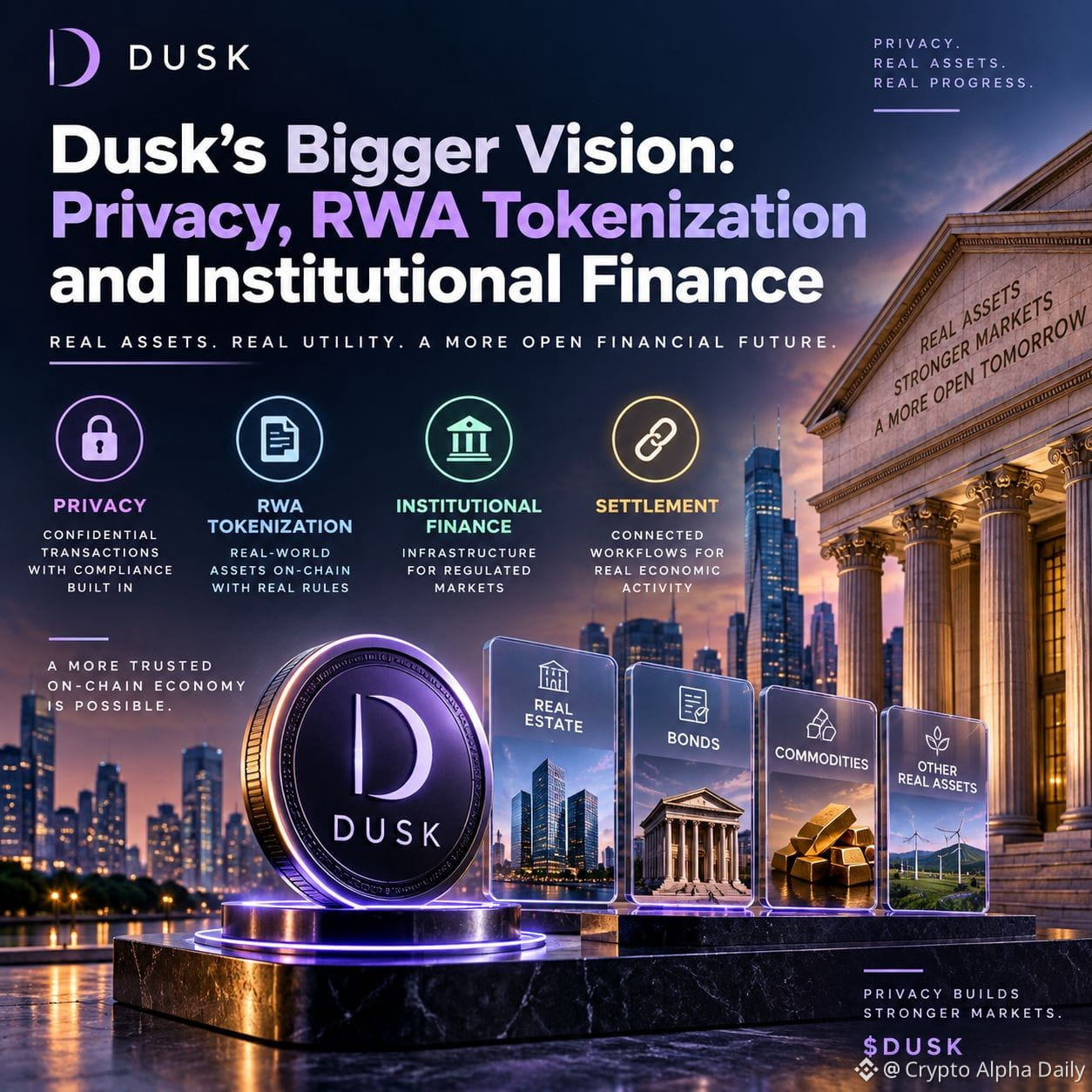
What if bringing finance on-chain isn’t really about putting assets on a blockchain—but rebuilding the financial workflow around privacy, compliance, and settlement?
That is where @Dusk takes a different approach.
1. Privacy is part of the infrastructure
Dusk supports shielded transfers and zero-knowledge technology, allowing sensitive balances, positions, and transactions to remain private while still enabling controlled disclosure when authorized parties need evidence.
2. Tokenization needs more than a token
For regulated assets, issuance is only the beginning. Eligibility, transfer restrictions, disclosure, servicing, and settlement all matter. Dusk is designed to bring these requirements into a connected on-chain workflow rather than treating tokenization as a simple digital wrapper.
3. Settlement is central to the bigger picture
Dusk combines privacy-capable transaction models with deterministic finality and settlement infrastructure. Its architecture is designed for workflows where the asset leg and payment leg need to coordinate efficiently and transparently where appropriate.
4. The goal is institutional-grade market infrastructure
Dusk is positioning its network around regulated digital assets, with tools such as DuskEVM, DuskVM, identity and access primitives, and Dusk Trade for tokenized financial-asset workflows.
The interesting part of $DUSK is therefore not just the token itself. The larger story is whether blockchain infrastructure can support financial markets where privacy, compliance, programmable assets, and settlement have to work together.
That is the bigger vision behind Dusk.
Has the industry focused too much on tokenizing assets and not enough on rebuilding the full financial lifecycle?
#dusk #RWA #Tokenization
That is where @Dusk takes a different approach.
1. Privacy is part of the infrastructure
Dusk supports shielded transfers and zero-knowledge technology, allowing sensitive balances, positions, and transactions to remain private while still enabling controlled disclosure when authorized parties need evidence.
2. Tokenization needs more than a token
For regulated assets, issuance is only the beginning. Eligibility, transfer restrictions, disclosure, servicing, and settlement all matter. Dusk is designed to bring these requirements into a connected on-chain workflow rather than treating tokenization as a simple digital wrapper.
3. Settlement is central to the bigger picture
Dusk combines privacy-capable transaction models with deterministic finality and settlement infrastructure. Its architecture is designed for workflows where the asset leg and payment leg need to coordinate efficiently and transparently where appropriate.
4. The goal is institutional-grade market infrastructure
Dusk is positioning its network around regulated digital assets, with tools such as DuskEVM, DuskVM, identity and access primitives, and Dusk Trade for tokenized financial-asset workflows.
The interesting part of $DUSK is therefore not just the token itself. The larger story is whether blockchain infrastructure can support financial markets where privacy, compliance, programmable assets, and settlement have to work together.
That is the bigger vision behind Dusk.
Has the industry focused too much on tokenizing assets and not enough on rebuilding the full financial lifecycle?
#dusk #RWA #Tokenization