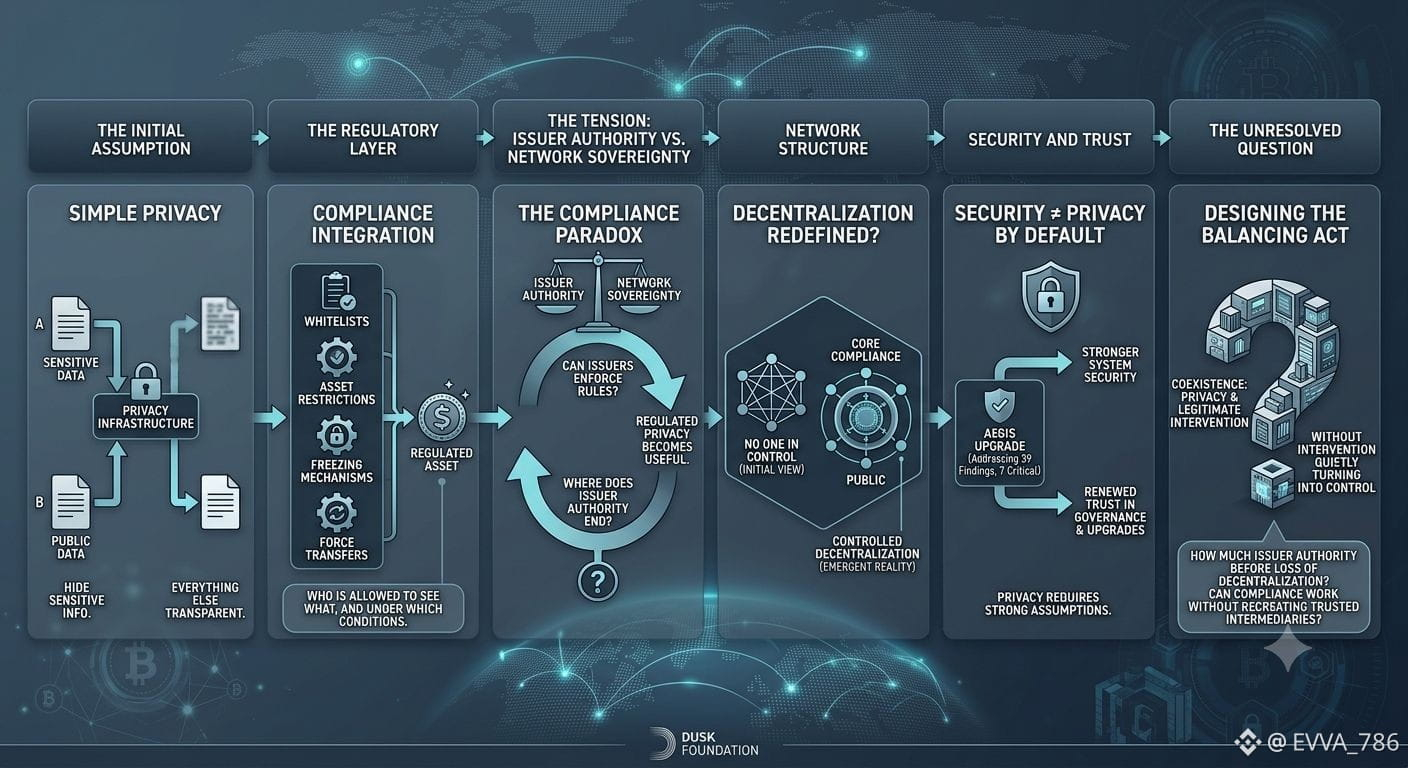
I used to think privacy infrastructure had a fairly simple job: hide sensitive information while leaving everything else transparent.
But Dusk made that assumption feel incomplete.
Once regulated assets enter the picture, privacy stops being just about hiding data. It becomes a question of who is allowed to see what, and under which conditions. Whitelists, asset restrictions, freezing, or force transfers can make compliance possible, but they also introduce another tension: if an issuer can enforce those rules, where does issuer authority end and network sovereignty begin?
That seems especially interesting with @DuskFoundation. The more useful regulated privacy becomes, the harder it is to pretend that decentralization simply means “no one is in control.”
And then there’s security.
The AEGIS upgrade addressing 39 findings, including seven critical ones, makes me think about another assumption we rarely question: that privacy and security naturally travel together. They don’t necessarily. A system can reveal less while still requiring very strong assumptions about upgrades, governance, permissions, and who can intervene when something goes wrong.
Maybe the harder problem isn’t making financial activity private.
Maybe it’s designing a system where privacy can coexist with legitimate intervention without quietly turning intervention into control.
So I keep coming back to one unresolved question: how much authority can regulated privacy infrastructure give issuers before the network stops being meaningfully decentralized—and can compliance ever work without recreating trusted intermediaries somewhere underneath?
@Dusk #DUSK $DUSK
But Dusk made that assumption feel incomplete.
Once regulated assets enter the picture, privacy stops being just about hiding data. It becomes a question of who is allowed to see what, and under which conditions. Whitelists, asset restrictions, freezing, or force transfers can make compliance possible, but they also introduce another tension: if an issuer can enforce those rules, where does issuer authority end and network sovereignty begin?
That seems especially interesting with @DuskFoundation. The more useful regulated privacy becomes, the harder it is to pretend that decentralization simply means “no one is in control.”
And then there’s security.
The AEGIS upgrade addressing 39 findings, including seven critical ones, makes me think about another assumption we rarely question: that privacy and security naturally travel together. They don’t necessarily. A system can reveal less while still requiring very strong assumptions about upgrades, governance, permissions, and who can intervene when something goes wrong.
Maybe the harder problem isn’t making financial activity private.
Maybe it’s designing a system where privacy can coexist with legitimate intervention without quietly turning intervention into control.
So I keep coming back to one unresolved question: how much authority can regulated privacy infrastructure give issuers before the network stops being meaningfully decentralized—and can compliance ever work without recreating trusted intermediaries somewhere underneath?
@Dusk #DUSK $DUSK