#dusk $DUSK @Dusk
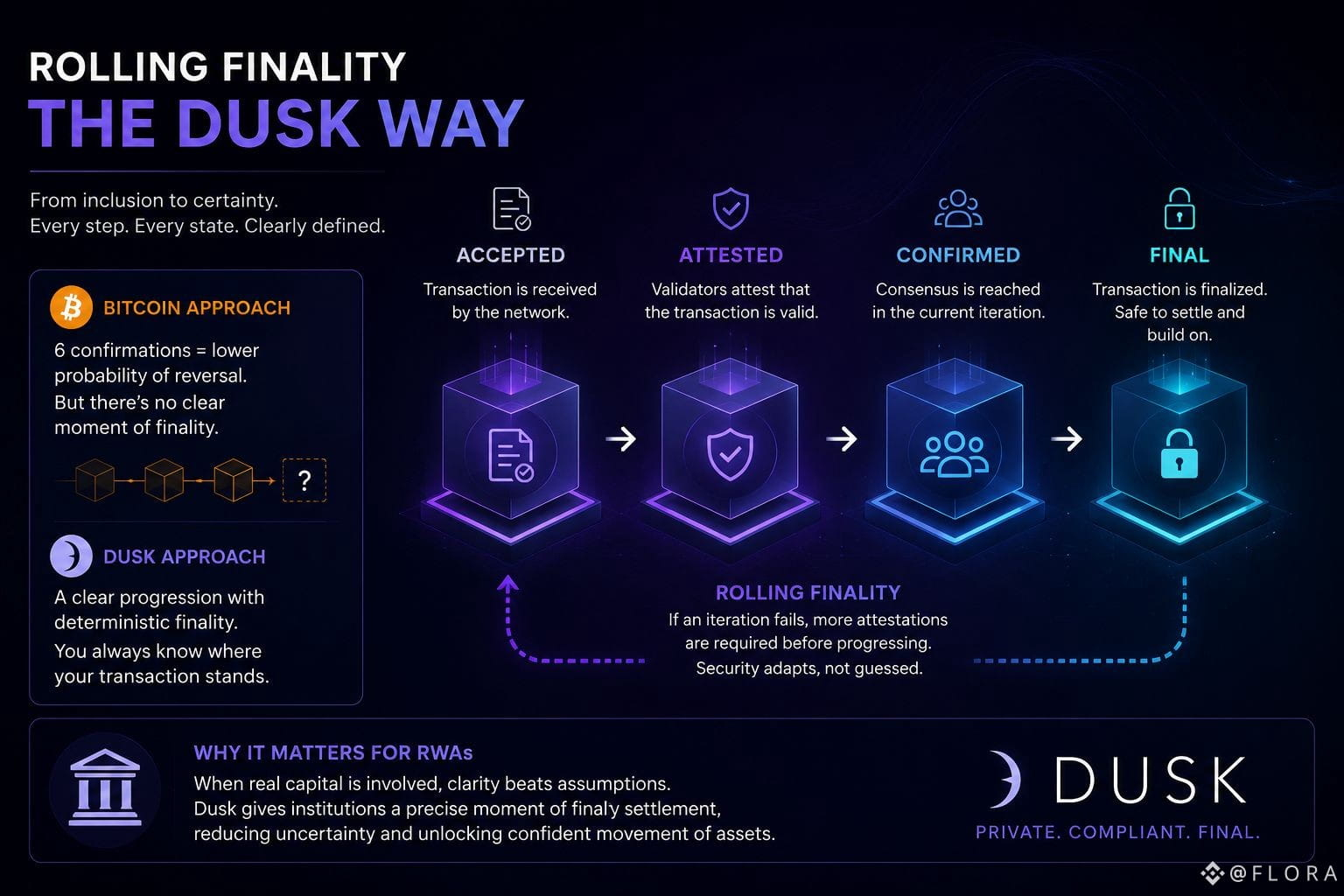
The more I dig into @Dusk , the more I think its approach to finality deserves more attention. At first, I looked at finality like most people do: as a question of how many confirmations you need before feeling safe. Bitcoin is a good example. Waiting for several confirmations lowers the chance of a reversal, but it’s still more of a probability-based convention than a clearly defined settlement state. Dusk looks at this differently, with a progression from Accepted to Attested, Confirmed, and finally Final. I find that interesting because the difference matters a lot when blockchain starts handling real financial assets. For a normal transaction, waiting a little longer might not matter. But if you’re dealing with a custodian, tokenized security, or large settlement, knowing exactly where a transaction stands becomes much more important. The rolling part makes this even more interesting. If an iteration doesn’t reach agreement, the protocol can continue through additional attestations rather than relying on a simple “wait X blocks” rule. There is some extra complexity here, and developers need to understand the different states instead of treating confirmation as the finish line. But for regulated finance, that trade-off could make sense. When capital is involved, uncertainty has a cost. What interests me most is that Dusk isn’t only trying to make settlement faster. It’s trying to make the point of final settlement clearer. For RWAs, that certainty could be just as important as speed.
The more I dig into @Dusk , the more I think its approach to finality deserves more attention. At first, I looked at finality like most people do: as a question of how many confirmations you need before feeling safe. Bitcoin is a good example. Waiting for several confirmations lowers the chance of a reversal, but it’s still more of a probability-based convention than a clearly defined settlement state. Dusk looks at this differently, with a progression from Accepted to Attested, Confirmed, and finally Final. I find that interesting because the difference matters a lot when blockchain starts handling real financial assets. For a normal transaction, waiting a little longer might not matter. But if you’re dealing with a custodian, tokenized security, or large settlement, knowing exactly where a transaction stands becomes much more important. The rolling part makes this even more interesting. If an iteration doesn’t reach agreement, the protocol can continue through additional attestations rather than relying on a simple “wait X blocks” rule. There is some extra complexity here, and developers need to understand the different states instead of treating confirmation as the finish line. But for regulated finance, that trade-off could make sense. When capital is involved, uncertainty has a cost. What interests me most is that Dusk isn’t only trying to make settlement faster. It’s trying to make the point of final settlement clearer. For RWAs, that certainty could be just as important as speed.