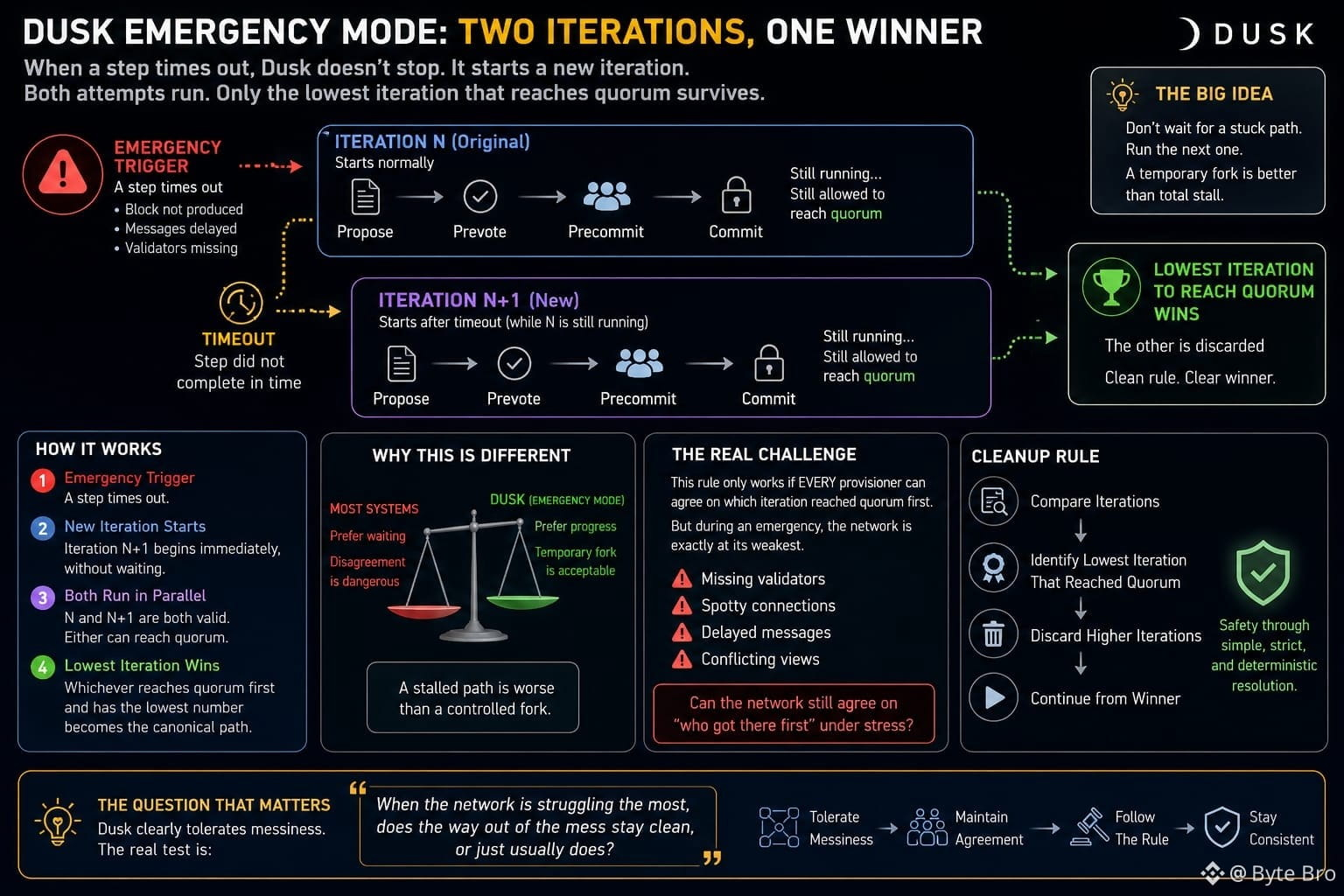

Everyone talks about Dusk's emergency mode like it's just a safety net for when block production stalls. But the thing that actually caught my attention is smaller than that: when a step times out, Dusk doesn't stop and wait. It just starts a new iteration, while the old one is still running, still allowed to reach quorum. Two attempts alive at once, and that's not an accident.
That's a strange thing to be okay with, if you think about it. Most consensus systems treat waiting as the safe move and disagreement as the scary one. Dusk basically flips that around during emergencies. It says: a stalled path is worse than a temporary fork, as long as there's a clean rule for cleaning the fork up afterward, lowest iteration wins, done.
But here's what nags at me. That rule only works if every provisioner can actually agree on which iteration hit quorum first, without arguing about it. And the moment you're in emergency mode is exactly the moment that's hardest to know, missing validators, spotty connections, delayed messages.
So I don't think the interesting question is does Dusk tolerate messiness. Clearly it does, on purpose. The real question is whether the way out of that mess stays clean when the network is already struggling, or just usually does.
#dusk @Dusk $DUSK
That's a strange thing to be okay with, if you think about it. Most consensus systems treat waiting as the safe move and disagreement as the scary one. Dusk basically flips that around during emergencies. It says: a stalled path is worse than a temporary fork, as long as there's a clean rule for cleaning the fork up afterward, lowest iteration wins, done.
But here's what nags at me. That rule only works if every provisioner can actually agree on which iteration hit quorum first, without arguing about it. And the moment you're in emergency mode is exactly the moment that's hardest to know, missing validators, spotty connections, delayed messages.
So I don't think the interesting question is does Dusk tolerate messiness. Clearly it does, on purpose. The real question is whether the way out of that mess stays clean when the network is already struggling, or just usually does.
#dusk @Dusk $DUSK