Dusk is often compared with privacy-focused blockchains, but that misses the real contest. Its toughest competitor is the financial system institutions already use.
Banks know their existing databases are slow, fragmented, and expensive. They also know who is responsible when something fails. Regulators understand those systems, employees are trained on them, and legal agreements have been tested through years of disputes.
Dusk offers a cleaner alternative. Its blockchain supports confidential transactions, selective disclosure, and regulated digital assets. In theory, an institution could protect sensitive information while proving that every transaction followed the rules.
The technology is useful. The difficult part is convincing institutions that switching is worth the disruption.
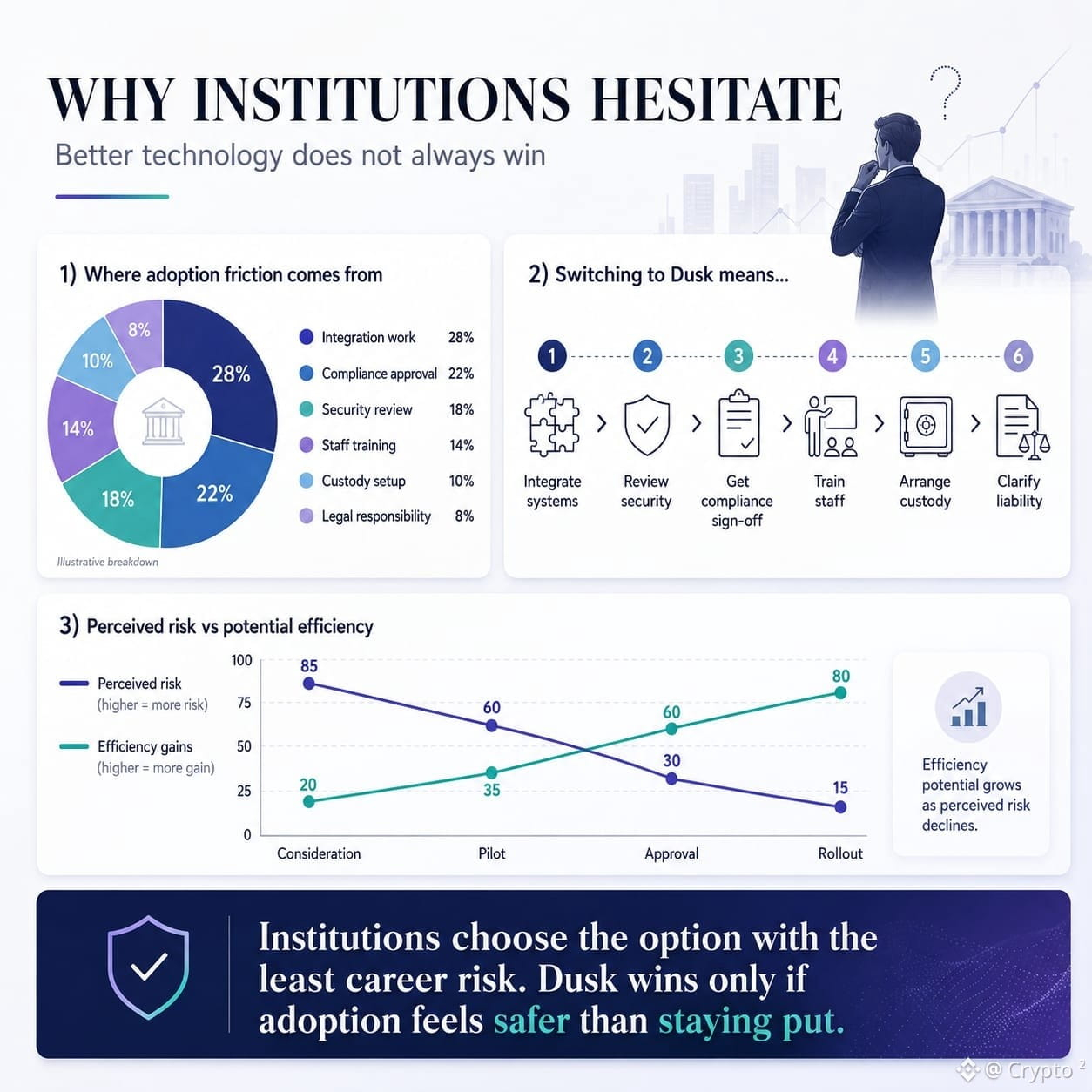
Moving financial operations onto Dusk would require new integrations, security reviews, compliance approval, staff training, custody arrangements, and clear legal responsibility. A faster settlement process means little if adopting it creates months of uncertainty elsewhere.
This is why better technology does not always win. Institutions rarely choose the most advanced system. They choose the one carrying the least career risk. A manager is seldom punished for keeping an old platform that everyone already understands. Recommending an unfamiliar blockchain is different: if it fails, the decision has a name attached to it.
Dusk does not merely need to prove that its privacy works. It must prove that using it is safer, cheaper, and easier than doing nothing.
That is a far harder test—and the one that will decide its future.
@Dusk #dusk $DUSK
Banks know their existing databases are slow, fragmented, and expensive. They also know who is responsible when something fails. Regulators understand those systems, employees are trained on them, and legal agreements have been tested through years of disputes.
Dusk offers a cleaner alternative. Its blockchain supports confidential transactions, selective disclosure, and regulated digital assets. In theory, an institution could protect sensitive information while proving that every transaction followed the rules.
The technology is useful. The difficult part is convincing institutions that switching is worth the disruption.
Moving financial operations onto Dusk would require new integrations, security reviews, compliance approval, staff training, custody arrangements, and clear legal responsibility. A faster settlement process means little if adopting it creates months of uncertainty elsewhere.
This is why better technology does not always win. Institutions rarely choose the most advanced system. They choose the one carrying the least career risk. A manager is seldom punished for keeping an old platform that everyone already understands. Recommending an unfamiliar blockchain is different: if it fails, the decision has a name attached to it.
Dusk does not merely need to prove that its privacy works. It must prove that using it is safer, cheaper, and easier than doing nothing.
That is a far harder test—and the one that will decide its future.
@Dusk #dusk $DUSK