


Over the last two years, the AI industry has moved through a clear evolution.
First came copilots: AI tools that helped people write, search, summarize, create, and work faster.
Then came agents: AI systems that could start taking action, completing tasks, using tools, writing code, replying to customers, scanning data, and automating parts of a workflow.
That shift mattered. It proved that AI was no longer just a content layer. It could become an execution layer.
But 2026 is where the next step becomes obvious.
The question is no longer just: “Can AI complete a task?”
The question is: “Can AI help run the business?”
That is a much bigger idea.
A business is not one task, one prompt, one workflow, or one chatbot. A business has marketing, sales, support, business development, operations, research, reporting, customers, payments, approvals, rules, policies, reputation, and memory. It needs coordination. It needs context. It needs different workers doing different jobs while still understanding the same mission.
That is why agents alone are not enough.
One agent can be useful. Ten disconnected agents become chaos. The real unlock is not more agents, but structure around them.
This is where AI Organisations come in.
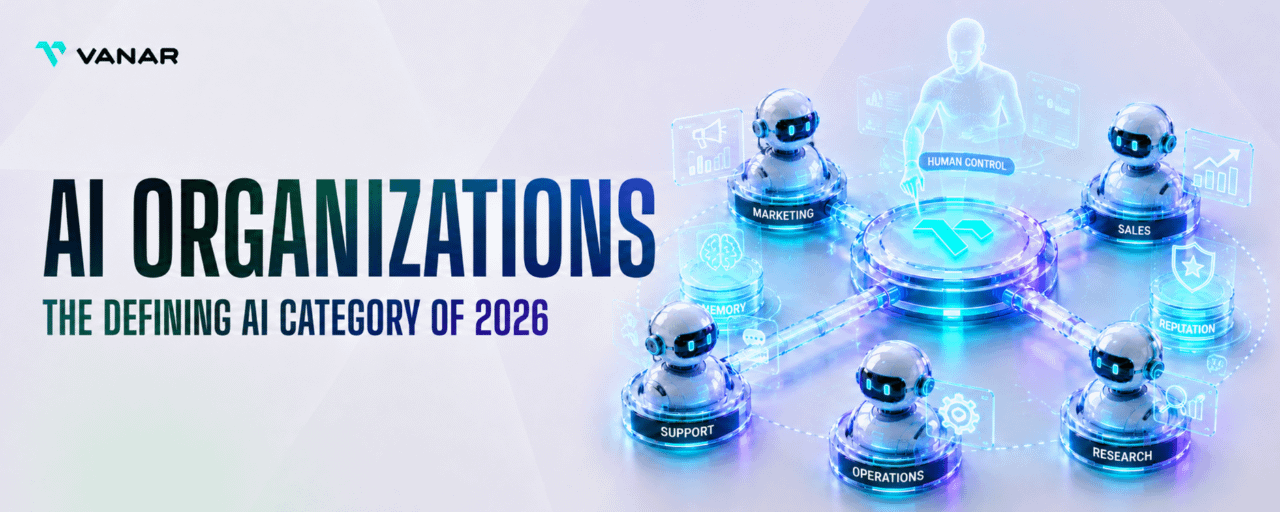
An AI Organisation is a company-like system built around a connected AI workforce. Instead of one assistant sitting in a chat window, an Org has multiple AI workers operating around the same business, sharing memory, context, tools, rules, policies, payments, reputation, and proof of work.
But the important part is this: the founder stays in control.
AI Organisations are not about handing your business to agents and hoping they make the right decisions. They are about giving AI workers the structure to operate safely inside a business, with human approval where it matters, clear permissions, defined policies, spending limits, escalation paths, and visibility into what is happening.
That is the difference between automation and an actual operating layer.
Marketing knows what Sales is pushing. Sales knows what Support is hearing. Support understands the product. BD knows the growth goals. Reporting can show what happened. The whole system can learn over time instead of starting from zero every session, while the founder keeps control over direction, approvals, and final decisions.
That is what makes AI Organisations one of the defining categories of 2026.
They move AI from productivity into execution.
They turn AI from a tool you use into a workforce you operate.
They give solo founders, developers, projects, creators, agencies, and teams the ability to launch with the business layer already around them, without giving up control of the business itself.
This matters because the biggest blocker for most builders is no longer only building the product. Tools already made that easier. The blocker is everything around the product: getting users, answering customers, creating content, doing outreach, managing leads, handling support, packaging services, reporting progress, and turning an idea into something that behaves like a real business.
Foundry is Vanar’s answer to that shift.
Vanar started building toward this before the category became obvious. While the market was still focused mostly on standalone agents and chatbots, Vanar was building the operating layer for AI Organisations: connected AI workers, shared memory, business tools, rules, policies, marketplace activity, payments, reputation, and on-chain proof.
Foundry is not another agent dashboard. It is the launch environment for AI Organisations.
A founder can bring an idea. A developer can bring an app. A creator can bring a service. A project can bring a community. A business can bring an existing workflow. Foundry gives it an AI workforce and the structure to start operating.
Marketing. Sales. Support. BD. Growth. Research. Operations. Reporting.
All connected through one shared brain, guided by the rules and policies set by the Organisation owner.
Most platforms are still trying to sell better agents. Vanar is building the system those agents need to become useful at company level. The market is moving from “AI that helps me do work” to “AI that helps my business run.” That is a much larger category, and it needs more than prompts.
It needs memory.
It needs roles.
It needs rules.
It needs policies.
It needs permissions.
It needs payments.
It needs reputation.
It needs proof.
It needs human control.
It needs a place where the Organisation can launch, operate, transact, and be discovered.
That is the role Foundry is built to play.
The next wave of AI will not be won by whoever launches the most agents. It will be won by whoever turns agents into coordinated business systems that people can actually trust, guide, and control.
AI agents were the first step.
AI Organisations are the category that comes next.
And Vanar is not waiting for that future to arrive.
Vanar is building it now.
Foundry launches soon.
Read more: https://onvanar.com