I started looking into Dusk expecting a pretty simple privacy model: either a blockchain shows everything, or it hides everything.
Turns out, it’s more nuanced than that.
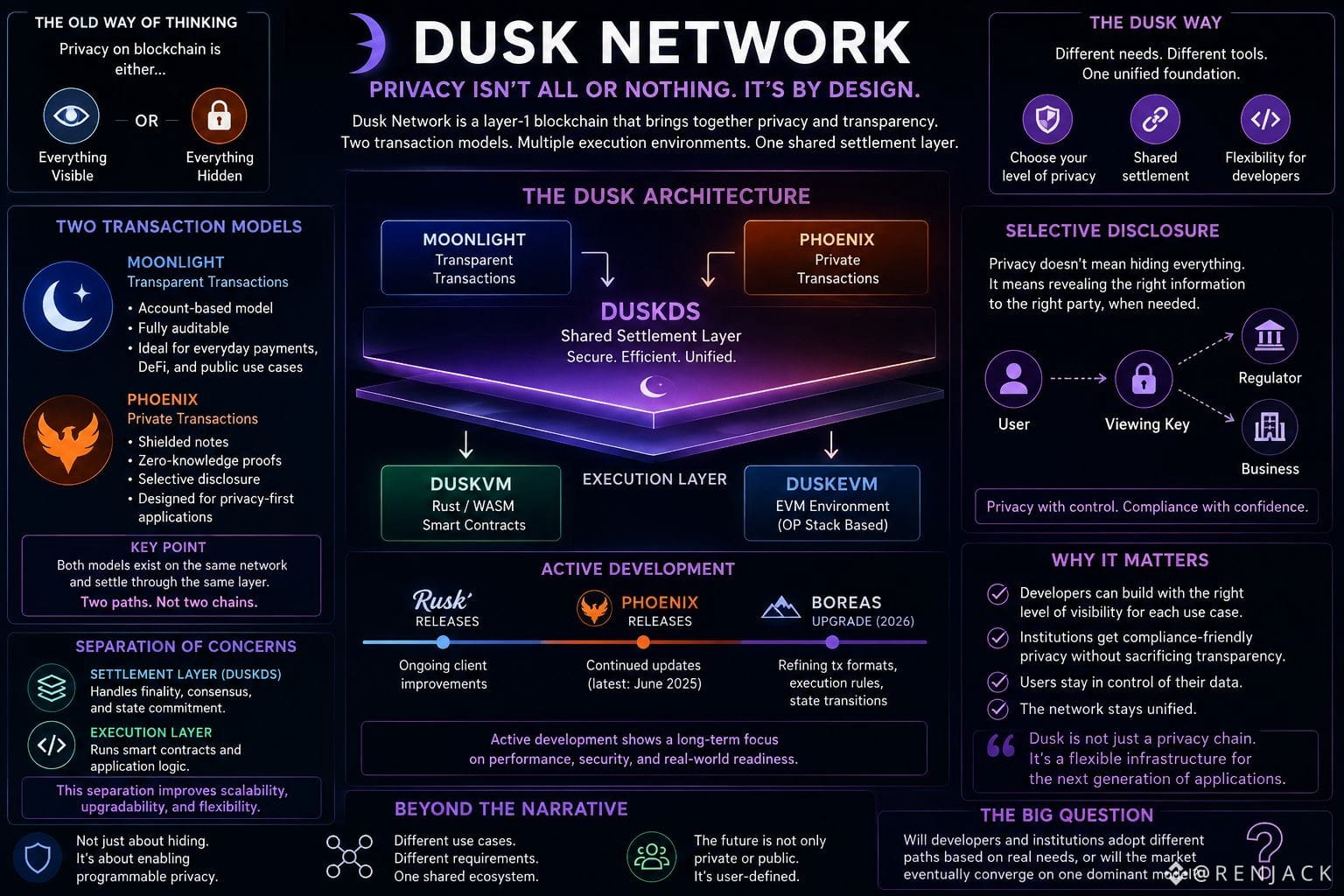
What caught my attention was how Dusk handles transactions. Moonlight is used for transparent account-based activity, while Phoenix takes a different route with shielded notes and zero-knowledge proofs. Both still settle through the same DuskDS layer.
That made me pause.
I initially thought privacy was mainly a wallet-level feature. But Dusk’s architecture made me look at it differently. Privacy can actually be part of how the application chooses to operate.
Then there’s the execution side. Dusk separates settlement from execution, with DuskVM supporting Rust/WASM contracts and DuskEVM providing an EVM environment.
So you have different execution paths, different transaction models, and different levels of visibility — without simply creating separate chains for each use case.
The selective-disclosure idea is another detail I found interesting. Privacy doesn't necessarily mean nobody can ever verify anything. It can mean the right information is revealed to the right party when needed.
That feels like a much more practical problem to solve.
For $DUSK, I’m less interested in calling it just a “privacy chain” now. I’m more curious about whether developers will actually use this flexibility once real applications and institutional requirements enter the picture.
Will the architecture prove useful in practice, or will most users eventually settle around one simple path?
#DUSK @Dusk $DUSK
Turns out, it’s more nuanced than that.
What caught my attention was how Dusk handles transactions. Moonlight is used for transparent account-based activity, while Phoenix takes a different route with shielded notes and zero-knowledge proofs. Both still settle through the same DuskDS layer.
That made me pause.
I initially thought privacy was mainly a wallet-level feature. But Dusk’s architecture made me look at it differently. Privacy can actually be part of how the application chooses to operate.
Then there’s the execution side. Dusk separates settlement from execution, with DuskVM supporting Rust/WASM contracts and DuskEVM providing an EVM environment.
So you have different execution paths, different transaction models, and different levels of visibility — without simply creating separate chains for each use case.
The selective-disclosure idea is another detail I found interesting. Privacy doesn't necessarily mean nobody can ever verify anything. It can mean the right information is revealed to the right party when needed.
That feels like a much more practical problem to solve.
For $DUSK, I’m less interested in calling it just a “privacy chain” now. I’m more curious about whether developers will actually use this flexibility once real applications and institutional requirements enter the picture.
Will the architecture prove useful in practice, or will most users eventually settle around one simple path?
#DUSK @Dusk $DUSK