
#dusk $DUSK @Dusk
I used to think that moving the heavy computation away from the base layer was just a performance win. Then I started looking at what actually happens on top of it.
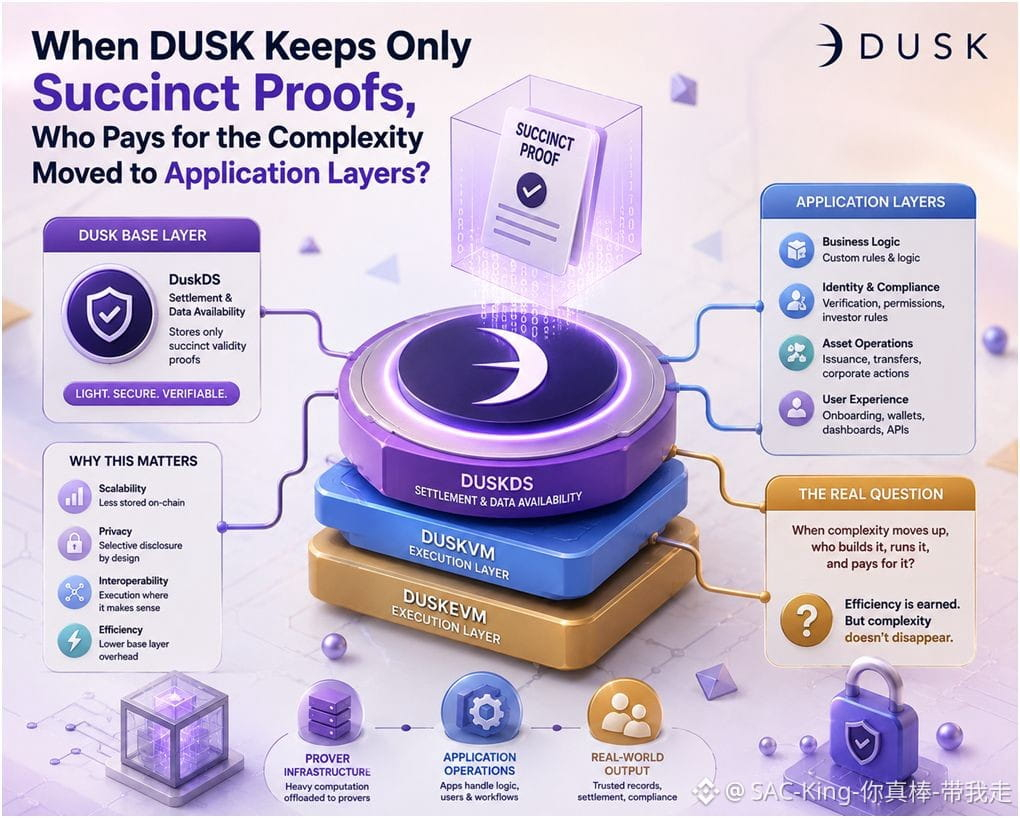
DUSK’s architecture intentionally separates settlement from execution. Its documentation describes DuskDS as the settlement and data availability layer, while DuskVM and DuskEVM handle application execution. Earlier architectural material also describes DuskDS as storing valid proofs of validity while the heavy execution state resides in the application layers.
This is elegant, but it doesn’t make the complexity go away.
It changes who has to handle it.
An application building regulated finance still needs its own implementation logic, identity flows, asset rules, and operational infrastructure. Dusk Trade, for example, sits on top of the base protocol and handles workflows like onboarding, wallet connection, trading, and settlement coordination.
There’s another cost: proving yourself is computationally demanding. Dusk’s documentation notes that a dedicated prover infrastructure handles the heavy lifting of generating ZK proofs.
So the interesting question isn’t whether DUSK reduces the complexity of the base layer.
It does.
The hard question is whether application developers can absorb the complexity that each regulated use case pushes upwards without turning it into their own engineering and operational burden.
This is where architectural efficiency meets economic reality.
#Dusk #GrowWithSAC $ZRO $BMT
I used to think that moving the heavy computation away from the base layer was just a performance win. Then I started looking at what actually happens on top of it.
DUSK’s architecture intentionally separates settlement from execution. Its documentation describes DuskDS as the settlement and data availability layer, while DuskVM and DuskEVM handle application execution. Earlier architectural material also describes DuskDS as storing valid proofs of validity while the heavy execution state resides in the application layers.
This is elegant, but it doesn’t make the complexity go away.
It changes who has to handle it.
An application building regulated finance still needs its own implementation logic, identity flows, asset rules, and operational infrastructure. Dusk Trade, for example, sits on top of the base protocol and handles workflows like onboarding, wallet connection, trading, and settlement coordination.
There’s another cost: proving yourself is computationally demanding. Dusk’s documentation notes that a dedicated prover infrastructure handles the heavy lifting of generating ZK proofs.
So the interesting question isn’t whether DUSK reduces the complexity of the base layer.
It does.
The hard question is whether application developers can absorb the complexity that each regulated use case pushes upwards without turning it into their own engineering and operational burden.
This is where architectural efficiency meets economic reality.
#Dusk #GrowWithSAC $ZRO $BMT
Who absorbs the burden?
Apps or base layer?
Does complexity vanish?
5 يوم (أيام) مُتبقية