
I've been burned by this before. Watched an infrastructure token rack up transactions for months, convinced the market was just slow to notice. Turns out I was counting the wrong activity.
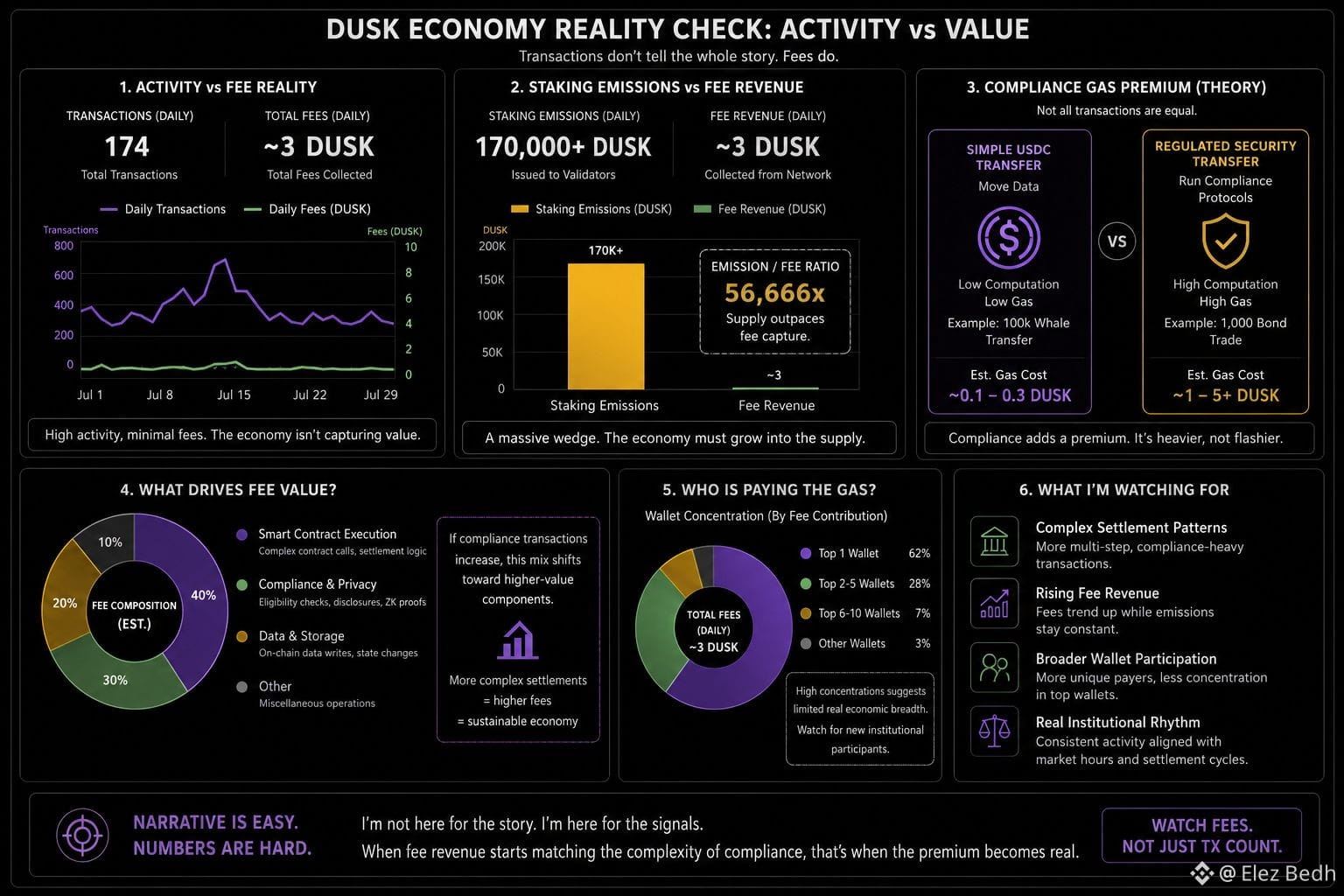
That bias followed me when I looked at $DUSK . A simple USDC transfer and a regulated security transfer might look identical in a block explorer, but on Dusk they aren't even playing the same game. One is moving data. The other runs eligibility checks, compliance filters, and selective disclosure protocols around a single trade. It's computationally heavier. I started calling it a "Compliance Gas Premium" in my head—a boring 1,000 bond trade could consume more gas than a flashy 100k whale transfer.
But then I pulled the scanner data. Oof. One recent day showed roughly 174 transactions total. Total fees? Maybe 3 DUSK. Meanwhile, staking issuance spits out over 170k tokens daily just to validators. That's an uncomfortable wedge between what could be and what currently is.
NPEX is a legit anchor—they've tokenized hundreds of millions in securities—and they're live on DuskEVM. But one heavyweight partner doesn't equal a bustling economy. The app layer is thin. Liquidity is shallow.
What I actually watch now isn't the narrative around "tokenizing the world." It's the ugly, boring stuff: what are the fees actually composed of? Is it the same wallet doing tiny test transactions, or are we starting to see complex settlement patterns that look like real institutional rhythm?
Transaction count gives a warm, fuzzy feeling. Knowing who is paying the gas, and what they're executing, is the only thing that tells me whether the economy is keeping pace with the token supply. If fee revenue stays flat while emissions run, the premium is just a clever theory. If it starts climbing with actual complex settlements, that's when I'll stop lurking and actually start paying attention.
@Dusk #dusk #DUSK $DUSK
That bias followed me when I looked at $DUSK . A simple USDC transfer and a regulated security transfer might look identical in a block explorer, but on Dusk they aren't even playing the same game. One is moving data. The other runs eligibility checks, compliance filters, and selective disclosure protocols around a single trade. It's computationally heavier. I started calling it a "Compliance Gas Premium" in my head—a boring 1,000 bond trade could consume more gas than a flashy 100k whale transfer.
But then I pulled the scanner data. Oof. One recent day showed roughly 174 transactions total. Total fees? Maybe 3 DUSK. Meanwhile, staking issuance spits out over 170k tokens daily just to validators. That's an uncomfortable wedge between what could be and what currently is.
NPEX is a legit anchor—they've tokenized hundreds of millions in securities—and they're live on DuskEVM. But one heavyweight partner doesn't equal a bustling economy. The app layer is thin. Liquidity is shallow.
What I actually watch now isn't the narrative around "tokenizing the world." It's the ugly, boring stuff: what are the fees actually composed of? Is it the same wallet doing tiny test transactions, or are we starting to see complex settlement patterns that look like real institutional rhythm?
Transaction count gives a warm, fuzzy feeling. Knowing who is paying the gas, and what they're executing, is the only thing that tells me whether the economy is keeping pace with the token supply. If fee revenue stays flat while emissions run, the premium is just a clever theory. If it starts climbing with actual complex settlements, that's when I'll stop lurking and actually start paying attention.
@Dusk #dusk #DUSK $DUSK