
نشر

--


Techno BNB
·
--
#dusk $DUSK @Dusk Previously, I used to think the migration to blockchain was about bringing existing assets on-chain.
Bonds. Equities. Funds. Tokenize them, trade them on a distributed ledger, and the hardest part was done.
But the more I looked into Dusk, the more I realized that view was incomplete.
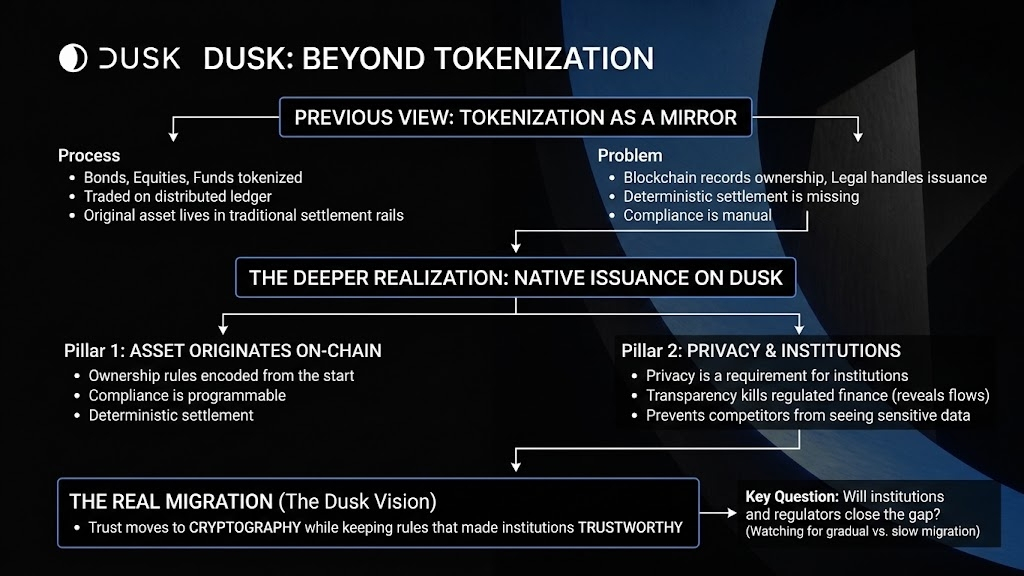
Tokenization is a mirror. It reflects an existing asset onto a new system while the original instrument still lives in traditional settlement rails. The blockchain records ownership. The legal system still handles issuance and enforcement. The token is a representation, not a replacement.
Dusk is building for something different.
Native issuance means the asset itself originates on-chain. The ownership rules are encoded from the start. The settlement is deterministic, not probabilistic. The privacy is selective, not optional. The compliance is programmable, not manual.
Most chains treat privacy as a feature for users who want discretion. Dusk treats it as a requirement for institutions that cannot expose sensitive data to competitors. Most chains celebrate transparency as a virtue. Dusk recognizes that transparency kills regulated finance because a public ledger reveals positions and flows that institutions are legally bound to protect.
I find this approach far more practical than the standard crypto narrative.
The real migration is not assets moving to blockchain. It is trust moving to cryptography while keeping the rules that made institutions trustworthy. Dusk does not ask finance to abandon compliance. It asks finance to enforce compliance through code.
That is a harder path. It requires regulators to accept on-chain records as legal records. It requires institutions to trust confidential smart contracts with custody and settlement.
I am still watching whether that migration happens gradually or whether the gap between what Dusk can do and what institutions are ready to adopt remains wider than the technology alone can bridge.
That is the gap I want to keep observing.
@Dusk
$DUSK
#dusk
Bonds. Equities. Funds. Tokenize them, trade them on a distributed ledger, and the hardest part was done.
But the more I looked into Dusk, the more I realized that view was incomplete.
Tokenization is a mirror. It reflects an existing asset onto a new system while the original instrument still lives in traditional settlement rails. The blockchain records ownership. The legal system still handles issuance and enforcement. The token is a representation, not a replacement.
Dusk is building for something different.
Native issuance means the asset itself originates on-chain. The ownership rules are encoded from the start. The settlement is deterministic, not probabilistic. The privacy is selective, not optional. The compliance is programmable, not manual.
Most chains treat privacy as a feature for users who want discretion. Dusk treats it as a requirement for institutions that cannot expose sensitive data to competitors. Most chains celebrate transparency as a virtue. Dusk recognizes that transparency kills regulated finance because a public ledger reveals positions and flows that institutions are legally bound to protect.
I find this approach far more practical than the standard crypto narrative.
The real migration is not assets moving to blockchain. It is trust moving to cryptography while keeping the rules that made institutions trustworthy. Dusk does not ask finance to abandon compliance. It asks finance to enforce compliance through code.
That is a harder path. It requires regulators to accept on-chain records as legal records. It requires institutions to trust confidential smart contracts with custody and settlement.
I am still watching whether that migration happens gradually or whether the gap between what Dusk can do and what institutions are ready to adopt remains wider than the technology alone can bridge.
That is the gap I want to keep observing.
@Dusk
$DUSK
#dusk
إخلاء مسؤولية: يتضمن آراء جهات خارجية. لا تُعدّ نصيحة. يُمكن استخدام Binance AI دون أي ضمان. اطلع على الشروط والأحكام.