Math Behind Dusk Privacy – How Does It Work? 🧠🔐
Initially, when researching Dusk, my primary focus was on its privacy features and RWA angle.
However, as I went deeper into the technology, my interest gradually shifted toward what was really behind this privacy – cryptography and math.
I'm definitely no mathematician, yet I did my best to understand this part from the perspective of a beginner.
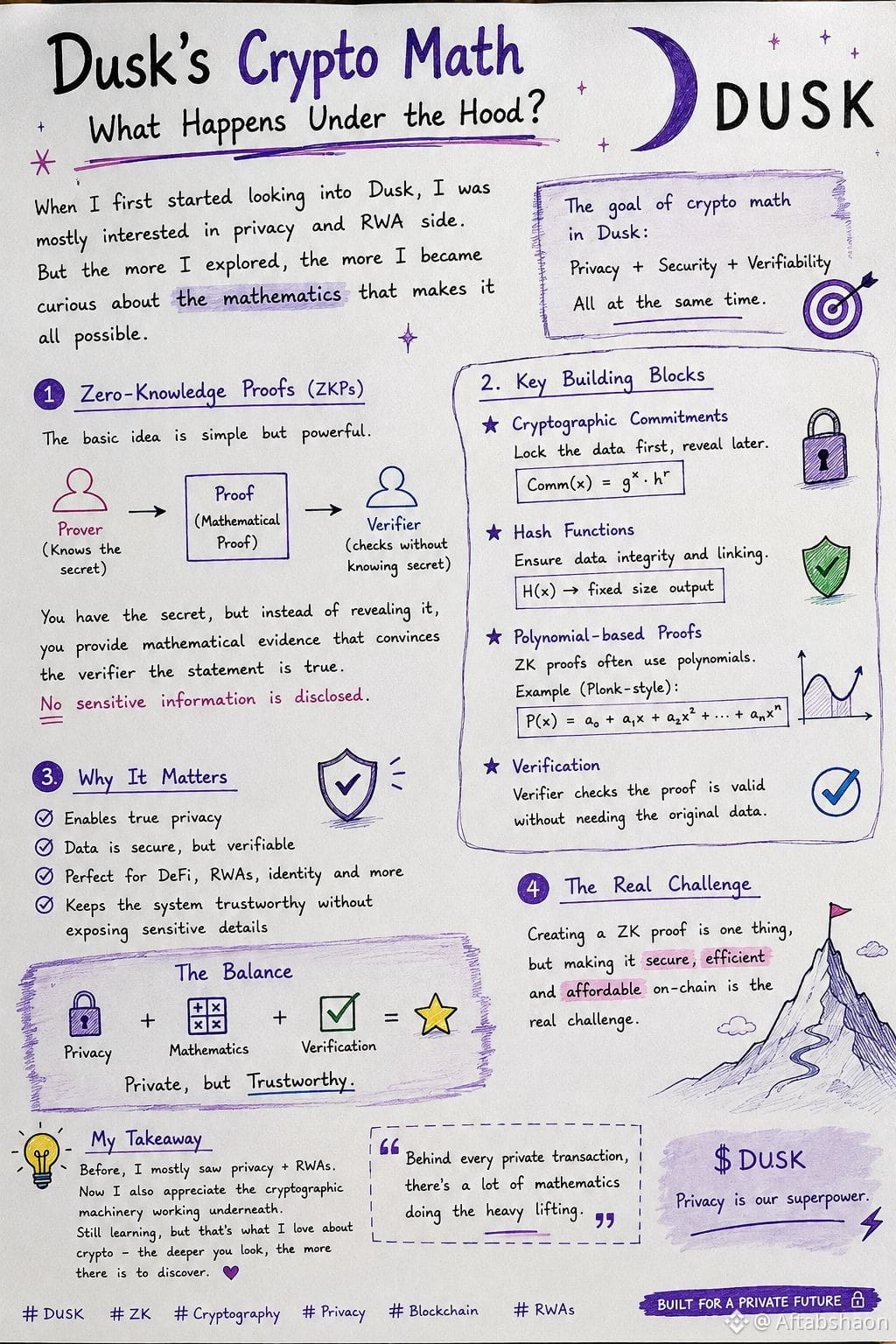
The principle of Zero-Knowledge Proof (ZKP), as far as I can see, is quite interesting:
Secret → Mathematical Proof → Verification
So, you know the secret but don't have to show it directly – you show the mathematical proof of your statement instead.
Here comes the role of cryptographic commitments, hashing, and proofs based on polynomials.
The network can verify the validity of your proof without necessarily having access to the private data.
And, to be honest, this is exactly what I find interesting:
Privacy 🔐 + Mathematics 🧮 + Verification ✅
Generating a ZK-proof is one thing; making the whole process secure, efficient, and relatively cheap to run on a blockchain is another.
In fact, this is what changed my perspective on Dusk.
At the beginning of my research, I primarily paid attention to privacy + RWAs.
Now I also appreciate the underlying cryptographic system.
Just starting to learn it, yet this is exactly what I like about the crypto world – the deeper you go, the more you discover.
What do you think – could the cryptographic systems become one of the greatest strengths of blockchain networks in the future? 👀
#dusk $DUSK @Dusk
Initially, when researching Dusk, my primary focus was on its privacy features and RWA angle.
However, as I went deeper into the technology, my interest gradually shifted toward what was really behind this privacy – cryptography and math.
I'm definitely no mathematician, yet I did my best to understand this part from the perspective of a beginner.
The principle of Zero-Knowledge Proof (ZKP), as far as I can see, is quite interesting:
Secret → Mathematical Proof → Verification
So, you know the secret but don't have to show it directly – you show the mathematical proof of your statement instead.
Here comes the role of cryptographic commitments, hashing, and proofs based on polynomials.
The network can verify the validity of your proof without necessarily having access to the private data.
And, to be honest, this is exactly what I find interesting:
Privacy 🔐 + Mathematics 🧮 + Verification ✅
Generating a ZK-proof is one thing; making the whole process secure, efficient, and relatively cheap to run on a blockchain is another.
In fact, this is what changed my perspective on Dusk.
At the beginning of my research, I primarily paid attention to privacy + RWAs.
Now I also appreciate the underlying cryptographic system.
Just starting to learn it, yet this is exactly what I like about the crypto world – the deeper you go, the more you discover.
What do you think – could the cryptographic systems become one of the greatest strengths of blockchain networks in the future? 👀
#dusk $DUSK @Dusk