

I run public infrastructure on BTX. This week it broke, and how it broke is more interesting than most whitepapers I have read.
Block 199,297 arrived with a timestamp about fifty minutes ahead of its parent. That single block consumed almost the entire future time window the protocol allows, which left the next block roughly thirteen seconds of legal room to set its own timestamp.
Here is the part that makes it beautiful and awful at the same time. BTX difficulty reads block timestamps. It never looks at the wall clock. So while hours passed in the real world, the algorithm saw nothing at all. It held difficulty high and waited for blocks that could not legally exist yet.
That combination does not self heal. The chain sat for over a day.
## The fix took six hours and it was a hard fork
The consensus change was written, reviewed and shipped in about six hours, with a flag day at height 199,299, no signalling and no grace period. Upgrade or stop following the chain, permanently.
I will be honest about my own position here. Several public operators are still on the wrong side of that fork, and one of them is mine. That is what a real deadline looks like when it arrives at five in the morning.
## Then the core developer stepped off the field
This is the part worth your attention. In the open, to the whole community:
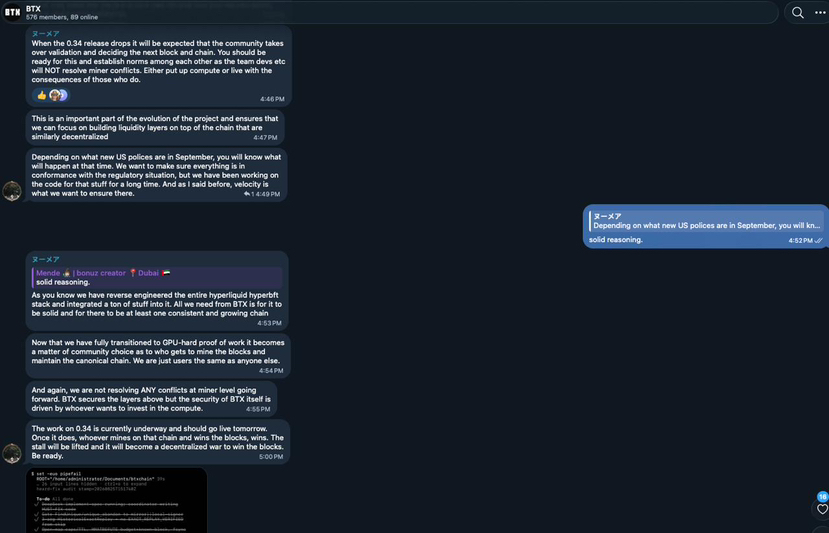
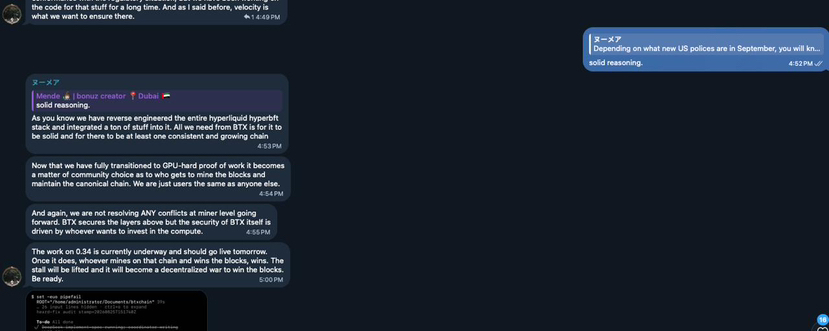
> "Now that we have fully transitioned to GPU hard proof of work it becomes a matter of community choice as to who gets to mine the blocks and maintain the canonical chain. We are just users the same as anyone else."
> "We are not resolving ANY conflicts at miner level going forward. BTX secures the layers above but the security of BTX itself is driven by whoever wants to invest in the compute."
> "Once 0.34 goes live, whoever mines on that chain and wins the blocks, wins. The stall will be lifted and it will become a decentralized war to win the blocks. Be ready."
A core team choosing not to referee its own chain is rare. Announcing it in advance, in writing, while the chain is still stalled, is rarer.
## What they are actually handing over
BTX does not hash. It multiplies matrices.
At the difficulty where it stalled, a single block took roughly 445,000 attempts, and every one of those attempts is a 4096 dimension matrix problem that any verifying node has to reproduce exactly, bit for bit. Not approximately. Exactly. That reproducibility requirement is the whole design, and it is why the chain can be verified rather than merely trusted.
It also explains something people are getting wrong right now. The hardware requirement is architecture, not raw power. The production manifest accepts exactly one CUDA architecture, sm_120. A 5060 Ti qualifies. A 4090 does not. The cheaper newer card beats the expensive older one, because the work is integer tensor math rather than brute force.
Version 0.34 opens block attestation from a fixed pair of signers to M of N. Anyone qualified can take part in deciding what the canonical chain is.
## Why I am writing this down
Because it is rare and because it is real.
A chain broke in public. The people who built it published the exact failure mechanism, shipped a consensus fix in hours, and then widened the set of people allowed to decide what is true, at the precise moment when holding that power would have been most convenient.
No roadmap theatre. No promises about the future. Turn up with compute or accept the chain other people build.
If you write consensus code, run infrastructure, or mine, this one is live right now.
———-
Nothing here is a claim about price or a recommendation to buy anything. This is about engineering, and about who gets to decide a chain.
What you think? Surely fun & action loaded
mende