$BMT
$STAR
$DUSK #dusk @Dusk
I used to think Binance’s Proof of Reserves answered one simple question:
“Does Binance have enough crypto?”
Then I looked at what the Merkle Tree is actually proving.
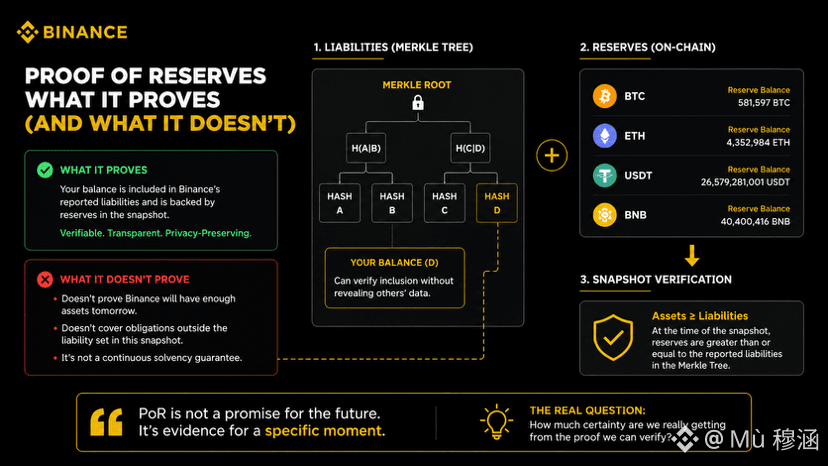
Your balance can be included in Binance’s reported liabilities, and you can verify that inclusion without exposing everyone else’s balances.
That’s useful.
But there’s a distinction I think gets lost.
A Merkle proof can help me verify “my balance is included in the liability snapshot.”
It doesn’t by itself prove that Binance will still hold enough assets tomorrow, or that the snapshot represents every possible obligation outside that specific liability set.
So I stopped reading PoR as a solvency certificate.
I read it more like a verifiable snapshot of a specific asset-to-liability relationship at a specific point in time.
That makes the methodology almost as important as the reserve number itself.
Because “Binance holds X BTC” is one statement.
“Here is evidence that the assets cover the liabilities included in this snapshot” is a much stronger — and much more precise — statement.
The interesting question isn’t whether PoR is useful.
It is how much certainty we’re actually getting from the proof we can verify.
Do you treat Proof of Reserves as a solvency check — or as a point-in-time verification tool?
$STAR
$DUSK #dusk @Dusk
I used to think Binance’s Proof of Reserves answered one simple question:
“Does Binance have enough crypto?”
Then I looked at what the Merkle Tree is actually proving.
Your balance can be included in Binance’s reported liabilities, and you can verify that inclusion without exposing everyone else’s balances.
That’s useful.
But there’s a distinction I think gets lost.
A Merkle proof can help me verify “my balance is included in the liability snapshot.”
It doesn’t by itself prove that Binance will still hold enough assets tomorrow, or that the snapshot represents every possible obligation outside that specific liability set.
So I stopped reading PoR as a solvency certificate.
I read it more like a verifiable snapshot of a specific asset-to-liability relationship at a specific point in time.
That makes the methodology almost as important as the reserve number itself.
Because “Binance holds X BTC” is one statement.
“Here is evidence that the assets cover the liabilities included in this snapshot” is a much stronger — and much more precise — statement.
The interesting question isn’t whether PoR is useful.
It is how much certainty we’re actually getting from the proof we can verify.
Do you treat Proof of Reserves as a solvency check — or as a point-in-time verification tool?