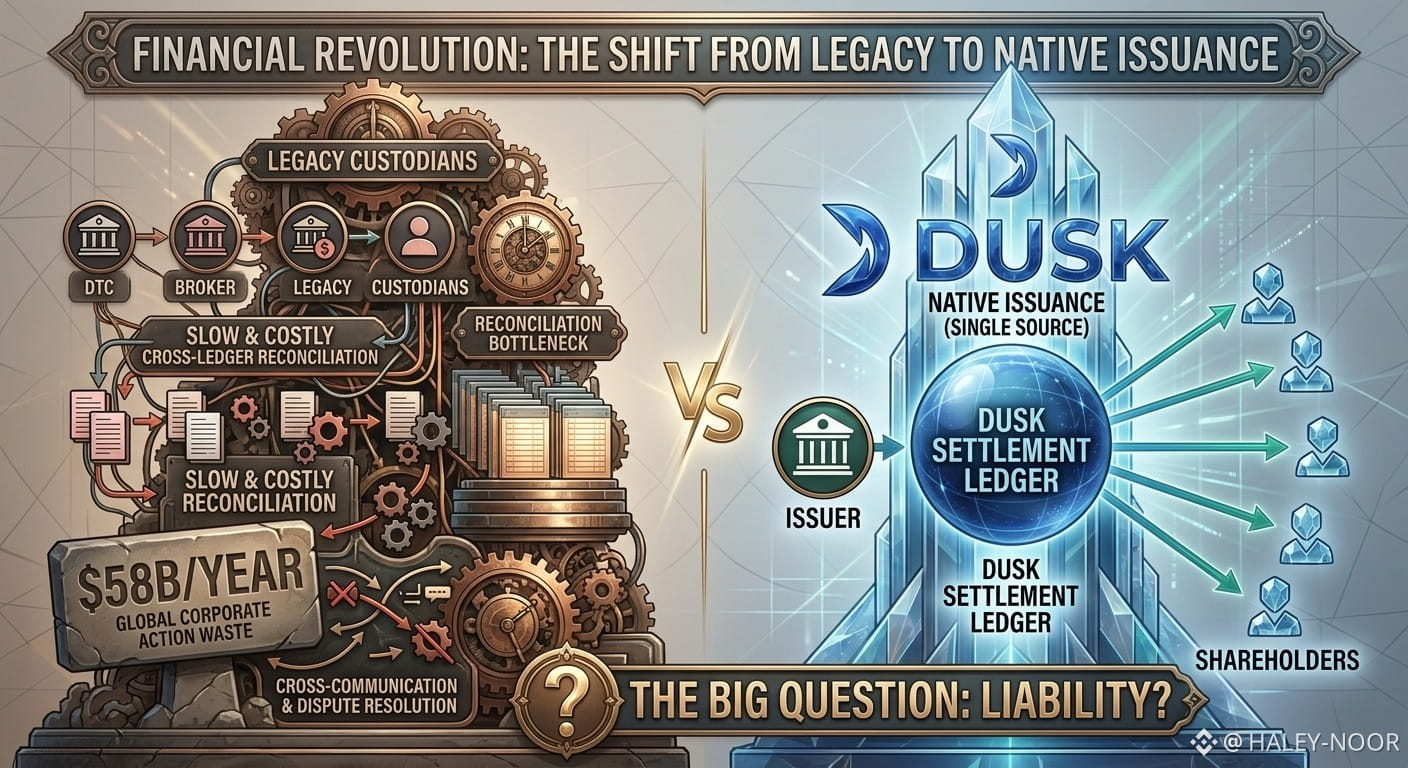

I kept staring at a dividend payment flowchart until it stopped making sense. DTC to broker to sub-custodian to shareholder four hops, and I assumed the bottleneck was somewhere in processing speed. It's not. The more I looked into it, the real cost sits in reconciliation: each link in that chain updates its own records independently, then everyone compares notes afterward. That's where the $58B a year in corporate-action costs actually goes.
What stood out to me digging into DUSK's XSC design is that it doesn't try to make each hop faster. It removes the need for hops to reconcile at all one execution, one result, every holder reads from the same source instead of four parties calculating separately and cross-checking later. This is where DUSK's approach starts to feel different from most infrastructure I'd looked at before.
That's when the tokenization-vs-native distinction clicked for me. Wrapping a stock in a token still sits on top of the same DTC plumbing you've added a layer, not replaced one. Native issuance on something like DUSK asks a blunter question: do you still need thousands of paying agents independently processing the same dividend event if there's one settlement layer everyone reads from? DUSK's whole architecture seems to be betting on the answer being no.
I'm still stuck on the liability part, though. If a DUSK contract miscalculates a payout, who's on the hook the chain, the issuer, the paying agent that used to exist? I don't think that's answered yet, and I'm not sure it should be glossed over just because the architecture is cleaner.
#dusk $DUSK @Dusk
What stood out to me digging into DUSK's XSC design is that it doesn't try to make each hop faster. It removes the need for hops to reconcile at all one execution, one result, every holder reads from the same source instead of four parties calculating separately and cross-checking later. This is where DUSK's approach starts to feel different from most infrastructure I'd looked at before.
That's when the tokenization-vs-native distinction clicked for me. Wrapping a stock in a token still sits on top of the same DTC plumbing you've added a layer, not replaced one. Native issuance on something like DUSK asks a blunter question: do you still need thousands of paying agents independently processing the same dividend event if there's one settlement layer everyone reads from? DUSK's whole architecture seems to be betting on the answer being no.
I'm still stuck on the liability part, though. If a DUSK contract miscalculates a payout, who's on the hook the chain, the issuer, the paying agent that used to exist? I don't think that's answered yet, and I'm not sure it should be glossed over just because the architecture is cleaner.
#dusk $DUSK @Dusk