
#dusk $DUSK @Dusk
Today morning, I was talking to my sister about Dusk. She was saying that Dusk basicaly wants to create a bridge between TradFi and DeFi.
Hearing this, a question naturally came to my mind - okay, but how does this bridge and migration system actually work?
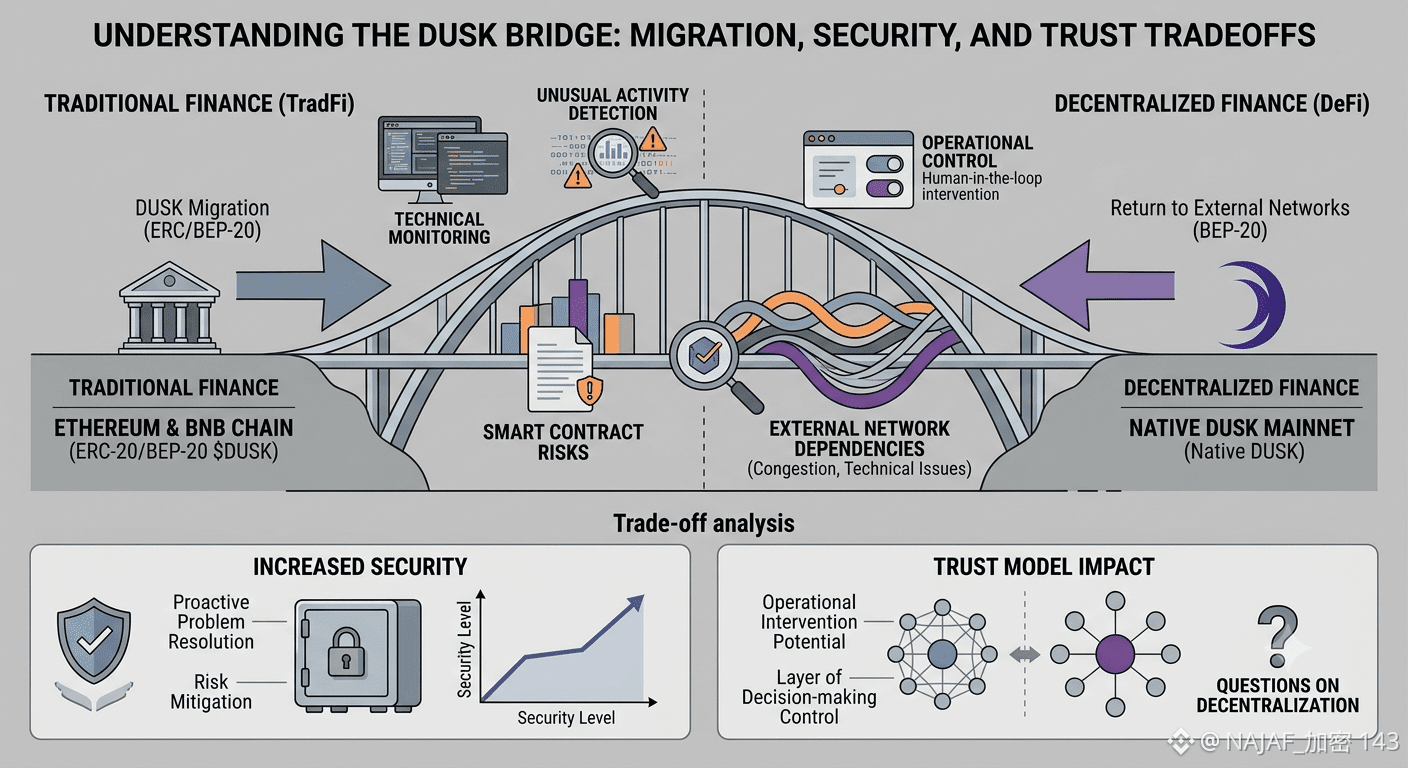
At first, the matter seemed quite straightforward. Moving from ERC-20 or BEP-20 $DUSK to Native Dusk Mainnet, and then returning from Native DUSK to BEP-20 DUSK if necessary. In other words, the way to move assets from one network to another is basically the job of the Bridge. But if you go a little deeper, the matter is not confined to token transfer only.
This is where I found it interesting. If there is any unusual activity or technical problem in the Bridge network, it is monitored and if necessary, operational action is taken. At first glance, this seems like a good thing for security.
But then another question comes to mind. Isn't this operational control adding a new layer to the trust model of the Bridge while increasing security? That is, on the one hand, monitoring and intervention may be required. On the other hand, as control increases, questions about centralized decision-making will naturally arise. With this, there is also the risk of smart contracts. There is also a dependency on external networks like Ethereum or BNB Chain. If there is congestion, technical issues or any other problem there, it can affect the migration process.
Here is an interesting thing. We usually see bridges as just “a way to send tokens from one place to another”. But in reality, behind this, security, monitoring, operational control and third-party dependency - everything works together.
So I am not saying that Dusk Bridge is bad or unsafe. Rather, I find the matter more interesting now. Because how secure the technology is, and how much control is being maintained to maintain that security.... these two things are actually not the same thing.
In the end, the question that remains in my mind is:
$DUSK #dusk @Dusk
Today morning, I was talking to my sister about Dusk. She was saying that Dusk basicaly wants to create a bridge between TradFi and DeFi.
Hearing this, a question naturally came to my mind - okay, but how does this bridge and migration system actually work?
At first, the matter seemed quite straightforward. Moving from ERC-20 or BEP-20 $DUSK to Native Dusk Mainnet, and then returning from Native DUSK to BEP-20 DUSK if necessary. In other words, the way to move assets from one network to another is basically the job of the Bridge. But if you go a little deeper, the matter is not confined to token transfer only.
This is where I found it interesting. If there is any unusual activity or technical problem in the Bridge network, it is monitored and if necessary, operational action is taken. At first glance, this seems like a good thing for security.
But then another question comes to mind. Isn't this operational control adding a new layer to the trust model of the Bridge while increasing security? That is, on the one hand, monitoring and intervention may be required. On the other hand, as control increases, questions about centralized decision-making will naturally arise. With this, there is also the risk of smart contracts. There is also a dependency on external networks like Ethereum or BNB Chain. If there is congestion, technical issues or any other problem there, it can affect the migration process.
Here is an interesting thing. We usually see bridges as just “a way to send tokens from one place to another”. But in reality, behind this, security, monitoring, operational control and third-party dependency - everything works together.
So I am not saying that Dusk Bridge is bad or unsafe. Rather, I find the matter more interesting now. Because how secure the technology is, and how much control is being maintained to maintain that security.... these two things are actually not the same thing.
In the end, the question that remains in my mind is:
$DUSK #dusk @Dusk