
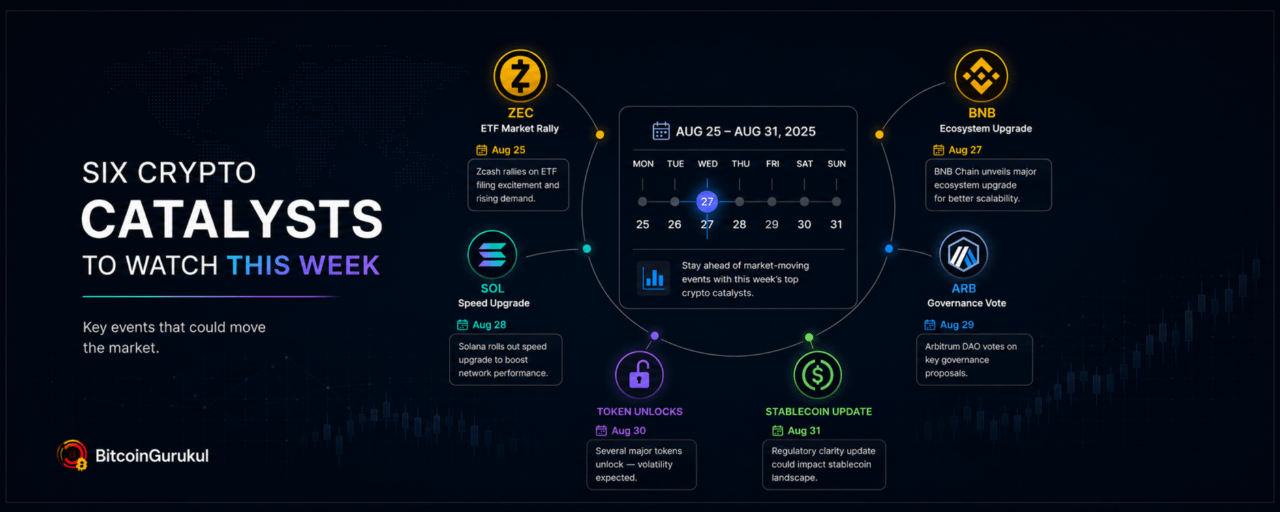


Six Things Moving Crypto Markets This Week
Six separate stories are converging on the same few days: a privacy coin re-rating on ETF hopes, two major networks shipping upgrades, roughly $44 million in tokens hitting circulating supply, and a stablecoin issuer pushing into a market it's never touched before. None of these are isolated. Together they explain a lot of the volatility traders are seeing right now.
Here's what's actually happening, and why each one matters.
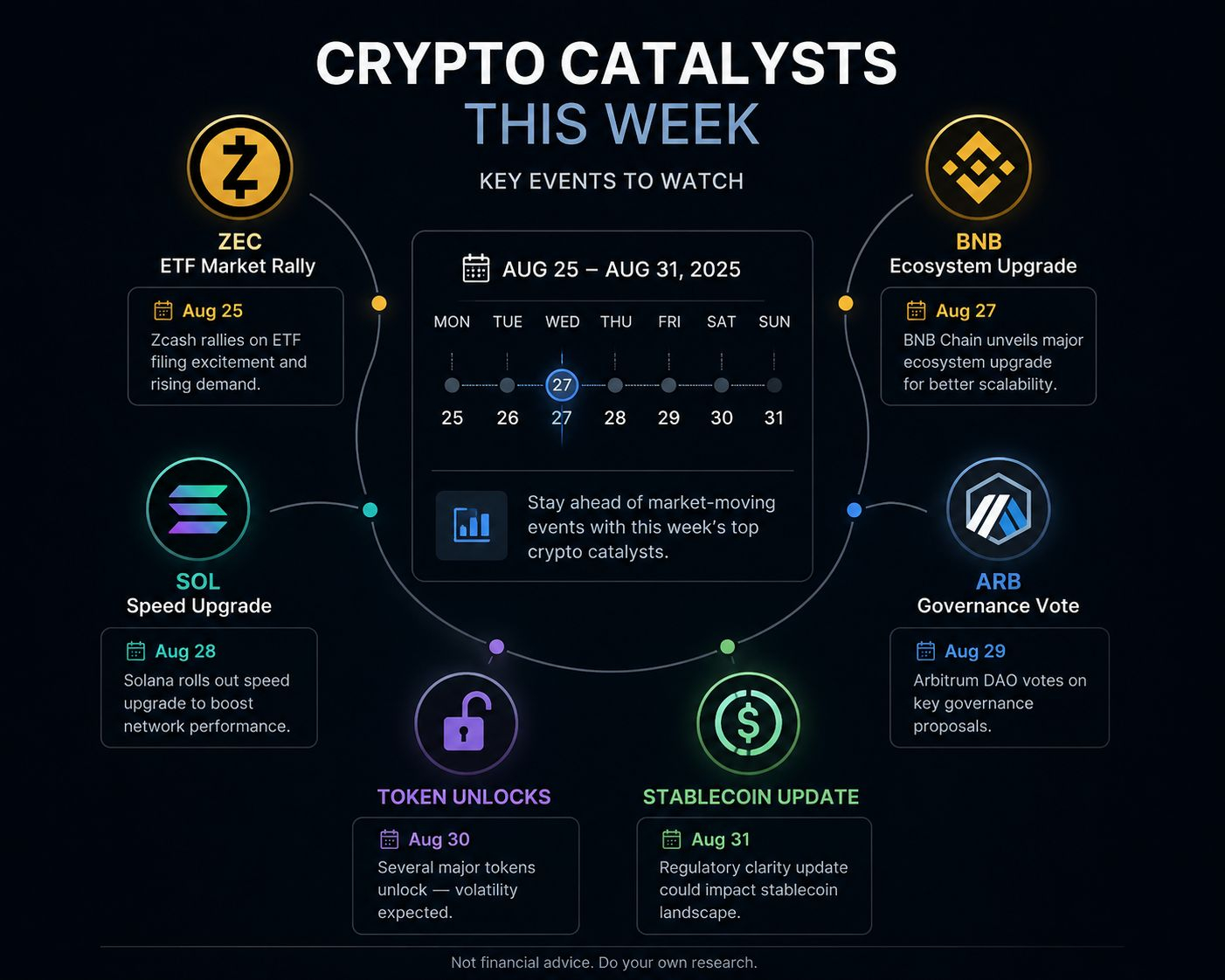
ZEC: Zcash Hits an 8-Year High as Grayscale Pushes Toward an ETF
Zcash (ZEC) traded above $850 this week, its highest level since 2018, after Grayscale filed a fifth amended registration statement with the SEC to convert its existing Zcash Trust into a spot ETF. If the conversion goes through, the fund would be renamed The Zcash ETF, list on NYSE Arca under the ticker ZCSH, and become the first U.S. ETF to directly track a privacy-focused cryptocurrency.
Grayscale set the proposed annual sponsor fee at 2.5%. A Digital Currency Group subsidiary is also in nonbinding talks to contribute roughly 200,000 ZEC to the trust, a stake that could represent around a third of the fund depending on final terms.
Why it matters: ZEC's rally wasn't built on the ETF news alone. Derivatives activity did most of the heavy lifting, with 24-hour futures volume far outpacing spot trading and open interest nearly doubling in days. That's a classic setup for sharp moves in either direction once leveraged positions get squeezed. The ETF filing gives the rally a fundamental story, but the price action itself is being driven by traders, not allocators.
BNB: Pasteur Hard Fork Activates on Mainnet
BNB Smart Chain activated its Pasteur hard fork on August 25 at 02:30 UTC, requiring node operators to run client version v1.7.7. The upgrade bundles three proposals under the umbrella BEP-673: BEP-682 closes a bridge validation loophole that could have let duplicate validator signatures inflate voting power, BEP-695 strips consensus authority from retired validator keys so a validator can't dodge a pending slashing penalty by rotating keys, and BEP-675 raises how much transaction data fits in each block, part of BNB Chain's stated goal of doubling mainnet throughput in the second half of 2026.
Why it matters: This isn't a speed upgrade in the way past BNB Chain forks have been. It's a security hardening pass aimed specifically at cross-chain bridges, which remain one of the most exploited surfaces in crypto. Tighter bridge verification reduces one specific attack vector without touching user experience.
SOL: Solana Cuts Slot Time to 350ms
Solana's mainnet slot time dropped from 400ms to 350ms at epoch 1020 on August 21, the first reduction of its kind since the network launched. The change is the opening stage of SIMD-0525, a staged rollout with further planned cuts to 300ms, 250ms, and eventually 200ms, each requiring its own validator activation and stability check before moving forward.
Shorter slots don't automatically mean more throughput. Because block size scales down with slot time, the maximum compute units per block actually fell from 100 million to 87.5 million. The tradeoff is intentional: Solana is optimizing for lower confirmation latency, not raw transaction volume.
Why it matters: Faster confirmations matter most for trading applications, where the gap between submitting an order and knowing it landed has real cost. This is one piece of a broader latency push that also includes Solana's in-development Alpenglow consensus overhaul, aimed at cutting full finality from roughly 12.8 seconds down to about 150 milliseconds.
ARB: ArbOS 61 "Elara" Expands Stylus Capacity
Arbitrum activated its ArbOS 61 "Elara" upgrade on August 20 across Arbitrum One and Nova. The headline change for developers is a fourfold jump in Stylus contract code size limits, from 24 KB to 96 KB, giving teams building in Rust, C, and C++ more room before they're forced to split logic across multiple contracts.
Elara also introduces optional protocol-level compliance filtering, but that feature ships disabled on Arbitrum One and Nova. It's built for operators of dedicated Orbit chains who need configurable transaction screening for regulatory reasons, not for the public network.
Why it matters: The compliance tooling headline can be misleading if read out of context. It doesn't change how Arbitrum One works for existing users. The more consequential change for the ecosystem is the Stylus capacity increase, which lowers a real technical barrier for non-Solidity developers building on Arbitrum.
Token Unlocks: Roughly $44 Million Hits Circulating Supply
Several projects are releasing previously locked tokens this week, adding new sell-side supply to thin order books:
Humanity (H) — 266.47 million tokens (~$18.3 million), about 7.9% of released supply
Huma Finance (HUMA) — roughly 459 million tokens (~$10.1 million), the largest unlock by percentage of the week at close to 17% of circulating supply
SoSoValue (SOSO) — 23.46 million tokens (~$7.4 million)
Plasma (XPL) — 88.89 million tokens (~$8.9 million), about 3.3% of released supply
Why it matters: Unlocks don't dilute what any individual holder owns; they increase total circulating supply, which can pressure price if new sellers outnumber buyers absorbing the release. HUMA's unlock is the one worth watching most closely given its size relative to existing float.
TAO and RLUSD: Two Institutional Storylines Worth Tracking
Grayscale is separately advancing a trust-to-ETF conversion for Bittensor (TAO), following the same regulatory path it used for ZEC. Grayscale filed an amended S-1 for its Bittensor Trust earlier this year, aiming for a NYSE Arca listing under the ticker GTAO, and has raised TAO's weighting inside its broader AI sector fund. An approval would put a second AI-linked, non-Bitcoin, non-Ethereum asset in front of U.S. ETF investors.
Separately, Ripple is backing a new institutional credit fund built with Clearpool and Cicada Partners that will issue working-capital loans denominated in RLUSD to fintech and payments companies on the XRP Ledger. Clearpool builds the lending infrastructure, Cicada sources borrowers and manages credit risk, and Ripple participates as a limited partner without guaranteeing losses. The structure depends on two XRPL protocol amendments, the Single Asset Vault and Lending Protocol, that haven't finished the amendment voting process yet.
Why it matters: Both stories point the same direction: stablecoins and altcoins moving from pure trading assets into regulated financial infrastructure. RLUSD as loan collateral, rather than just a payments rail, is a meaningfully different use case than what Ripple has marketed the token for since launch.
What to Watch Next
The overlap of an ETF-driven rally, two live network upgrades, and a concentrated unlock week is not a coincidence traders should ignore. Watch whether ZEC holds its gains once the leveraged positions built during the rally start to unwind, whether HUMA absorbs its unlock without a sustained drawdown, and whether the SEC gives any signal on the Zcash ETF timeline beyond the current filing stage.
FAQ
Why did Zcash (ZEC) hit an 8-year high this week? ZEC rallied after Grayscale filed a fifth amended registration statement to convert its existing Zcash Trust into a spot ETF that would list on NYSE Arca under the ticker ZCSH. The move was amplified by heavy derivatives trading, with futures volume far exceeding spot volume during the run-up.
What does the BNB Pasteur hard fork actually change for regular users? Nothing changes for how you send or hold BNB. The upgrade tightens cross-chain bridge validation and validator key security, and it modestly raises how much data fits in each block. Node operators had to upgrade software; wallet holders didn't need to do anything.
Does Solana's 350ms slot time mean faster transactions right now? It means shorter block production intervals, which can reduce perceived confirmation latency, but it's not designed to raise overall throughput. Solana plans three more staged cuts toward an eventual 200ms target, each requiring its own network stability check before activating.