
I went back through the $DUSK documentation last night, and the consensus design made more sense once I stopped seeing it as “proof of stake.”
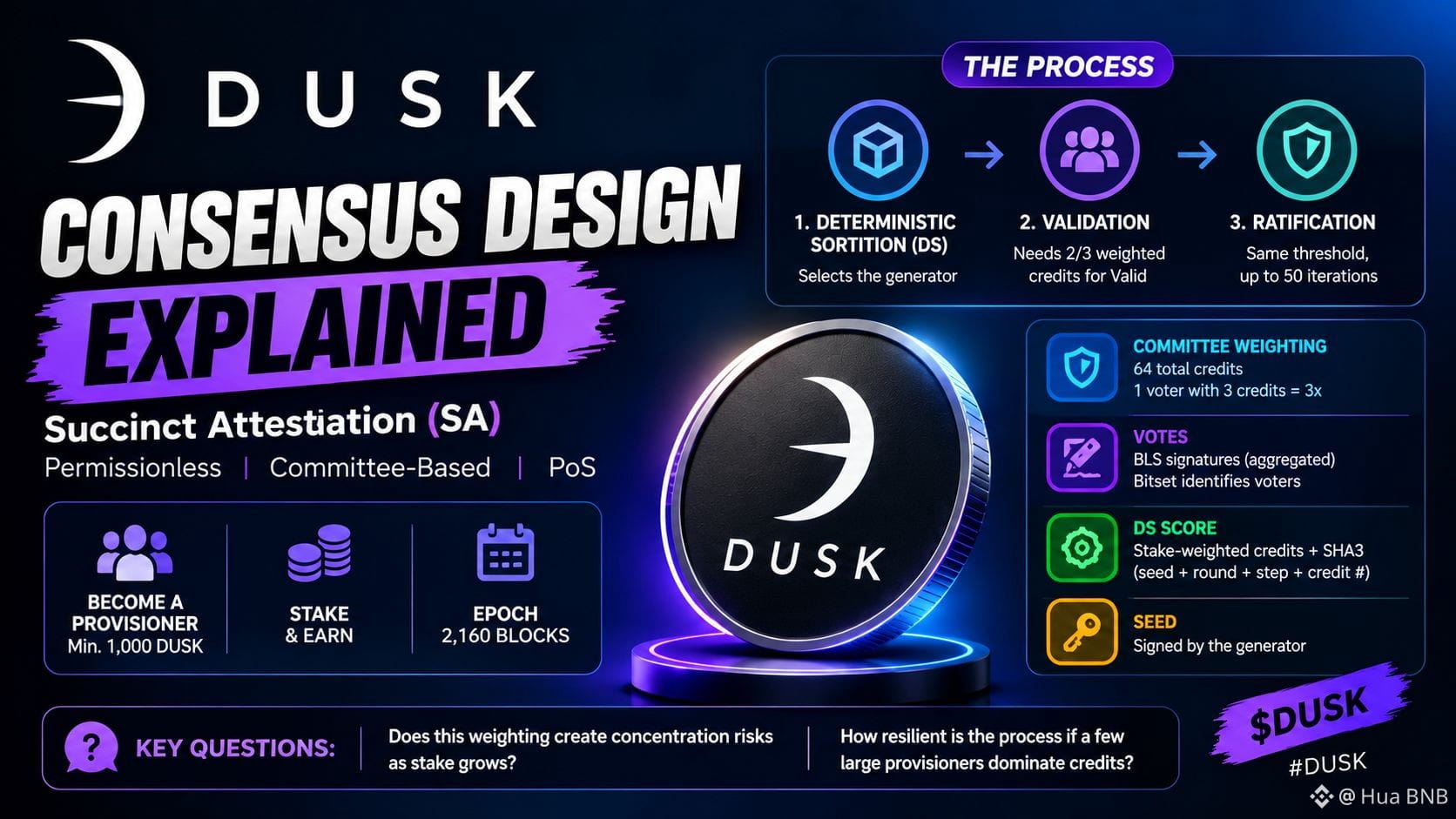
Dusk calls it Succinct Attestation (SA), a permissionless, committee-based PoS system. Anyone can become a provisioner by staking, with the minimum at 1,000 DUSK. A stake becomes eligible after M = 2 × epoch − (height mod epoch), with the epoch 2,160 blocks.
Each round can run through iterations. Deterministic sortition (DS) selects the generator, then committees handle validation and ratification. Validation needs 2/3 of weighted credits for Valid, while Invalid or NoCandidate needs 1/2 + 1. Ratification uses the same thresholds, with up to 50 iterations allowed.
The committee weighting caught my attention: there are 64 total credits, and a voter with 3 credits counts three times. Votes use BLS signatures and can be aggregated, while a bitset identifies voters.
DS uses stake-weighted credits and a SHA3 score based on the block’s seed, round, step, and credit number. The seed is signed by the generator.
My questions are: does this weighting create concentration risks as stake grows? And how resilient is the process if a few large provisioners dominate credits?
#dusk $DUSK @Dusk
Dusk calls it Succinct Attestation (SA), a permissionless, committee-based PoS system. Anyone can become a provisioner by staking, with the minimum at 1,000 DUSK. A stake becomes eligible after M = 2 × epoch − (height mod epoch), with the epoch 2,160 blocks.
Each round can run through iterations. Deterministic sortition (DS) selects the generator, then committees handle validation and ratification. Validation needs 2/3 of weighted credits for Valid, while Invalid or NoCandidate needs 1/2 + 1. Ratification uses the same thresholds, with up to 50 iterations allowed.
The committee weighting caught my attention: there are 64 total credits, and a voter with 3 credits counts three times. Votes use BLS signatures and can be aggregated, while a bitset identifies voters.
DS uses stake-weighted credits and a SHA3 score based on the block’s seed, round, step, and credit number. The seed is signed by the generator.
My questions are: does this weighting create concentration risks as stake grows? And how resilient is the process if a few large provisioners dominate credits?
#dusk $DUSK @Dusk