#dusk $DUSK @Dusk
The more I dig into @Dusk , the more I realize that the interesting part of consensus isn’t simply how validators reach agreement. It’s what happens when those validators have their own incentives. One thing that really caught my attention is the future generator problem. If a generator knows it could be selected in a later iteration, there could be a reason to let the current iteration fail if that improves its own position. That’s where consensus becomes more than a technical problem. You have to think about human behavior and economics too, because validators aren’t perfectly cooperative machines. They’re participants who will naturally look for the outcome that benefits them most.
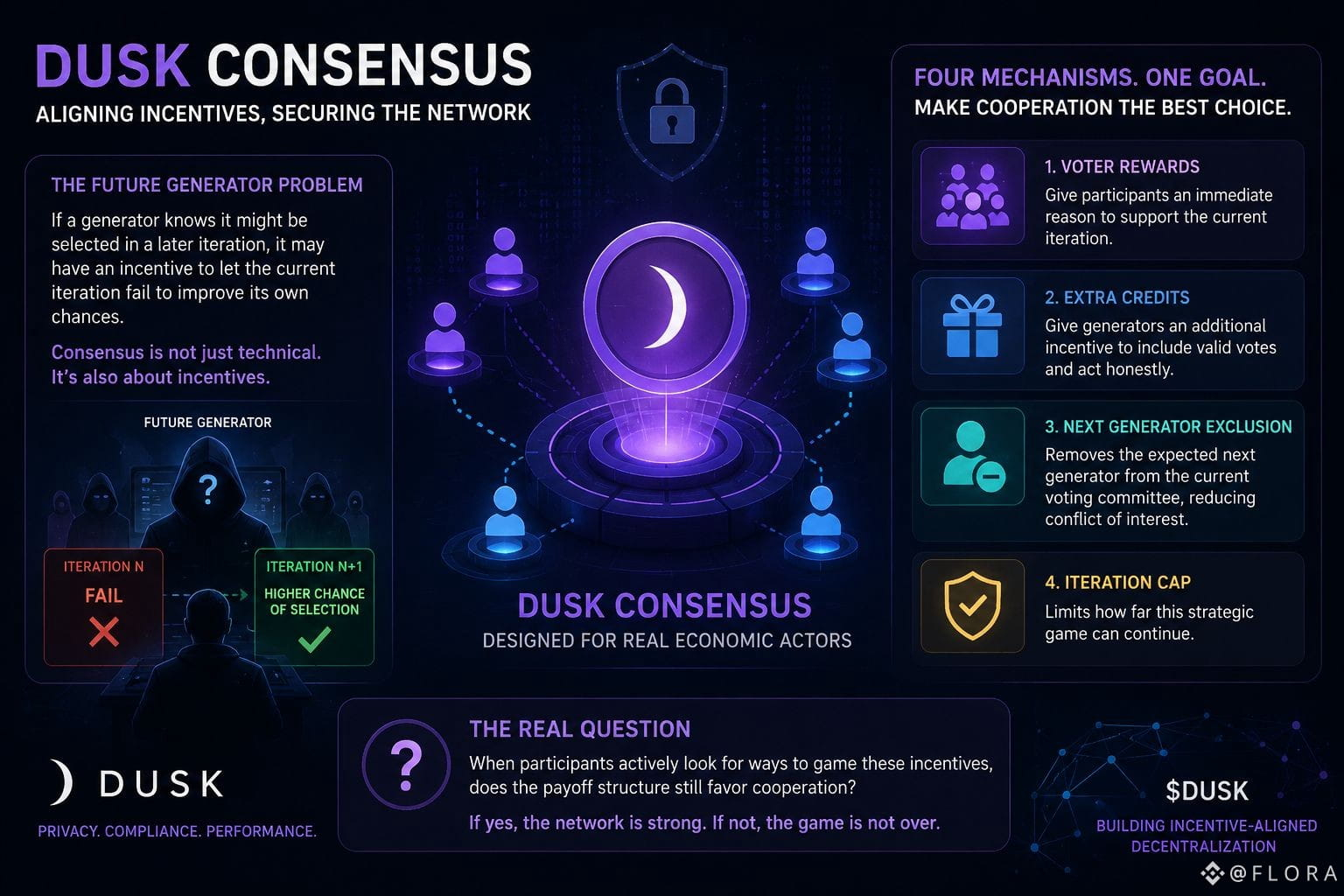
This is where Dusk’s design gets interesting to me. Voter rewards give participants a reason to support the current iteration, while extra credits give generators another incentive to include valid votes. The next-generator exclusion also helps reduce the obvious conflict by keeping the expected next generator out of the current voting committee. Then the iteration cap puts a limit on how long this strategic game can continue. I like the thinking behind it because the protocol seems designed with a realistic assumption: if there’s an incentive to exploit something, eventually someone will try. But that also raises the question I find most important. What happens when participants actively search for the most profitable way to game the system? If cooperation still gives them the best outcome, then the incentive design is doing its job. For me, that’s the real test of Dusk consensus. Not whether everyone behaves perfectly, but whether the system makes the rational choice the cooperative one.
The more I dig into @Dusk , the more I realize that the interesting part of consensus isn’t simply how validators reach agreement. It’s what happens when those validators have their own incentives. One thing that really caught my attention is the future generator problem. If a generator knows it could be selected in a later iteration, there could be a reason to let the current iteration fail if that improves its own position. That’s where consensus becomes more than a technical problem. You have to think about human behavior and economics too, because validators aren’t perfectly cooperative machines. They’re participants who will naturally look for the outcome that benefits them most.
This is where Dusk’s design gets interesting to me. Voter rewards give participants a reason to support the current iteration, while extra credits give generators another incentive to include valid votes. The next-generator exclusion also helps reduce the obvious conflict by keeping the expected next generator out of the current voting committee. Then the iteration cap puts a limit on how long this strategic game can continue. I like the thinking behind it because the protocol seems designed with a realistic assumption: if there’s an incentive to exploit something, eventually someone will try. But that also raises the question I find most important. What happens when participants actively search for the most profitable way to game the system? If cooperation still gives them the best outcome, then the incentive design is doing its job. For me, that’s the real test of Dusk consensus. Not whether everyone behaves perfectly, but whether the system makes the rational choice the cooperative one.