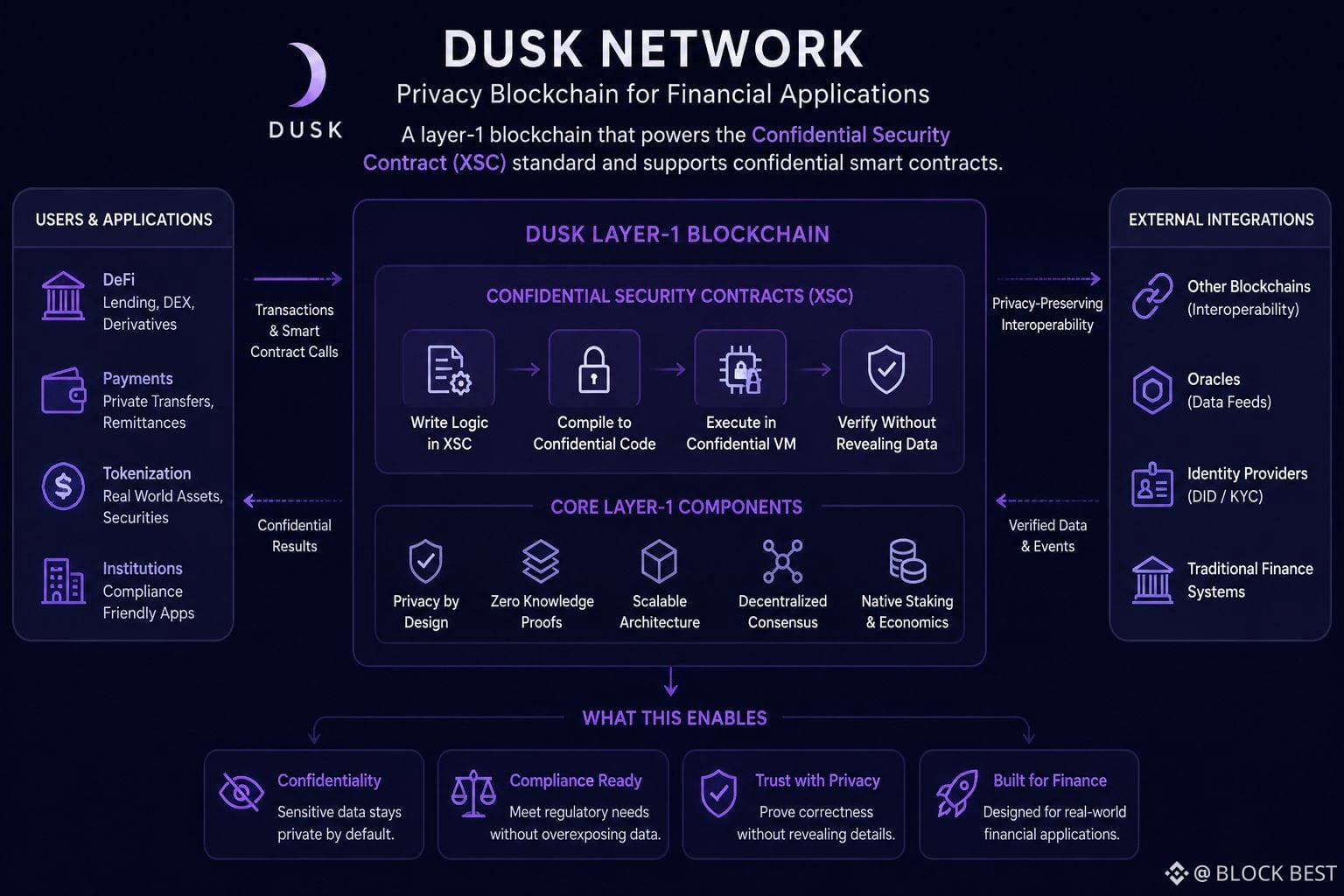
I keep coming back to one quiet choice in Dusk: privacy isn't treated as an extra layer around the financial system, but as something contracts have to live with from the start. That changes the question for me. It isn't simply whether confidential execution works, but what developers stop assuming when transaction details are no longer naturally exposed.
The interesting friction is in the handoff between confidentiality and everything that still needs to coordinate around it. A financial application can hide sensitive state, but it still has to prove enough for other parts of the system to trust what happened. That boundary feels more important than the privacy claim itself.
Maybe that's where Dusk gets genuinely interesting. Not because hiding information is new, but because financial infrastructure has spent years quietly depending on information being visible. If that assumption starts disappearing, the harder work may be deciding what must remain provable, and what never needed to be public in the first place.
@Dusk #dusk $DUSK
The interesting friction is in the handoff between confidentiality and everything that still needs to coordinate around it. A financial application can hide sensitive state, but it still has to prove enough for other parts of the system to trust what happened. That boundary feels more important than the privacy claim itself.
Maybe that's where Dusk gets genuinely interesting. Not because hiding information is new, but because financial infrastructure has spent years quietly depending on information being visible. If that assumption starts disappearing, the harder work may be deciding what must remain provable, and what never needed to be public in the first place.
@Dusk #dusk $DUSK