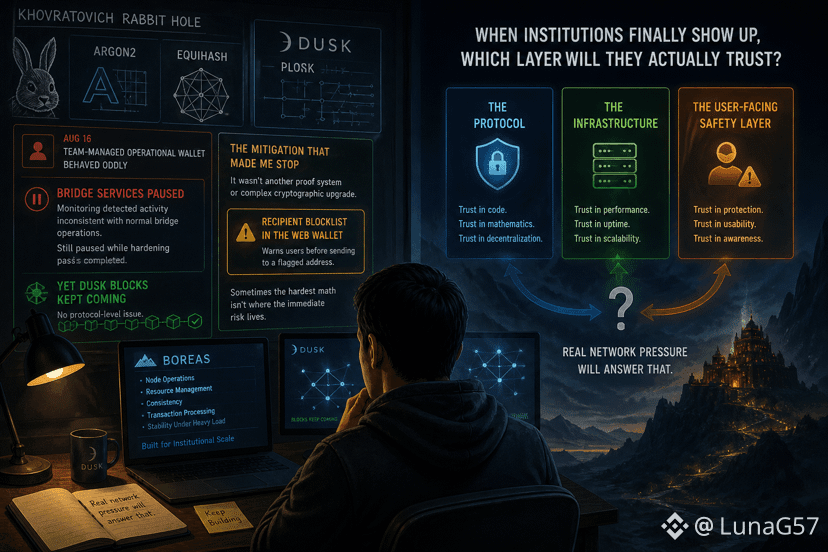
I spent this whole task going deep down the Khovratovich rabbit hole Argon2, Equihash, and the PLONK work behind Dusk. The cryptography was fascinating, but when I looked at what had actually happened on the network recently, something unexpected caught my attention.A team managed operational wallet had behaved unusually.
On August 16, bridge services were paused after monitoring detected activity inconsistent with normal bridge operations. They’re still paused while the hardening process is completed. Yet Dusk blocks continued coming the entire time, and there was no protocol-level issue. @Dusk #dusk $DUSK $NVDAB
But what really made me stop and think was the mitigation.It wasn’t another proof system or some complex cryptographic upgrade. Instead, a recipient blocklist was added to the Web Wallet, warning users before they send funds to a flagged address.
That made me realize something: sometimes, the most complex mathematics in the stack isn’t where the immediate risk actually lives.The fix was placed exactly where the average user interacts with the network. That’s a practical approach it can protect a large number of users quickly. But if you’re running Rusk CLI or your own tooling, you don’t automatically inherit that protection.
And that creates an interesting tension.
Part of me thinks this is the right move: protect the majority of users first, then debate architectural elegance later.
But another part of me keeps asking whether a network targeting regulated markets should have its most visible safety controls sitting outside the protocol.Boreas focuses on node operations, resource management, consistency, transaction processing, and stability under heavier loads. Those things will become increasingly important when institutional activity starts arriving at scale.
So I’m left with one question:When institutions finally show up, which layer will they actually trust the protocol, the infrastructure, or the user-facing safety layer?Maybe real network pressure will be what finally answers that question. @Dusk #dusk $DUSK
On August 16, bridge services were paused after monitoring detected activity inconsistent with normal bridge operations. They’re still paused while the hardening process is completed. Yet Dusk blocks continued coming the entire time, and there was no protocol-level issue. @Dusk #dusk $DUSK $NVDAB
But what really made me stop and think was the mitigation.It wasn’t another proof system or some complex cryptographic upgrade. Instead, a recipient blocklist was added to the Web Wallet, warning users before they send funds to a flagged address.
That made me realize something: sometimes, the most complex mathematics in the stack isn’t where the immediate risk actually lives.The fix was placed exactly where the average user interacts with the network. That’s a practical approach it can protect a large number of users quickly. But if you’re running Rusk CLI or your own tooling, you don’t automatically inherit that protection.
And that creates an interesting tension.
Part of me thinks this is the right move: protect the majority of users first, then debate architectural elegance later.
But another part of me keeps asking whether a network targeting regulated markets should have its most visible safety controls sitting outside the protocol.Boreas focuses on node operations, resource management, consistency, transaction processing, and stability under heavier loads. Those things will become increasingly important when institutional activity starts arriving at scale.
So I’m left with one question:When institutions finally show up, which layer will they actually trust the protocol, the infrastructure, or the user-facing safety layer?Maybe real network pressure will be what finally answers that question. @Dusk #dusk $DUSK