#dusk $DUSK @Dusk
I think the most interesting thing about DUSK isn’t privacy itself — it’s where privacy becomes useful.
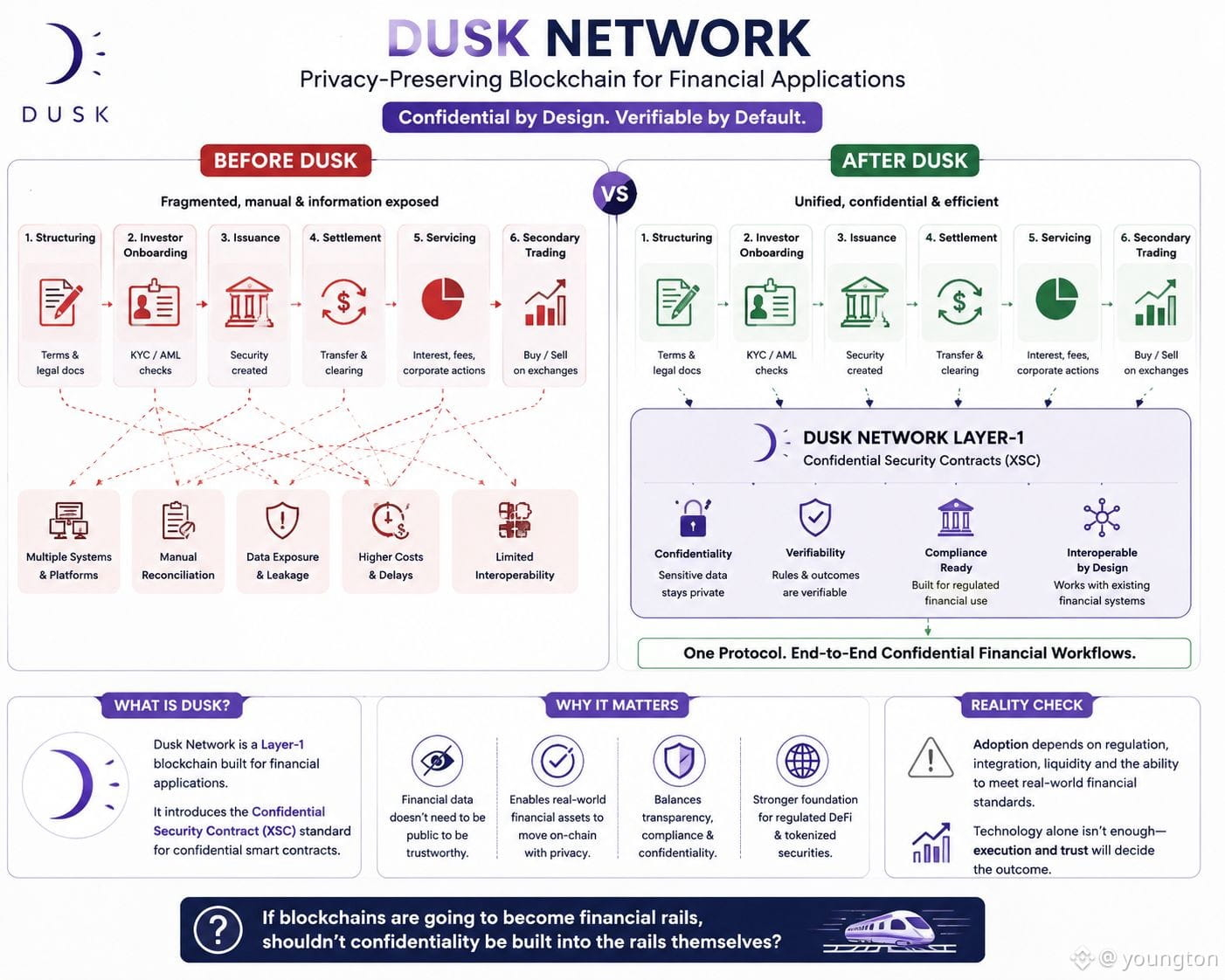
Look at traditional financial markets. A security issuance can involve investor checks, sensitive financial data, transaction records, compliance processes and settlement. Much of that information cannot simply be public, yet different parties still need to verify that the right rules were followed.
That creates a difficult trade-off: public blockchains offer transparency, but financial workflows often require confidentiality.
This is where Dusk Network gets interesting.
Dusk is a layer-1 focused on financial applications, with its Confidential Security Contract (XSC) standard designed for confidential smart contracts. The bigger idea is not “hide everything.” It is creating infrastructure where financial activity can remain verifiable while sensitive information does not need to become openly exposed.
Before this kind of architecture, blockchain-based financial workflows can require separate systems for privacy, compliance, issuance and settlement. With confidential smart-contract infrastructure, more of those rules can potentially be handled directly at the protocol level.
But there’s an important reality check: technology alone doesn’t guarantee adoption. Financial institutions have strict regulatory, liquidity and integration requirements. Dusk still has to prove that its infrastructure can handle those real-world constraints better than established alternatives.
That’s why I’m watching DUSK less as a privacy narrative and more as a bet on blockchain infrastructure for regulated finance.
If blockchains become financial rails, shouldn’t confidentiality be built into the rails themselves?
$ONG
$TLM
I think the most interesting thing about DUSK isn’t privacy itself — it’s where privacy becomes useful.
Look at traditional financial markets. A security issuance can involve investor checks, sensitive financial data, transaction records, compliance processes and settlement. Much of that information cannot simply be public, yet different parties still need to verify that the right rules were followed.
That creates a difficult trade-off: public blockchains offer transparency, but financial workflows often require confidentiality.
This is where Dusk Network gets interesting.
Dusk is a layer-1 focused on financial applications, with its Confidential Security Contract (XSC) standard designed for confidential smart contracts. The bigger idea is not “hide everything.” It is creating infrastructure where financial activity can remain verifiable while sensitive information does not need to become openly exposed.
Before this kind of architecture, blockchain-based financial workflows can require separate systems for privacy, compliance, issuance and settlement. With confidential smart-contract infrastructure, more of those rules can potentially be handled directly at the protocol level.
But there’s an important reality check: technology alone doesn’t guarantee adoption. Financial institutions have strict regulatory, liquidity and integration requirements. Dusk still has to prove that its infrastructure can handle those real-world constraints better than established alternatives.
That’s why I’m watching DUSK less as a privacy narrative and more as a bet on blockchain infrastructure for regulated finance.
If blockchains become financial rails, shouldn’t confidentiality be built into the rails themselves?
$ONG
$TLM