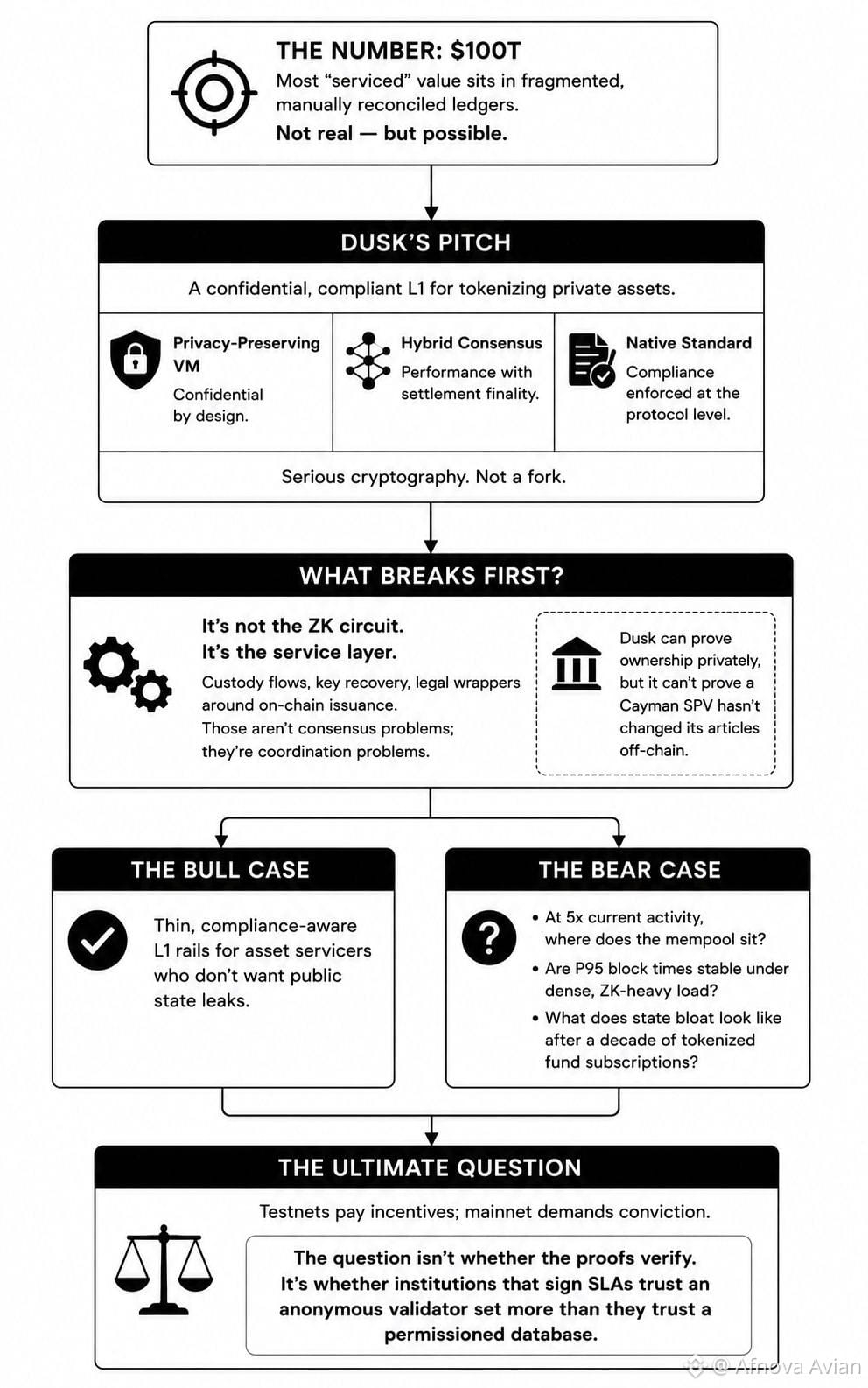

#dusk $DUSK @Dusk I keep coming back to one number $100T. Not because it’s real, but because it isn’t. Most of that “serviced” value sits in fragmented, manually reconciled ledgers. Dusk’s pitch a confidential, compliant L1 for tokenizing private assets makes theoretical sense.
The design is coherent a privacy-preserving VM, hybrid consnsus with settlement finality, and a native standard that forces compliance at the protocol level. I read the transaction format. I read Section 6. It’s serious cryptgraphy, not a fork.
But I also know what happens when a chain optimized for confidential, low-frequency institutional settlement meets real-world operator incentives. The first thing that breaks isn’t the ZK circuit. It’s the service layer. Custody flows, key recovery, legal wrapers around on-chain issuance. Those aren’t consensus problems they’re coOrdination problems. Dusk can prove ownership privately, but it can’t prove a Cayman SPV hasn’t changed its articles off-chain.
half of me thinks this is the right shape thin, compliance-aware L1 rails for asset servicers who don’t want public state leaks. The other half sees a familiar bottleneck. At 5x current activity, where does the mempool sit? Are the P95 block times stable under dense, zero-knowledge heavy load? What does state bloat look lik after a decade of tokenized fund subscriptions?
testnets pay incentives mainnet demands conviction. The question isn’t whether the proofs verify. It’s whether the institutions that sign service-level agreements trust an anonymous validator set more than they trust a permisioned database.
The design is coherent a privacy-preserving VM, hybrid consnsus with settlement finality, and a native standard that forces compliance at the protocol level. I read the transaction format. I read Section 6. It’s serious cryptgraphy, not a fork.
But I also know what happens when a chain optimized for confidential, low-frequency institutional settlement meets real-world operator incentives. The first thing that breaks isn’t the ZK circuit. It’s the service layer. Custody flows, key recovery, legal wrapers around on-chain issuance. Those aren’t consensus problems they’re coOrdination problems. Dusk can prove ownership privately, but it can’t prove a Cayman SPV hasn’t changed its articles off-chain.
half of me thinks this is the right shape thin, compliance-aware L1 rails for asset servicers who don’t want public state leaks. The other half sees a familiar bottleneck. At 5x current activity, where does the mempool sit? Are the P95 block times stable under dense, zero-knowledge heavy load? What does state bloat look lik after a decade of tokenized fund subscriptions?
testnets pay incentives mainnet demands conviction. The question isn’t whether the proofs verify. It’s whether the institutions that sign service-level agreements trust an anonymous validator set more than they trust a permisioned database.