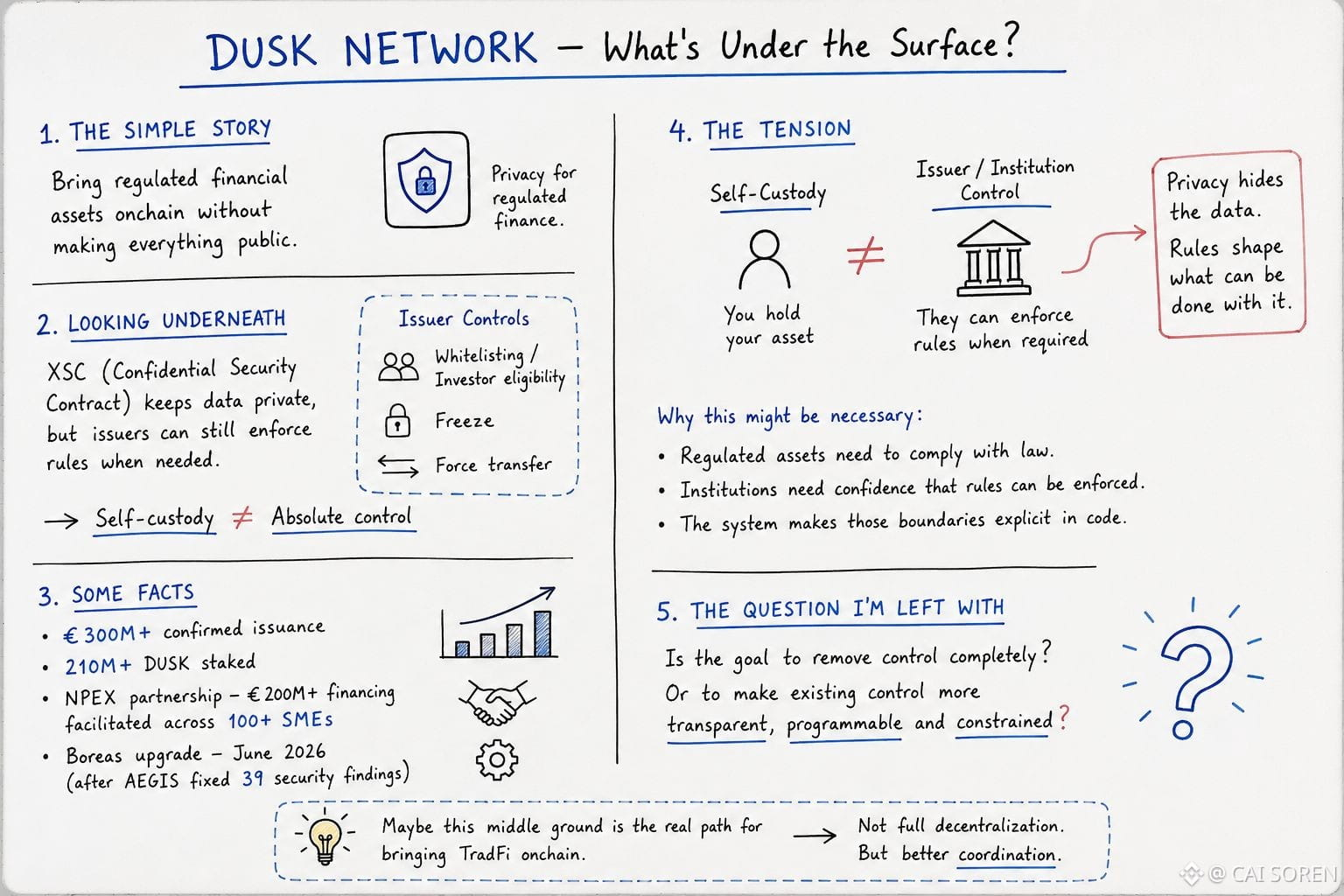

The thing that originally caught my attention with Dusk was pretty straightforward: putting regulated financial assets onchain without exposing everything publicly.
Made sense.
But after spending more time looking at XSC, I think the more interesting part is actually who still has control.
You can hold an asset yourself, but that doesn’t mean nobody else has authority over it. Depending on how the security is configured, issuers can still enforce things like investor eligibility, freezes or transfers when regulation requires it.
At first that felt slightly at odds with the usual idea of self-custody.
Then I thought about what Dusk is actually trying to bring onchain.
These aren’t necessarily assets designed to exist outside the legal system. Dusk reports €300M+ in confirmed issuance, while its connection with NPEX brings in a platform that has already helped finance 100+ SMEs.
So maybe removing every point of control was never the goal.
The distinction I keep coming back to is this:
holding something yourself isn't the same as having absolute control over it.
That sounds obvious once you say it, but crypto often mixes the two together.
Maybe this middle ground is necessary for regulated assets. I’m not sure it makes the system better or worse.
But it does make me wonder whether the interesting part of bringing traditional finance onchain is removing institutions at all...
or simply making their power more visible, limited and predictable.
@Dusk #dusk $DUSK
Made sense.
But after spending more time looking at XSC, I think the more interesting part is actually who still has control.
You can hold an asset yourself, but that doesn’t mean nobody else has authority over it. Depending on how the security is configured, issuers can still enforce things like investor eligibility, freezes or transfers when regulation requires it.
At first that felt slightly at odds with the usual idea of self-custody.
Then I thought about what Dusk is actually trying to bring onchain.
These aren’t necessarily assets designed to exist outside the legal system. Dusk reports €300M+ in confirmed issuance, while its connection with NPEX brings in a platform that has already helped finance 100+ SMEs.
So maybe removing every point of control was never the goal.
The distinction I keep coming back to is this:
holding something yourself isn't the same as having absolute control over it.
That sounds obvious once you say it, but crypto often mixes the two together.
Maybe this middle ground is necessary for regulated assets. I’m not sure it makes the system better or worse.
But it does make me wonder whether the interesting part of bringing traditional finance onchain is removing institutions at all...
or simply making their power more visible, limited and predictable.
@Dusk #dusk $DUSK