The part of Dusk security that caught my attention this week wasn’t the hardest cryptography.
It was the layer above it.
$DUSK
I went down a Khovratovich rabbit hole Argon2, Equihash, PLONK and it reminded me how deep the cryptographic stack behind Dusk actually goes. PLONK isn’t just a research name either; Dusk uses it in its proving stack, and PLONK V3 became part of the protocol’s consensus verification boundary with Aegis.
But that made me think about a different security question:
Where does the user’s protection actually live?
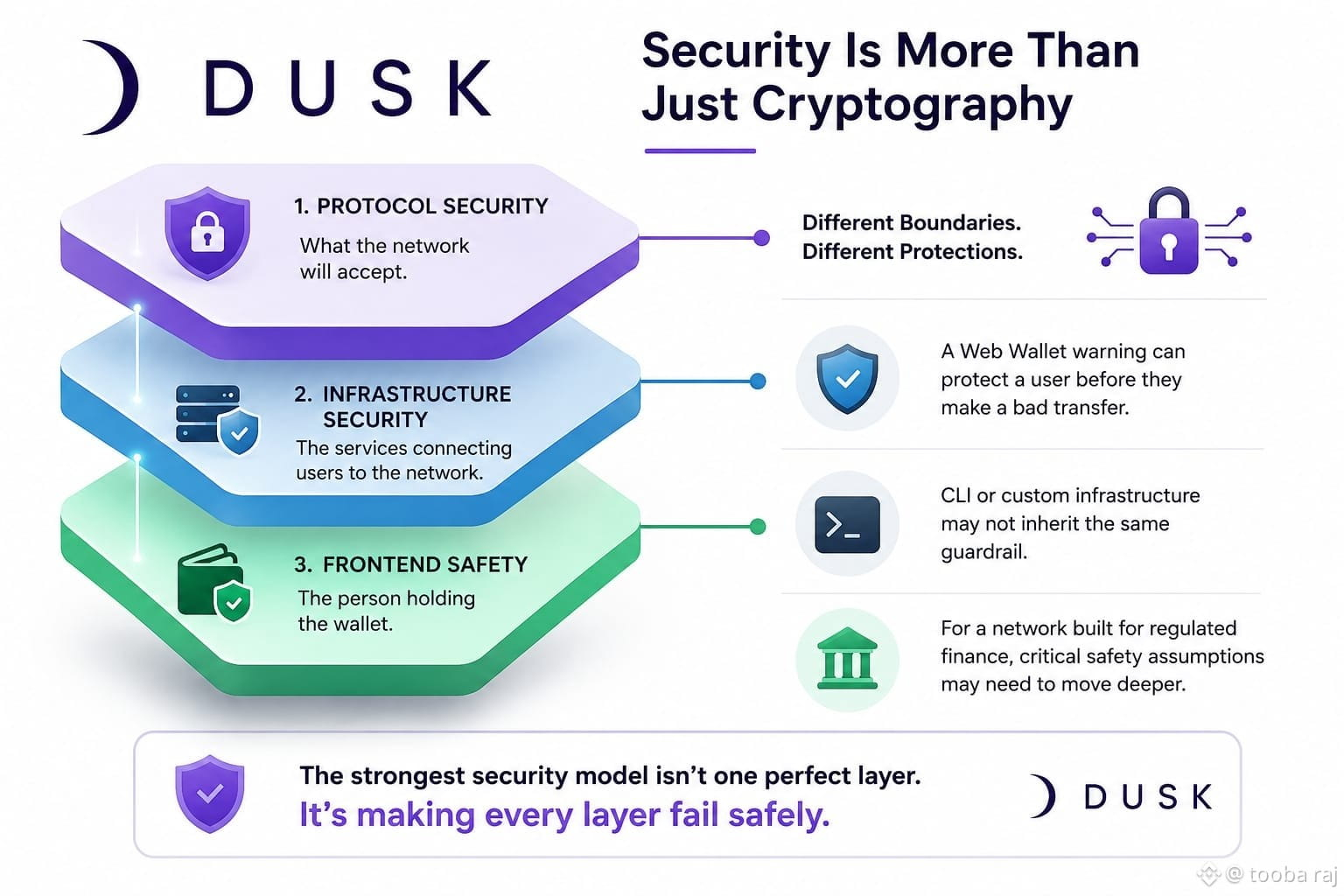
Protocol security protects what the network will accept.
#Dusk
Infrastructure security protects the services connecting users to that network.
Frontend safety protects the person holding the wallet.
Those are three different boundaries.
And that distinction matters because a Web Wallet warning can protect a user before they make a bad transfer, while someone interacting through CLI or custom infrastructure may not inherit the same guardrail.
I don’t see that as a weakness by itself. A fast application-level mitigation can be extremely practical.
But for a network positioning itself around regulated finance, I think the bigger question is whether critical safety assumptions eventually need to move deeper into the stack.
The strongest security model may not be one perfect layer. It may be making every layer fail safely.
That’s the part of Dusk I’m watching now.
@Dusk
It was the layer above it.
$DUSK
I went down a Khovratovich rabbit hole Argon2, Equihash, PLONK and it reminded me how deep the cryptographic stack behind Dusk actually goes. PLONK isn’t just a research name either; Dusk uses it in its proving stack, and PLONK V3 became part of the protocol’s consensus verification boundary with Aegis.
But that made me think about a different security question:
Where does the user’s protection actually live?
Protocol security protects what the network will accept.
#Dusk
Infrastructure security protects the services connecting users to that network.
Frontend safety protects the person holding the wallet.
Those are three different boundaries.
And that distinction matters because a Web Wallet warning can protect a user before they make a bad transfer, while someone interacting through CLI or custom infrastructure may not inherit the same guardrail.
I don’t see that as a weakness by itself. A fast application-level mitigation can be extremely practical.
But for a network positioning itself around regulated finance, I think the bigger question is whether critical safety assumptions eventually need to move deeper into the stack.
The strongest security model may not be one perfect layer. It may be making every layer fail safely.
That’s the part of Dusk I’m watching now.
@Dusk