


Tokenization is slowly moving beyond the crypto-native world.
We are already seeing traditional stocks and other financial assets being brought onchain.
Binance's tokenized stock product crossed $500M in AUM in July, while DTCC has started limited production trades involving tokenized stocks and Treasuries.
So the question is no longer simply whether financial assets can be tokenized.
The bigger question is what infrastructure is needed to actually run regulated financial markets onchain.
This is where #Dusk comes in.
Dusk is building blockchain infrastructure focused on regulated financial applications and tokenized assets.
One of the upcoming components is DuskEVM.
What is DuskEVM?
DuskEVM is the EVM-compatible application layer in the Dusk stack, giving partners, institutions, and builders a familiar Solidity/EVM path into Dusk. It supports confidential EVM workflows through Hedger, Dusk's privacy module for EVM. Hedger uses homomorphic encryption and zero-knowledge proofs to support reviewable privacy for regulated financial applications.
Financial markets need privacy
You can't expect institutions to put everything on a public blockchain where everyone can see their balances, positions, transactions and trad ing activity.
And this is where Dusk is trying to do something different.
Dusk is building infrastructure specifically around regulated onchain finance, with privacy and compliance built into the architecture.
DuskEVM gives developers an EVM compatible environment, meaning builders can use the Solidity/EVM ecosystem they are already familiar with.
But then you have Hedger, the privacy layer designed for DuskEVM.
Hedger, the privacy layer designed for DuskEVM.
It combines homomorphic encryption and zero-knowledge proofs to allow transactions to remain confidential while still being auditable when required.
Key Capabilities
Hedger unlocks a set of features purpose-built for regulated markets:
Support For Obfuscated Order Books: Hedger lays the ground for the upcoming deployment of obfuscated order books,, a critical feature for institutional trading that prevents market manipulation and protects participants from revealing intent or exposure.
Regulated Audit-ability: Transactions are fully auditable by design, ensuring compliance when required.
Confidential Asset Ownership & Transfers: Holdings, amounts, and balances remain fully encrypted end-to-end, preserving privacy while ensuring transactions stay auditable.
Fast In-Browser Proving: Lightweight circuits allow client-side proof generation in under 2 seconds, enabling a seamless user experience at scale.
These features make Hedger a core pillar of DuskEVM, bridging institutional privacy with real-world usability because institutional adoption isn't simply about putting an asset onchain.
It's about answering questions like:
Who is allowed to buy it?
Who is allowed to hold it?
What information should be public?
What information should remain private?
And who should be able to see that private information?
Dusk is trying to build those rules into the infrastructure itself.
Dusk Trade as a neobroker for tokenized financial assets
Dusk Trade is the application layer for tokenized financial assets on Dusk.
It sits above the base protocol and turns Dusk’s market-infrastructure primitives into user-facing workflows: asset discovery, investor onboarding, wallet connection, payment coordination, trading actions, and settlement.
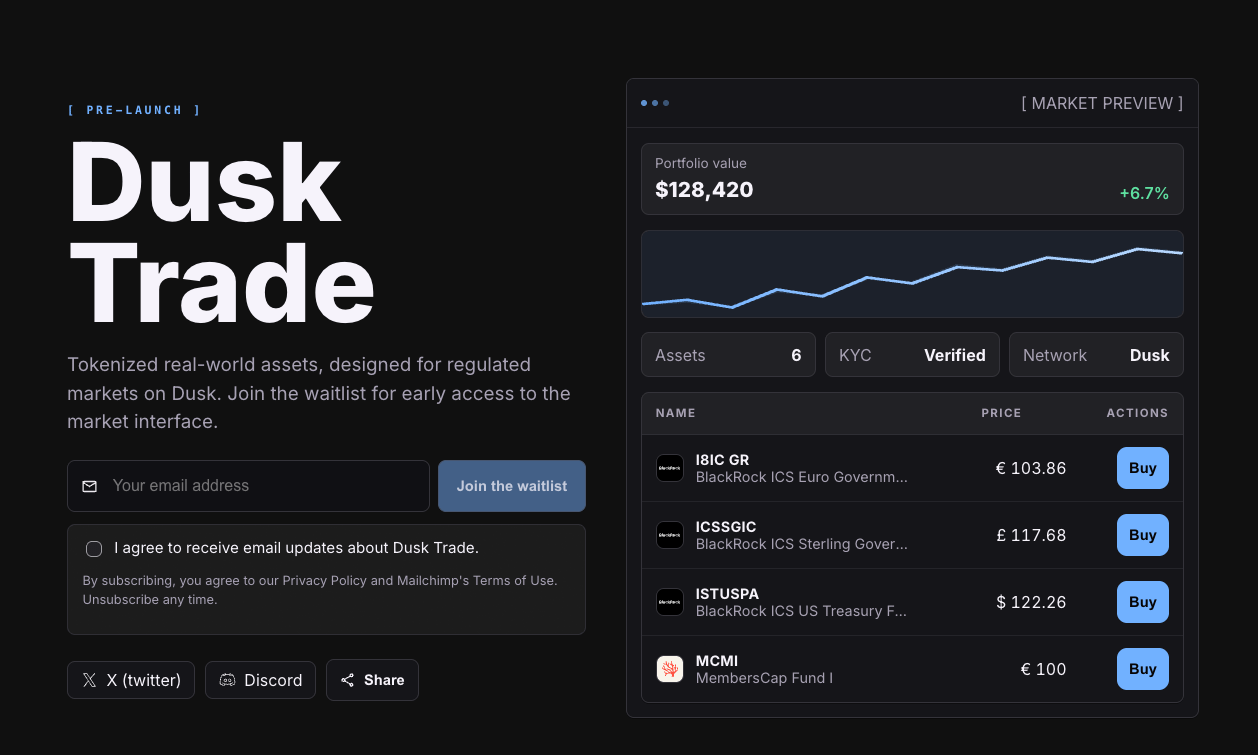
Dusk trade is currently in Pre-Launch
The assets being targeted include money market funds, ETFs, bonds and other RWAs.
Dusk is also working with institutions and infrastructure providers in this area.
@Dusk Partnership with licensed institutions
Dusk is setting a groundbreaking precedent in the cryptocurrency space, paving the way for real adoption of blockchain technology in the financial sector. Unlike others in the realm of Real-World Assets (RWA) frantically trying to persuade institutions to list assets on their chains, Dusk is positioning itself as the underlying technology of choice for the very platforms where financial institutions launch their products in the first place.
NPEX + Quantoz Payments
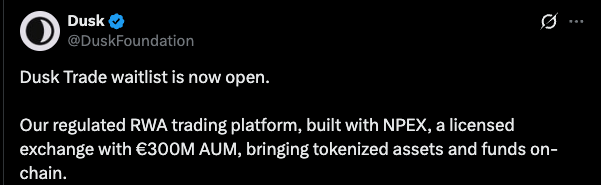
Partnership to bring EURQ, a MiCA-compliant digital euro, to Dusk and support the development of a fully on-chain stock exchange. The announcement states that NPEX's €300M in assets are being brought on-chain.
Partnership with Chainlink
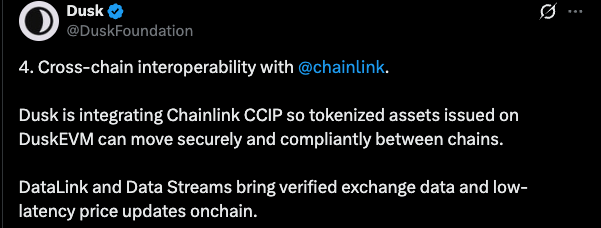
Dusk and NPEX adopted Chainlink CCIP, DataLink and Data Streams to bring regulated European securities and verified exchange data on-chain.
Cordial Systems
Strategic partnership focused on institutional-grade RWA custody, with Cordial Treasury integrated for NPEX's digital-asset custody needs.
Cordial Systems has established itself as a trusted innovator in the tokenization sector, collaborating with industry leaders such as Figure Markets and its parent company, Figure.com, which has facilitated the origination of over $20 billion in private credit on-chain.
Partnership with 21X
Dusk has Strategic collaboration with the regulated European DLT trading and settlement platform. $DUSK became a trade participant, with 21X planning to integrate DuskEVM.
21X is a regulated RWA platform and the first to receive the DLT Trading and Settlement System (DLT-TSS) license, allowing it to combine trading and settlement on a single blockchain. It can also operate on public, permissionless blockchains, enabling faster, near real-time settlement without traditional intermediaries.
Dusk’s Regulatory Edge
Dusk foundation partnered with NPEX this will give give Dusk access to a range of financial licenses and enabling regulated asset issuance, investment, trading and settlement on-chain
Through NPEX, Dusk inherits:
MTF License: Operate a regulated secondary market for trading securities.
Broker License: Source assets like money market funds (MMFs) and bonds, and ensure best-price execution.
ECSP: The European Crowdfunding Service Provider license grants the offering of retail-funded investment instruments across the entire EU.
DLT-TSS License (in progress): Enable native issuance and tokenization of regulated assets on-chain.
Programmable privacy for regulated markets
As we discussed above you can't expect institutions to put everything on a public blockchain where everyone can see their balances, positions, transactions and trading activity.
Privacy is the essential foundation for institutional blockchain adoption in regulated finance, as public chains’ full transparency exposes sensitive data like investor balances, transfer histories, and trading strategies something traditional markets cannot accept.
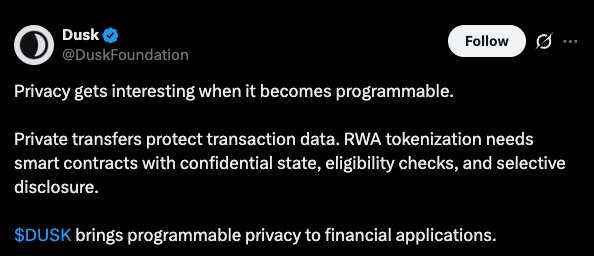
Dusk solves this through programmable privacy powered by zero-knowledge proofs, enabling selective disclosure: participants prove compliance (e.g., AML/KYC) and enforce asset rules without broadcasting details, while regulators retain audit access.
See it in action 👇
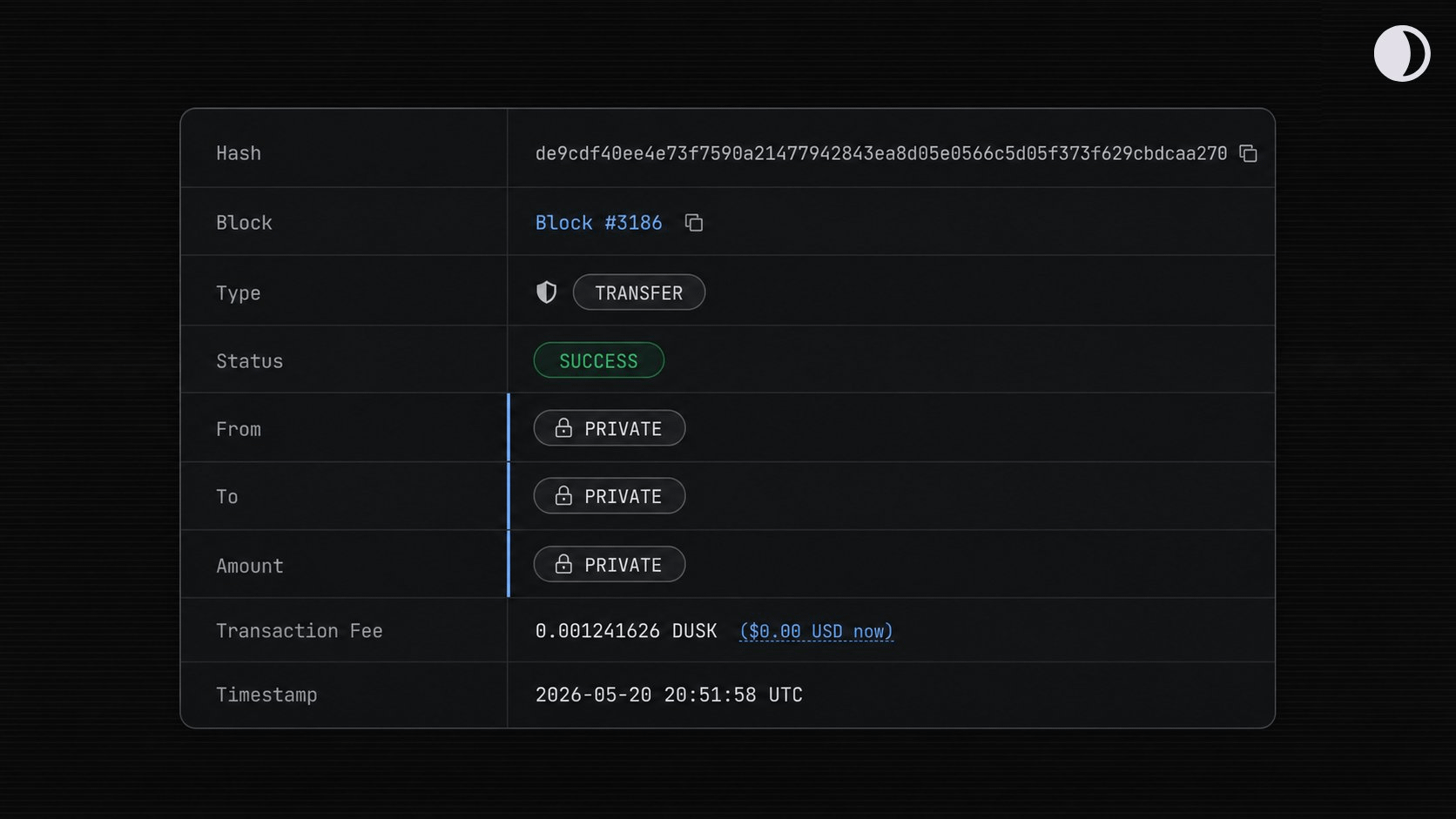
For tokenized bonds, equities, funds, or real-world assets, this means private smart contracts and transfers protect issuer conditions, investor positions, and settlement logic across DuskDS, DuskEVM (with Hedger), and DuskVM aligning with European standards like GDPR and MiCA to make regulated finance work securely on-chain.
RWAs and native issuance
Tokenization wraps an existing asset. Native issuance can move more of the asset lifecycle onchain, including issuance, transfer rules, settlement, review, and servicing.
There is a difference between simply creating a token that represents an existing asset and having more of the asset's lifecycle handled onchain.
Native issuance can include issuance, transfers, settlement, review and servicing directly within the blockchain infrastructure.
This is where privacy becomes important.
Financial markets cannot necessarily operate with the assumption that every piece of information should be public.
At the same time, regulated markets cannot operate without transparency and the ability to review transactions.
Dusk's approach is to use programmable privacy and selective disclosure to try to handle both requirements.
Dusk is built for regulated markets where access controls, privacy with selective disclosure, and deterministic settlement are requirements, not add-ons.
In practice, that means you can:
build applications and tokenization-style workflows with familiar EVM tooling through DuskEVM, and
rely on DuskDS for privacy-capable transaction models, data availability, and deterministic L1 finality.
That's pretty much everything important you need to know about where Dusk actually stands right now, the development is mainly around building the infrastructure needed for that use case.