Goo like😎

نشر

--

EVVA_786
·
--
I used to think privacy in financial systems meant hiding the transaction and leaving it at that.
But the more I look at Dusk, the less complete that idea feels.
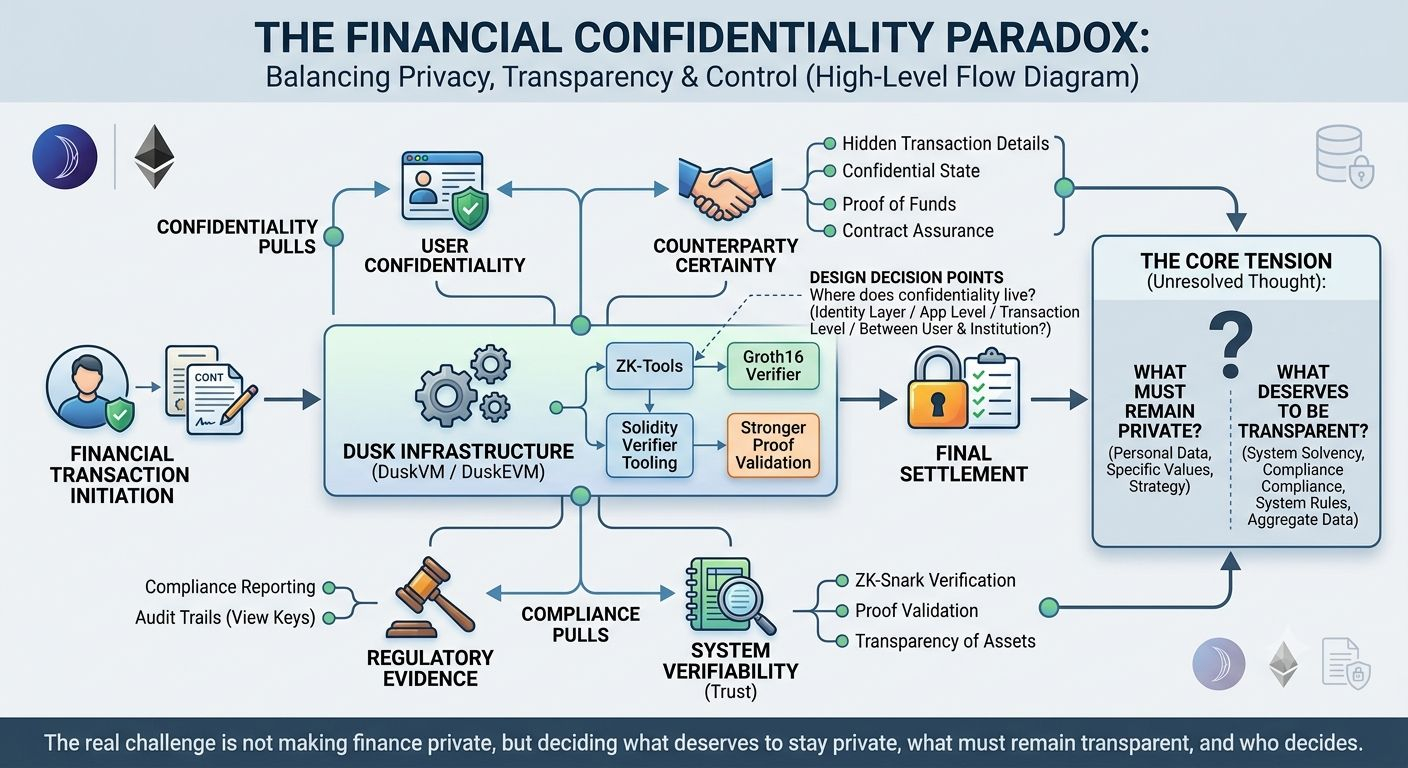
If regulated finance moves onchain, privacy can’t simply mean “nobody sees anything.” Regulators may need evidence. Counterparties may need certainty. Users may want confidentiality without surrendering control. Those needs don’t really cancel each other out; they pull in different directions.
That makes the infrastructure underneath the privacy story more interesting to me. Work around zk-tools, Solidity verifier tooling, Groth16 verification, and stronger proof validation suggests that privacy isn’t only a user-facing feature. It becomes a question of what the system can prove, to whom, and under which conditions.
The DuskVM and DuskEVM paths add another layer to that tension. Familiar developer environments can coexist with confidential flows and deterministic settlement, but that still leaves a harder design question.
Where should confidentiality actually live?
At the transaction level? The application level? The identity layer? Or somewhere between the user and the institution?
And perhaps the uncomfortable part is that more privacy isn’t automatically better.
A financial system needs some things to remain visible precisely because trust depends on them being verifiable.
So I keep coming back to the same unresolved thought: maybe the real challenge isn’t making finance private.
It’s deciding what deserves to stay private, what must remain transparent, and who gets to make that distinction.
@Dusk #DUSK $DUSK
But the more I look at Dusk, the less complete that idea feels.
If regulated finance moves onchain, privacy can’t simply mean “nobody sees anything.” Regulators may need evidence. Counterparties may need certainty. Users may want confidentiality without surrendering control. Those needs don’t really cancel each other out; they pull in different directions.
That makes the infrastructure underneath the privacy story more interesting to me. Work around zk-tools, Solidity verifier tooling, Groth16 verification, and stronger proof validation suggests that privacy isn’t only a user-facing feature. It becomes a question of what the system can prove, to whom, and under which conditions.
The DuskVM and DuskEVM paths add another layer to that tension. Familiar developer environments can coexist with confidential flows and deterministic settlement, but that still leaves a harder design question.
Where should confidentiality actually live?
At the transaction level? The application level? The identity layer? Or somewhere between the user and the institution?
And perhaps the uncomfortable part is that more privacy isn’t automatically better.
A financial system needs some things to remain visible precisely because trust depends on them being verifiable.
So I keep coming back to the same unresolved thought: maybe the real challenge isn’t making finance private.
It’s deciding what deserves to stay private, what must remain transparent, and who gets to make that distinction.
@Dusk #DUSK $DUSK
إخلاء مسؤولية: يتضمن آراء جهات خارجية. لا تُعدّ نصيحة. يُمكن استخدام Binance AI دون أي ضمان. اطلع على الشروط والأحكام.