I’ve been digging into Dusk for a while, and honestly, the privacy angle is what pulled me in first.
It makes sense. If you’re trying to bring real financial markets on-chain, you probably don’t want every trade, position, and balance sitting in public for everyone to inspect.
Dusk is built around that problem with confidential smart contracts and selective disclosure.
Sounds pretty compelling.
But then I started looking at the token side, and that’s where I paused.
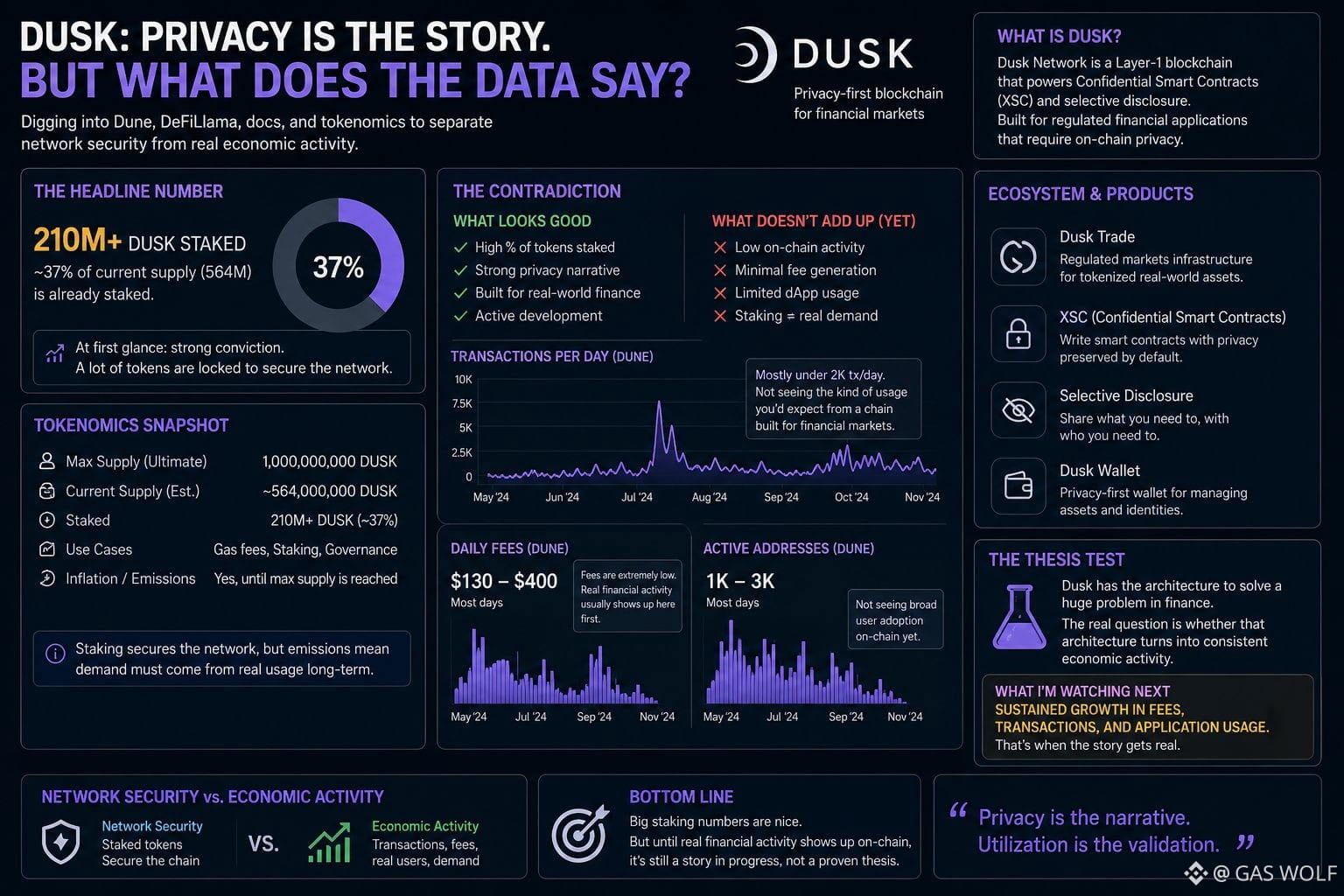
A lot of DUSK is staked. At first, I saw that as a strong signal. People are locking up their tokens to help secure the network, so clearly there’s some conviction there.
Then I thought about what staking actually tells me.
It tells me people are securing the chain.
It doesn’t necessarily tell me that people are using the chain.
That difference is easy to miss.
For Dusk, I think the real test is whether all this infrastructure eventually turns into actual financial activity: more transactions, more fees, more applications, and ultimately real users doing things that require privacy.
That’s the part I’m not willing to assume yet.
The technology is interesting because the problem it’s trying to solve is very real. But having the right architecture and getting institutions to actually use it are two completely different milestones.
So I’m not watching the staking number as closely anymore.
I’m watching the boring stuff: fees, transactions, and application usage.
If those start moving meaningfully, then the Dusk thesis gets a lot more interesting.
Until then, I’m still digging.
$ONG
#dusk $DUSK @Dusk
$TMX
It makes sense. If you’re trying to bring real financial markets on-chain, you probably don’t want every trade, position, and balance sitting in public for everyone to inspect.
Dusk is built around that problem with confidential smart contracts and selective disclosure.
Sounds pretty compelling.
But then I started looking at the token side, and that’s where I paused.
A lot of DUSK is staked. At first, I saw that as a strong signal. People are locking up their tokens to help secure the network, so clearly there’s some conviction there.
Then I thought about what staking actually tells me.
It tells me people are securing the chain.
It doesn’t necessarily tell me that people are using the chain.
That difference is easy to miss.
For Dusk, I think the real test is whether all this infrastructure eventually turns into actual financial activity: more transactions, more fees, more applications, and ultimately real users doing things that require privacy.
That’s the part I’m not willing to assume yet.
The technology is interesting because the problem it’s trying to solve is very real. But having the right architecture and getting institutions to actually use it are two completely different milestones.
So I’m not watching the staking number as closely anymore.
I’m watching the boring stuff: fees, transactions, and application usage.
If those start moving meaningfully, then the Dusk thesis gets a lot more interesting.
Until then, I’m still digging.
$ONG
#dusk $DUSK @Dusk
$TMX