
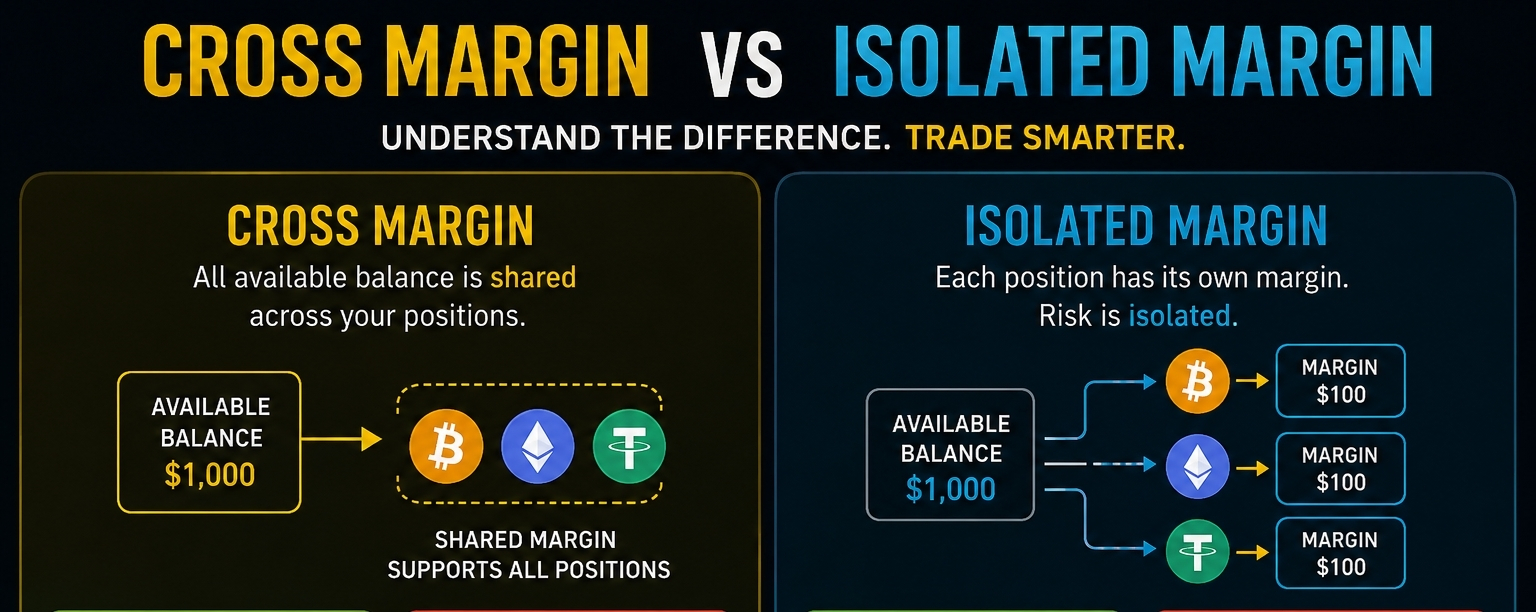


If you’ve ever traded futures or margin products, you’ve probably seen the words Cross Margin and Isolated Margin.
They may sound complicated at first, but the basic idea is simple:
Cross Margin = your available margin can be shared across positions.
Isolated Margin = each position has its own separate margin.
Understanding this difference is extremely important because your margin mode can determine how much of your account is exposed when a trade goes against you.
Let’s break it down in simple terms.
🔹 What Is Cross Margin?
With Cross Margin, the available balance in your margin/futures account can be used to support your open positions.
Imagine you have $1,000 in your futures wallet and open a position that requires $200 of margin.
With cross margin, the remaining available funds can potentially help keep the position open if the trade moves against you.
That can give you more room before liquidation.
But there is an important catch:
Your entire available margin can be exposed to the position.
If the market moves heavily against you, you could lose much more than the initial amount you intended to risk.
Advantages of Cross Margin
✅ Better capital efficiency
Your available margin can support your positions instead of keeping margin completely separated.
✅ More room before liquidation
Additional available balance can help absorb unrealized losses.
✅ Useful for hedging and multiple positions
Traders managing several positions may find cross margin more flexible.
✅ Less need to manually add margin
Because the system can use available margin automatically, depending on the platform and position setup.
Disadvantages of Cross Margin
❌ Higher account-wide risk
A losing position can consume funds that could otherwise remain untouched.
❌ Potentially larger losses
If the market moves aggressively against you, a significant portion or potentially all of the relevant margin balance can be at risk.
❌ Risk can spread across positions
When several positions share margin, problems with one position can affect the overall account.
🔹 What Is Isolated Margin?
Isolated Margin works differently.
Here, you assign a specific amount of margin to a particular position.
For example, suppose you have $1,000 in your account but decide to use only $100 as margin for a BTC position.
Under isolated margin, that position is generally limited to the margin allocated to it, subject to the platform's rules, fees, and liquidation mechanics.
The remaining $900 stays separate from that position.
This makes isolated margin popular among traders who want to define the maximum amount of capital they're willing to put at risk on a particular trade.
Advantages of Isolated Margin
✅ Better risk control
You can allocate a specific amount of capital to each position.
✅ Protects the rest of your balance
A liquidation of one isolated position does not normally consume margin assigned to unrelated positions.
✅ Good for beginners learning risk management
It makes it easier to understand exactly how much capital you've allocated to a trade.
✅ Useful for high-risk trades
If you're experimenting with a volatile asset, isolated margin can prevent that position from automatically putting your entire available balance at risk.
Disadvantages of Isolated Margin
❌ Higher liquidation risk for the individual position
Because the position has limited margin, it may reach liquidation sooner than a comparable cross-margin position.
❌ Requires more active management
If the trade starts moving against you, you may need to manually add margin or reduce the position, depending on the platform.
❌ Less flexible for portfolio-wide margin management
Capital assigned to one position generally cannot automatically support another position.
🧠 A Simple Example
Let's say you have $1,000 in your account.
You open a leveraged BTC position.
With Cross Margin
Your available balance can help support the position if it moves against you.
This could delay liquidation, but it also means more of your account may become exposed to the losing trade.
With Isolated Margin
You decide to allocate only $100 to that position.
If the position is liquidated, the loss is generally limited to the margin allocated to that position, plus applicable fees and other costs.
Your remaining $900 isn't automatically used to defend that trade.
That's the biggest difference:
Cross Margin prioritizes flexibility and shared collateral.
Isolated Margin prioritizes position-level risk control.
🚨 Which One Is Better?
There is no universal winner.
It depends on your trading strategy, risk tolerance, experience, and how you manage leverage.
If you are trading multiple positions and understand portfolio-level risk, Cross Margin can provide greater flexibility.
If you want to clearly define how much capital is exposed to a particular trade, Isolated Margin can be the safer structure.
For many newer traders, isolated margin is easier to understand because the risk is separated position by position.
But remember:
Isolated margin does NOT make leverage safe.
A 50x or 100x position can still be extremely risky even when using isolated margin.
💡 The Real Risk Isn't Just Cross or Isolated
One mistake traders make is focusing only on margin mode while ignoring leverage and position size.
A trader using isolated margin with excessive leverage can still lose their allocated margin very quickly.
Good risk management involves more than choosing a margin mode.
Consider:
1. Position size
Don't risk too much of your trading capital on one idea.
2. Leverage
Higher leverage means smaller price movements can have a much larger impact on your margin.
3. Stop-loss
Know where your trade idea is invalid before entering.
4. Liquidation price
Always understand where liquidation could occur.
5. Market volatility
Crypto can move extremely fast, especially during major news events.
🔥 Conclusion
Think of it this way:
Cross Margin:
"Let my available margin work together across my positions."
Isolated Margin:
"Keep this trade's risk separate from the rest of my balance."
Neither is automatically better.
The important thing is understanding how much money you're putting at risk, how much leverage you're using, and what happens if the market moves against you.
In crypto trading, protecting your capital is just as important as finding profitable opportunities.
Trade with a plan. Manage your leverage. And never risk money you can't afford to lose.
Educational content only not financial advice.
