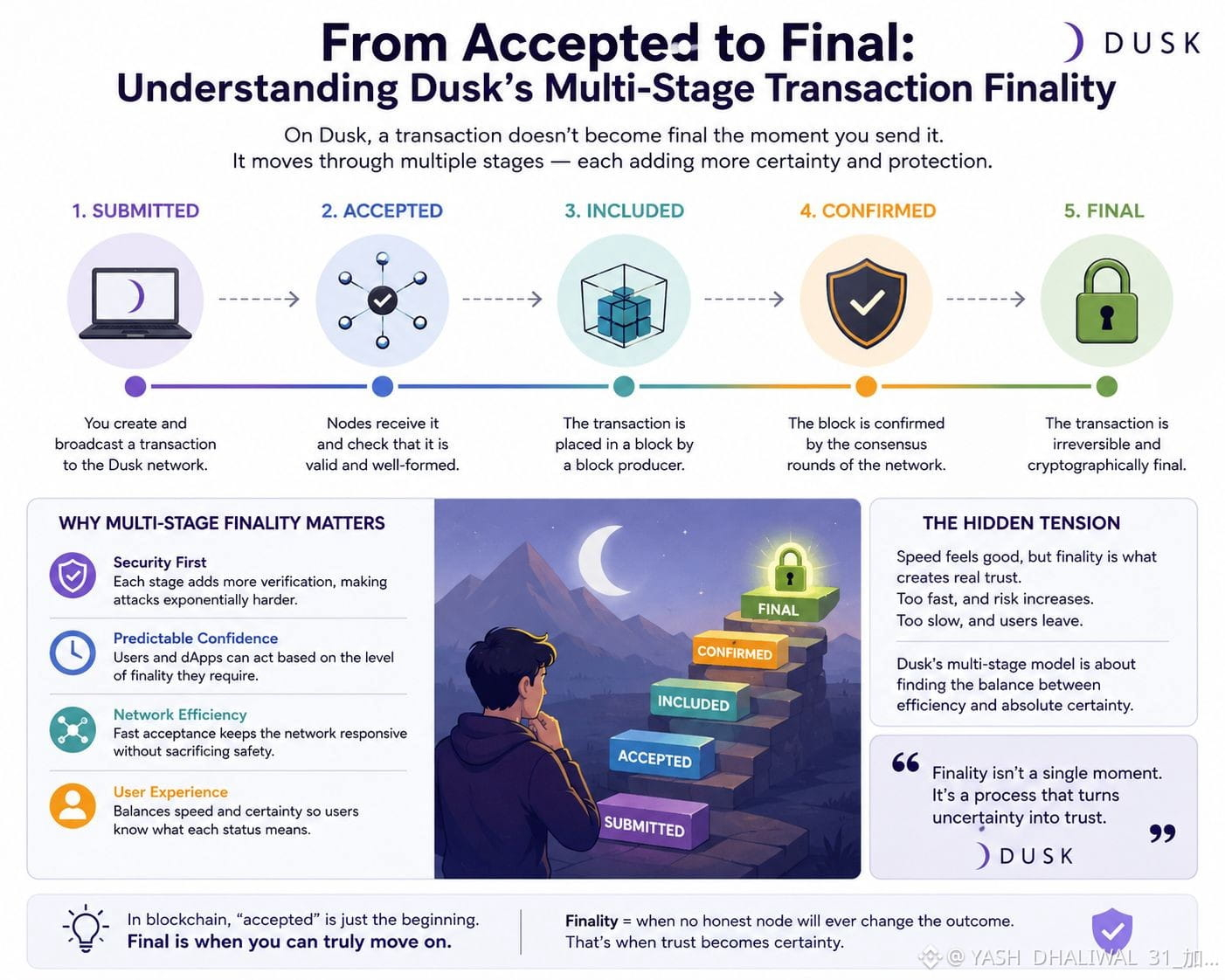
#dusk $DUSK @Dusk A funny thing about sending a message is how quickly we stop thinking about it. You press send, the screen changes, and your mind moves on.
Blockchains are less forgiving. “Accepted” does not always mean “final.”
That distinction is what caught my attention with Dusk. A transaction can move through stages before it reaches the point where the network considers it truly final.
At first, that sounds like unnecessary complexity. But maybe the opposite is true.
There is a hidden question here: when should a user actually trust that something is done?
The interesting part is that finality is not just a technical word. It shapes user expectations, application design, and even how quickly people are willing to act.
If accepted transactions can still be waiting for stronger confirmation, then the gap between “I sent it” and “it is final” becomes meaningful.
Most users probably never notice that gap when everything works smoothly. They notice it when timing matters.
That makes multi-stage finality less about adding steps and more about managing uncertainty.
I’m still curious whether users will understand these stages naturally, or whether interfaces will hide them completely.
Because eventually, the real measure of finality may not be when the protocol says “done,” but when people genuinely feel safe moving on.
Blockchains are less forgiving. “Accepted” does not always mean “final.”
That distinction is what caught my attention with Dusk. A transaction can move through stages before it reaches the point where the network considers it truly final.
At first, that sounds like unnecessary complexity. But maybe the opposite is true.
There is a hidden question here: when should a user actually trust that something is done?
The interesting part is that finality is not just a technical word. It shapes user expectations, application design, and even how quickly people are willing to act.
If accepted transactions can still be waiting for stronger confirmation, then the gap between “I sent it” and “it is final” becomes meaningful.
Most users probably never notice that gap when everything works smoothly. They notice it when timing matters.
That makes multi-stage finality less about adding steps and more about managing uncertainty.
I’m still curious whether users will understand these stages naturally, or whether interfaces will hide them completely.
Because eventually, the real measure of finality may not be when the protocol says “done,” but when people genuinely feel safe moving on.