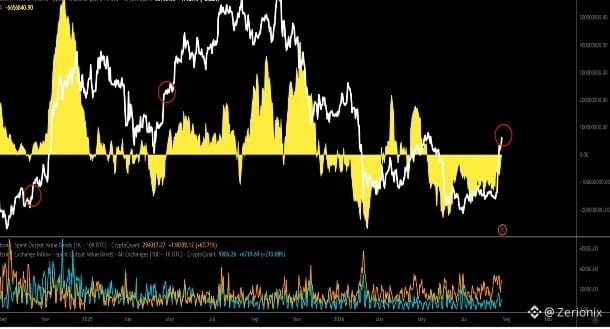
Stablecoin flows are starting to shift.
After April, stablecoins spent months in net outflow while Bitcoin weakened and eventually traded near the $58K area. That period of capital leaving the market lined up with weaker price action.
The trend now looks different. Net outflows have been shrinking, and exchange inflows are beginning to reappear. If this develops into a sustained net-inflow regime, it would mark a change in available liquidity conditions.
Historically, rising stablecoin balances on exchanges have often coincided with stronger risk appetite across crypto. More stablecoins sitting on trading venues means more capital is positioned to move into assets when demand appears.
But the mechanism is not automatic.
Stablecoins arriving on exchanges only create the potential for buying. They do not force it. That liquidity still has to be converted into actual spot demand for Bitcoin or other assets. Without that conversion, inflows can sit idle or rotate into other pairs without lifting BTC.
The setup worth watching is therefore conditional:
Stablecoin exchange inflows continue to build
Bitcoin holds its higher-low structure
Spot volume confirms that capital is actually being deployed
The inflow trend does not reverse
If those conditions hold, the liquidity backdrop becomes more supportive of continued upside. If inflows stall or turn negative again, one of the cleaner tailwinds for the market disappears.
The useful question right now is not simply where Bitcoin is headed. It is whether fresh stablecoin liquidity is still arriving to support the move — and whether that liquidity is being used.
$BTC #Altcoin Season# #Altcoin Season#
After April, stablecoins spent months in net outflow while Bitcoin weakened and eventually traded near the $58K area. That period of capital leaving the market lined up with weaker price action.
The trend now looks different. Net outflows have been shrinking, and exchange inflows are beginning to reappear. If this develops into a sustained net-inflow regime, it would mark a change in available liquidity conditions.
Historically, rising stablecoin balances on exchanges have often coincided with stronger risk appetite across crypto. More stablecoins sitting on trading venues means more capital is positioned to move into assets when demand appears.
But the mechanism is not automatic.
Stablecoins arriving on exchanges only create the potential for buying. They do not force it. That liquidity still has to be converted into actual spot demand for Bitcoin or other assets. Without that conversion, inflows can sit idle or rotate into other pairs without lifting BTC.
The setup worth watching is therefore conditional:
Stablecoin exchange inflows continue to build
Bitcoin holds its higher-low structure
Spot volume confirms that capital is actually being deployed
The inflow trend does not reverse
If those conditions hold, the liquidity backdrop becomes more supportive of continued upside. If inflows stall or turn negative again, one of the cleaner tailwinds for the market disappears.
The useful question right now is not simply where Bitcoin is headed. It is whether fresh stablecoin liquidity is still arriving to support the move — and whether that liquidity is being used.
$BTC #Altcoin Season# #Altcoin Season#