DUSK’S BIGGEST PROBLEM ISN’T TECHNOLOGY—IT’S ATTENTION
Privacy sounds important until people are asked to change how they already do business.
That is the real challenge facing Dusk. Its blockchain offers confidential transactions, selective disclosure, and tools for issuing regulated digital securities. On paper, this solves a genuine problem. Companies do not want their financial activity displayed publicly, while regulators still need lawful access to certain information.
But institutions rarely adopt technology because it is clever. They adopt it when staying with the old system becomes more expensive than changing.
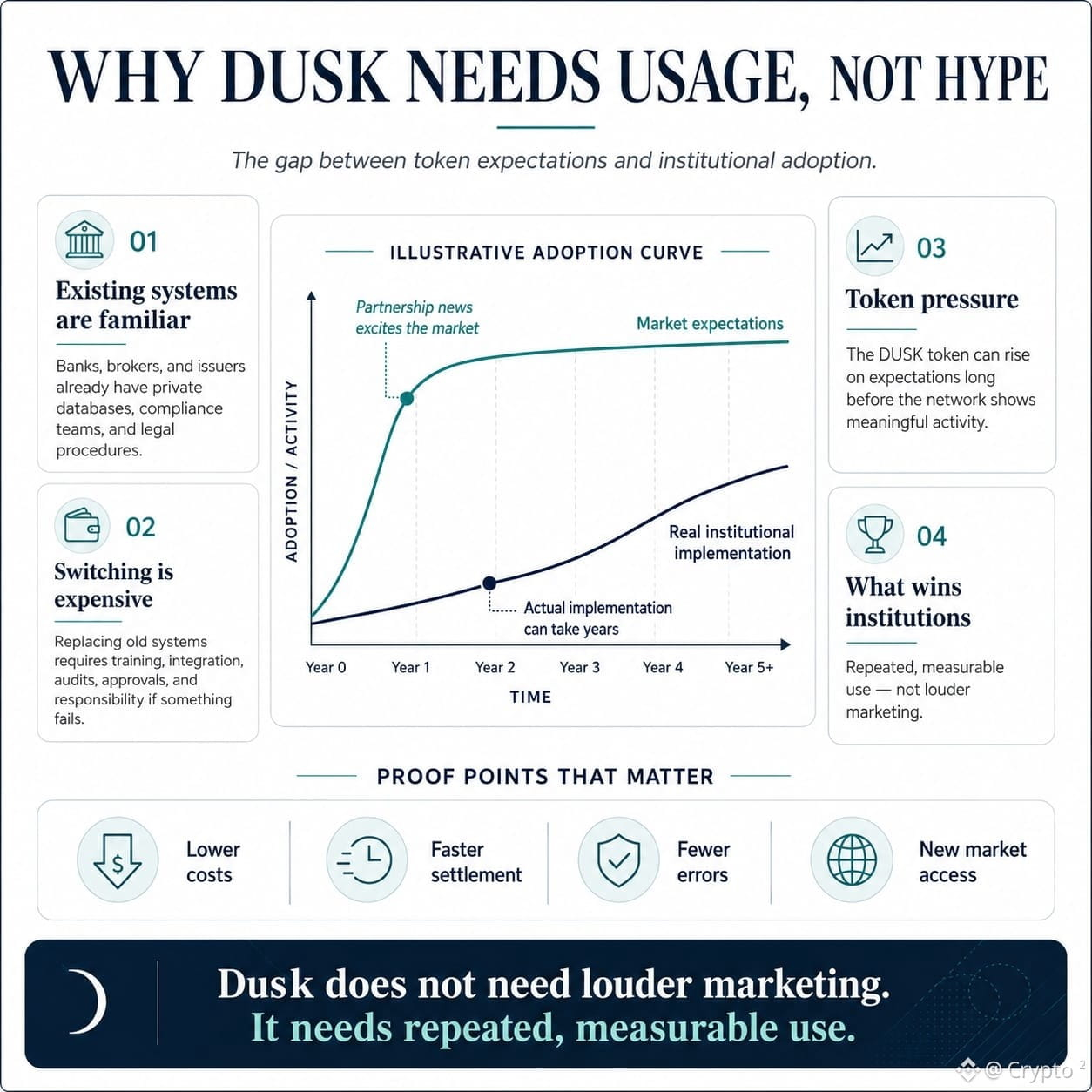
Banks, brokers, and asset issuers already have private databases, compliance teams, legal procedures, and established relationships. These systems may be slow and inefficient, but they are familiar. Replacing them requires training, integration, audits, approvals, and someone willing to accept responsibility if anything fails.
Dusk must therefore prove more than confidentiality. It must show that its network reduces costs, shortens settlement, prevents reconciliation errors, or opens markets that could not operate efficiently before.
The DUSK token adds pressure because traders expect visible growth much faster than institutions can deliver it. A partnership may excite the market today, while actual implementation takes years.
That difference creates danger. The token can rise on expectations long before the network produces meaningful activity.
Dusk does not need louder marketing. It needs repeated, measurable use. Privacy may attract attention, but only practical savings will make institutions stay.
@Dusk #dusk $DUSK
Privacy sounds important until people are asked to change how they already do business.
That is the real challenge facing Dusk. Its blockchain offers confidential transactions, selective disclosure, and tools for issuing regulated digital securities. On paper, this solves a genuine problem. Companies do not want their financial activity displayed publicly, while regulators still need lawful access to certain information.
But institutions rarely adopt technology because it is clever. They adopt it when staying with the old system becomes more expensive than changing.
Banks, brokers, and asset issuers already have private databases, compliance teams, legal procedures, and established relationships. These systems may be slow and inefficient, but they are familiar. Replacing them requires training, integration, audits, approvals, and someone willing to accept responsibility if anything fails.
Dusk must therefore prove more than confidentiality. It must show that its network reduces costs, shortens settlement, prevents reconciliation errors, or opens markets that could not operate efficiently before.
The DUSK token adds pressure because traders expect visible growth much faster than institutions can deliver it. A partnership may excite the market today, while actual implementation takes years.
That difference creates danger. The token can rise on expectations long before the network produces meaningful activity.
Dusk does not need louder marketing. It needs repeated, measurable use. Privacy may attract attention, but only practical savings will make institutions stay.
@Dusk #dusk $DUSK