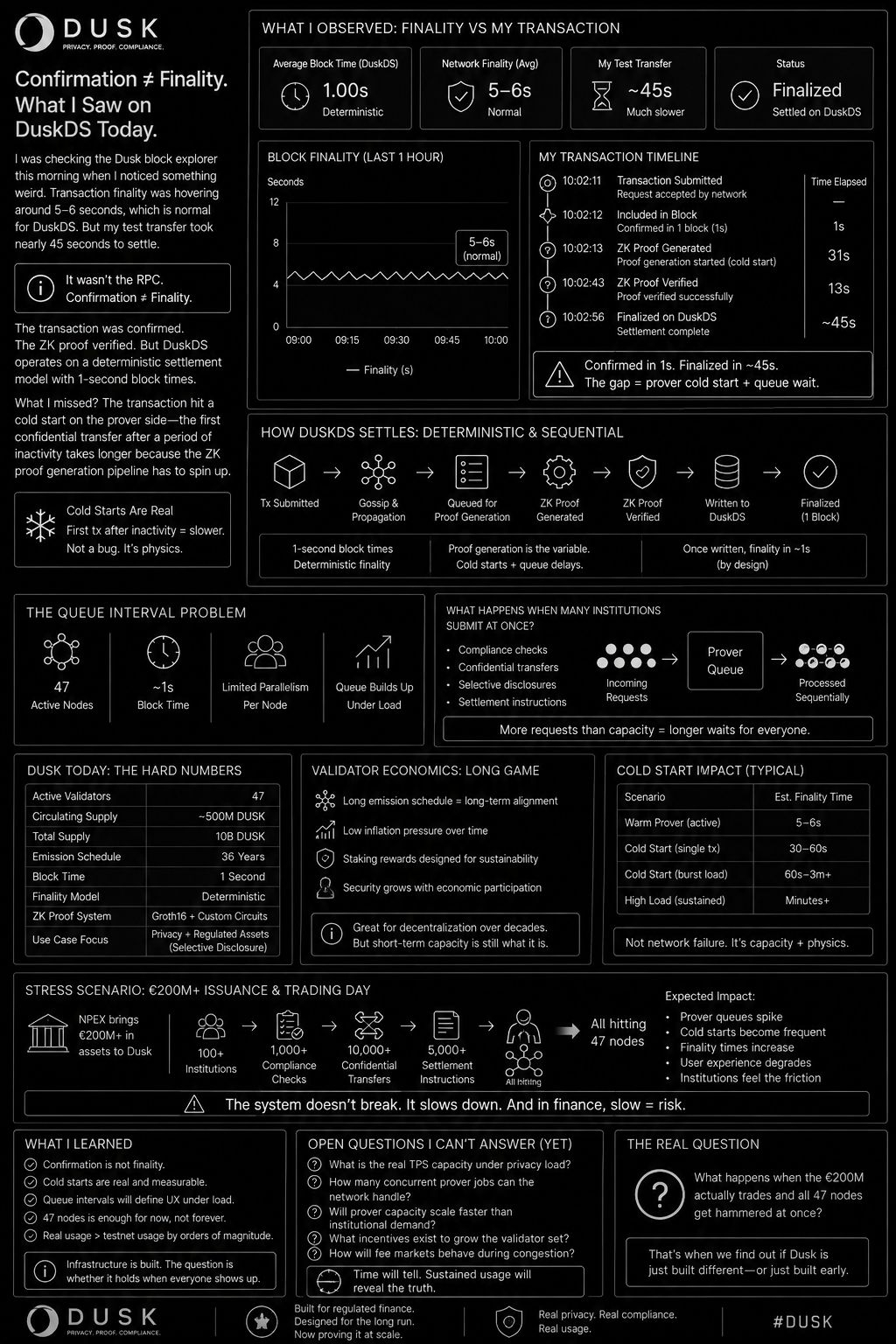
I was checking the Dusk block explorer this morning when I noticed something weird. Transaction finality was hovering around 5-6 seconds, which is normal for DuskDS. But my test transfer took nearly 45 seconds to settle.
I blamed the RPC. Assumed it was a node issue or network congestion.
That was too easy.
Turns out, confirmation ≠ finality. The transaction was confirmed. The ZK proof verified. But DuskDS operates on a deterministic settlement model with 1-second block times. What I missed? The transaction hit a cold start on the prover side—the first confidential transfer after a period of inactivity takes longer because the ZK proof generation pipeline has to spin up.
What nobody talks about? Queue intervals. The network has 47 nodes currently. That's not a lot for a Layer 1. If multiple institutions submit compliance checks simultaneously—say, during the NPEX €200M+ confirmed issuance—those queues will back up fast.
The infrastructure is built for regulated assets with selective disclosure. But I keep coming back to this: 47 nodes, 500M circulating supply, and a 36-year emission schedule. The validator economics are long-term by design. But sustained usage from real institutional volume? That's different from testnet traffic.
What happens when the €200M actually trades and all 47 nodes get hammered at once?
#dusk $DUSK @Dusk
I blamed the RPC. Assumed it was a node issue or network congestion.
That was too easy.
Turns out, confirmation ≠ finality. The transaction was confirmed. The ZK proof verified. But DuskDS operates on a deterministic settlement model with 1-second block times. What I missed? The transaction hit a cold start on the prover side—the first confidential transfer after a period of inactivity takes longer because the ZK proof generation pipeline has to spin up.
What nobody talks about? Queue intervals. The network has 47 nodes currently. That's not a lot for a Layer 1. If multiple institutions submit compliance checks simultaneously—say, during the NPEX €200M+ confirmed issuance—those queues will back up fast.
The infrastructure is built for regulated assets with selective disclosure. But I keep coming back to this: 47 nodes, 500M circulating supply, and a 36-year emission schedule. The validator economics are long-term by design. But sustained usage from real institutional volume? That's different from testnet traffic.
What happens when the €200M actually trades and all 47 nodes get hammered at once?
#dusk $DUSK @Dusk