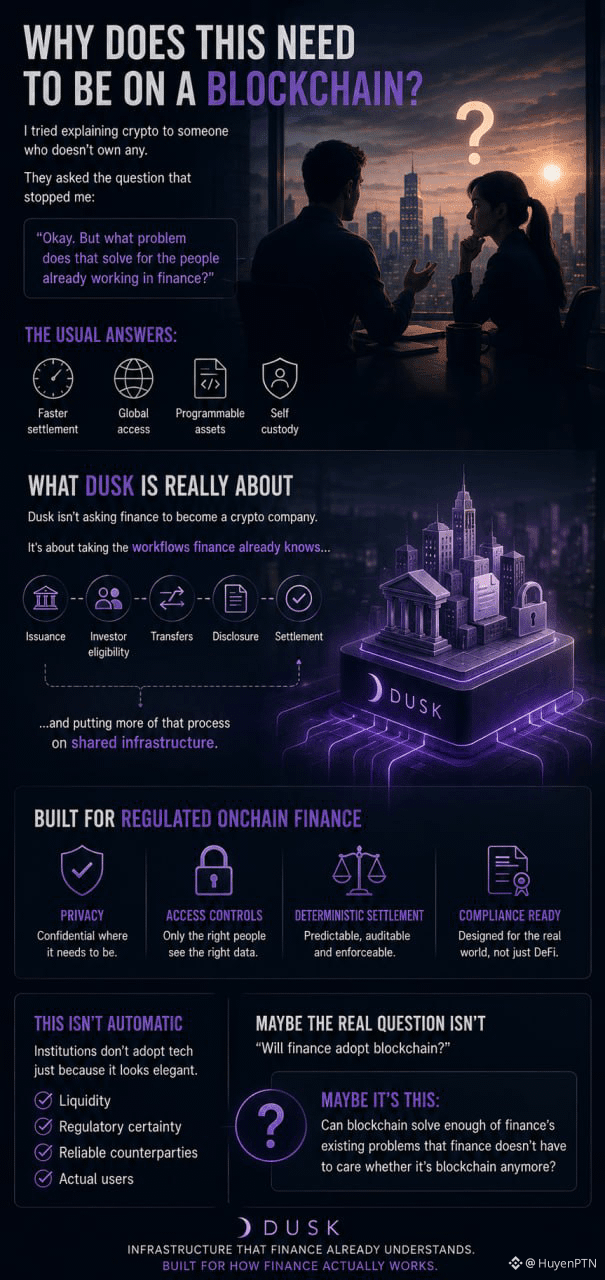
I tried explaining crypto to someone who doesn't own any yesterday.
It went badly.
Not because they disagreed with me.
They just asked:
“Why does any of this need to be on a blockchain?”
I started giving the usual answers.
Faster settlement.
Global access.
Programmable assets.
Self-custody.
They looked at me for a second and said:
“Okay. But what problem does that solve for the people already working in finance?”
I didn't have a good answer.
At least not immediately.
That question actually made me think about Dusk differently.
Dusk isn't really asking a bank to become a crypto company.
The idea is closer to taking the workflows financial institutions already understand — issuance, investor eligibility, transfers, disclosure and settlement — and putting more of that process on shared infrastructure.
That's a much less exciting pitch.
And maybe that's exactly why I like it.
If you have to convince an institution to completely change how it thinks about financial markets before it can use your blockchain, you've already created a huge problem for yourself.
But if the institution can keep thinking about securities, investors and settlement while the blockchain quietly handles part of the infrastructure underneath...
That's different.
Dusk's current positioning is very clearly around regulated onchain finance, with privacy, access controls and deterministic settlement built into the infrastructure rather than added as an afterthought.
I'm still skeptical.
Putting financial workflows on-chain doesn't automatically make them better.
And institutions don't adopt technology just because the architecture looks elegant.
They need liquidity.
Regulatory certainty.
Reliable counterparties.
Actual users.
So maybe the question isn't:
“Will finance adopt blockchain?”
Maybe that's backwards.
Maybe the better question is:
Can blockchain solve enough of finance's existing problems that finance doesn't have to care whether it's blockchain anymore?
That was the question I couldn't answer yesterday.
I'm still thinking about it.
#dusk $DUSK @Dusk
It went badly.
Not because they disagreed with me.
They just asked:
“Why does any of this need to be on a blockchain?”
I started giving the usual answers.
Faster settlement.
Global access.
Programmable assets.
Self-custody.
They looked at me for a second and said:
“Okay. But what problem does that solve for the people already working in finance?”
I didn't have a good answer.
At least not immediately.
That question actually made me think about Dusk differently.
Dusk isn't really asking a bank to become a crypto company.
The idea is closer to taking the workflows financial institutions already understand — issuance, investor eligibility, transfers, disclosure and settlement — and putting more of that process on shared infrastructure.
That's a much less exciting pitch.
And maybe that's exactly why I like it.
If you have to convince an institution to completely change how it thinks about financial markets before it can use your blockchain, you've already created a huge problem for yourself.
But if the institution can keep thinking about securities, investors and settlement while the blockchain quietly handles part of the infrastructure underneath...
That's different.
Dusk's current positioning is very clearly around regulated onchain finance, with privacy, access controls and deterministic settlement built into the infrastructure rather than added as an afterthought.
I'm still skeptical.
Putting financial workflows on-chain doesn't automatically make them better.
And institutions don't adopt technology just because the architecture looks elegant.
They need liquidity.
Regulatory certainty.
Reliable counterparties.
Actual users.
So maybe the question isn't:
“Will finance adopt blockchain?”
Maybe that's backwards.
Maybe the better question is:
Can blockchain solve enough of finance's existing problems that finance doesn't have to care whether it's blockchain anymore?
That was the question I couldn't answer yesterday.
I'm still thinking about it.
#dusk $DUSK @Dusk