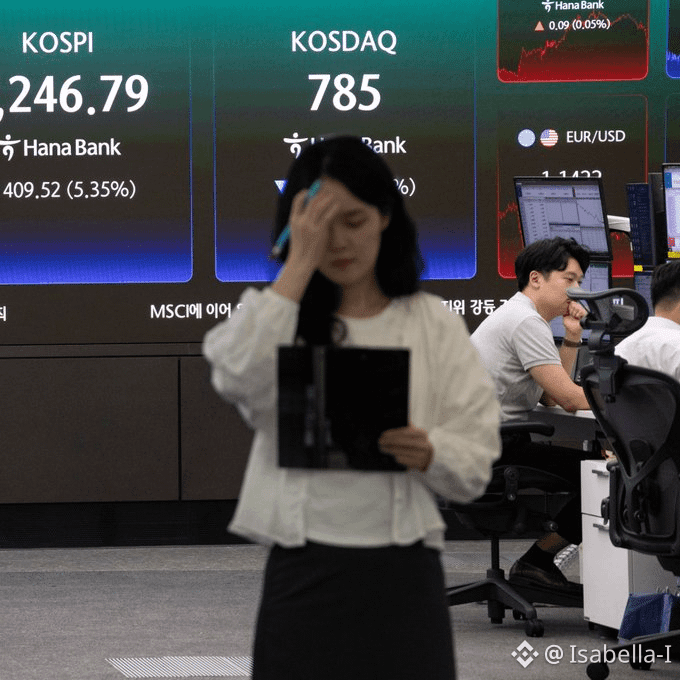
#kospi200nightfuturesfall1.77% The Kospi lost roughly $2.5 trillion in six weeks. Individual investors are 60-70% of daily volume there.
South Korea legalized single-stock leveraged ETFs on May 27. Demand crashed the website for days. By June the index had tripled from 2025 levels. Then it fell about 40%.
The sequence is the story. Rules banning these products existed specifically to stop compounded losses on one name. They got loosened because other major markets — including the US — allow them. Margin balances rose $7.9 billion to $27.1 billion in six months. Samsung and SK Hynix grew to more than half the entire exchange’s value.
So a national market became a leveraged bet on two memory stocks, and retail supplied most of the volume.
Americans got a door in too. Roundhill’s DRAM ETF launched around the same time, with Samsung and SK Hynix at nearly half the fund — the most successful ETF launch in US history by new money, sold through social media rather than advisers.
And Situational Awareness held a large position in Korea-listed SK Hynix before losing 67% in July and liquidating to repay lenders.
Regulators have now tripled the cash deposit required to trade these products to roughly $21,000 and paused approval of new ones. After.
💰
YOUR MOVE: If you own $DRAM
, know it’s concentrated in two Korean names whose home market runs on retail leverage — check the top holdings and the volatility, not the theme. The broader lesson is transferable: single-stock leveraged ETFs are legal and growing in the US, on the same names AI money crowds into. The Kospi 200 volatility index at 56.76 is down from 86.18 on July 30, so the rebound is real. So is the mechanism that caused the fall.$GRVT $VELVET
South Korea legalized single-stock leveraged ETFs on May 27. Demand crashed the website for days. By June the index had tripled from 2025 levels. Then it fell about 40%.
The sequence is the story. Rules banning these products existed specifically to stop compounded losses on one name. They got loosened because other major markets — including the US — allow them. Margin balances rose $7.9 billion to $27.1 billion in six months. Samsung and SK Hynix grew to more than half the entire exchange’s value.
So a national market became a leveraged bet on two memory stocks, and retail supplied most of the volume.
Americans got a door in too. Roundhill’s DRAM ETF launched around the same time, with Samsung and SK Hynix at nearly half the fund — the most successful ETF launch in US history by new money, sold through social media rather than advisers.
And Situational Awareness held a large position in Korea-listed SK Hynix before losing 67% in July and liquidating to repay lenders.
Regulators have now tripled the cash deposit required to trade these products to roughly $21,000 and paused approval of new ones. After.
💰
YOUR MOVE: If you own $DRAM
, know it’s concentrated in two Korean names whose home market runs on retail leverage — check the top holdings and the volatility, not the theme. The broader lesson is transferable: single-stock leveraged ETFs are legal and growing in the US, on the same names AI money crowds into. The Kospi 200 volatility index at 56.76 is down from 86.18 on July 30, so the rebound is real. So is the mechanism that caused the fall.$GRVT $VELVET