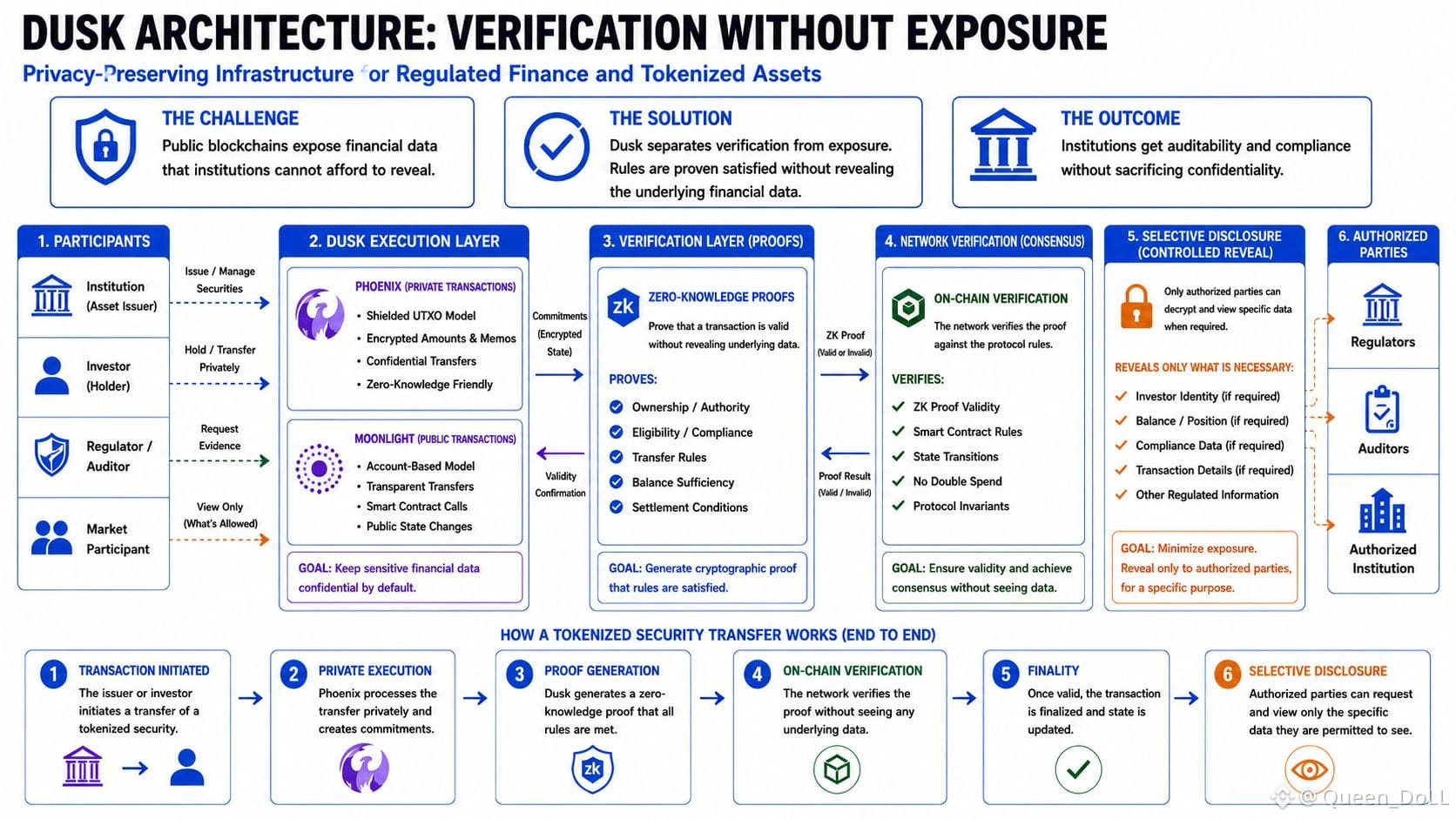
Here’s the uncomfortable part about putting serious financial markets on public blockchains: the transparency that makes a ledger trustworthy can also make it unusable for institutions.
The more I dug into @Dusk , the more I realised this isn’t really a “privacy coin” problem.
It’s a market-structure problem.
Imagine an institution holding a large position in a tokenized security.
The network needs to verify ownership, eligibility, settlement and compliance.
But why should every wallet, trader and analytics dashboard also see that institution’s entire financial footprint?
They shouldn’t.
That’s where Dusk gets interesting.
Phoenix uses a UTXO-based privacy model with commitments and zero-knowledge proofs, allowing transaction validity to be established without exposing the underlying financial state.
Then there’s Zedger, built around security-token workflows where privacy and enforceable financial rules have to coexist.
And that creates a much more interesting question:
Can you prove that the rules were followed without revealing everything behind the proof?
That’s the core idea I see emerging here.
A regulator may need evidence.
An issuer may need compliance data.
A random market participant doesn’t necessarily need either.
So instead of:
Everything public
or
Everything private
Dusk is exploring something in between:
Verifiable privacy.
There’s still a trade-off.
Too much privacy can complicate auditing.
Too much transparency can expose institutional positions and strategies.
If XSC, Phoenix and the surrounding architecture can translate into real securities and RWA settlement, then privacy stops being just a blockchain feature.
It becomes part of the financial infrastructure itself.
That’s the part of Dusk I’m watching. 🔐
#dusk $PROM $ONG $DUSK @Dusk
#CryptoResearch #RWA
#BitcoinRises23.6%Weekly #BitcoinOpenInterestFallsToTwoMonthLow
The more I dug into @Dusk , the more I realised this isn’t really a “privacy coin” problem.
It’s a market-structure problem.
Imagine an institution holding a large position in a tokenized security.
The network needs to verify ownership, eligibility, settlement and compliance.
But why should every wallet, trader and analytics dashboard also see that institution’s entire financial footprint?
They shouldn’t.
That’s where Dusk gets interesting.
Phoenix uses a UTXO-based privacy model with commitments and zero-knowledge proofs, allowing transaction validity to be established without exposing the underlying financial state.
Then there’s Zedger, built around security-token workflows where privacy and enforceable financial rules have to coexist.
And that creates a much more interesting question:
Can you prove that the rules were followed without revealing everything behind the proof?
That’s the core idea I see emerging here.
A regulator may need evidence.
An issuer may need compliance data.
A random market participant doesn’t necessarily need either.
So instead of:
Everything public
or
Everything private
Dusk is exploring something in between:
Verifiable privacy.
There’s still a trade-off.
Too much privacy can complicate auditing.
Too much transparency can expose institutional positions and strategies.
If XSC, Phoenix and the surrounding architecture can translate into real securities and RWA settlement, then privacy stops being just a blockchain feature.
It becomes part of the financial infrastructure itself.
That’s the part of Dusk I’m watching. 🔐
#dusk $PROM $ONG $DUSK @Dusk
#CryptoResearch #RWA
#BitcoinRises23.6%Weekly #BitcoinOpenInterestFallsToTwoMonthLow