#dusk $DUSK @Dusk
I was reading through Dusk’s approach to security tokenization and one detail kept pulling my attention. Most blockchain transfers feel instant from the outside. Assets move, balances change, and the transaction is considered finished. But regulated assets do not always work that way.
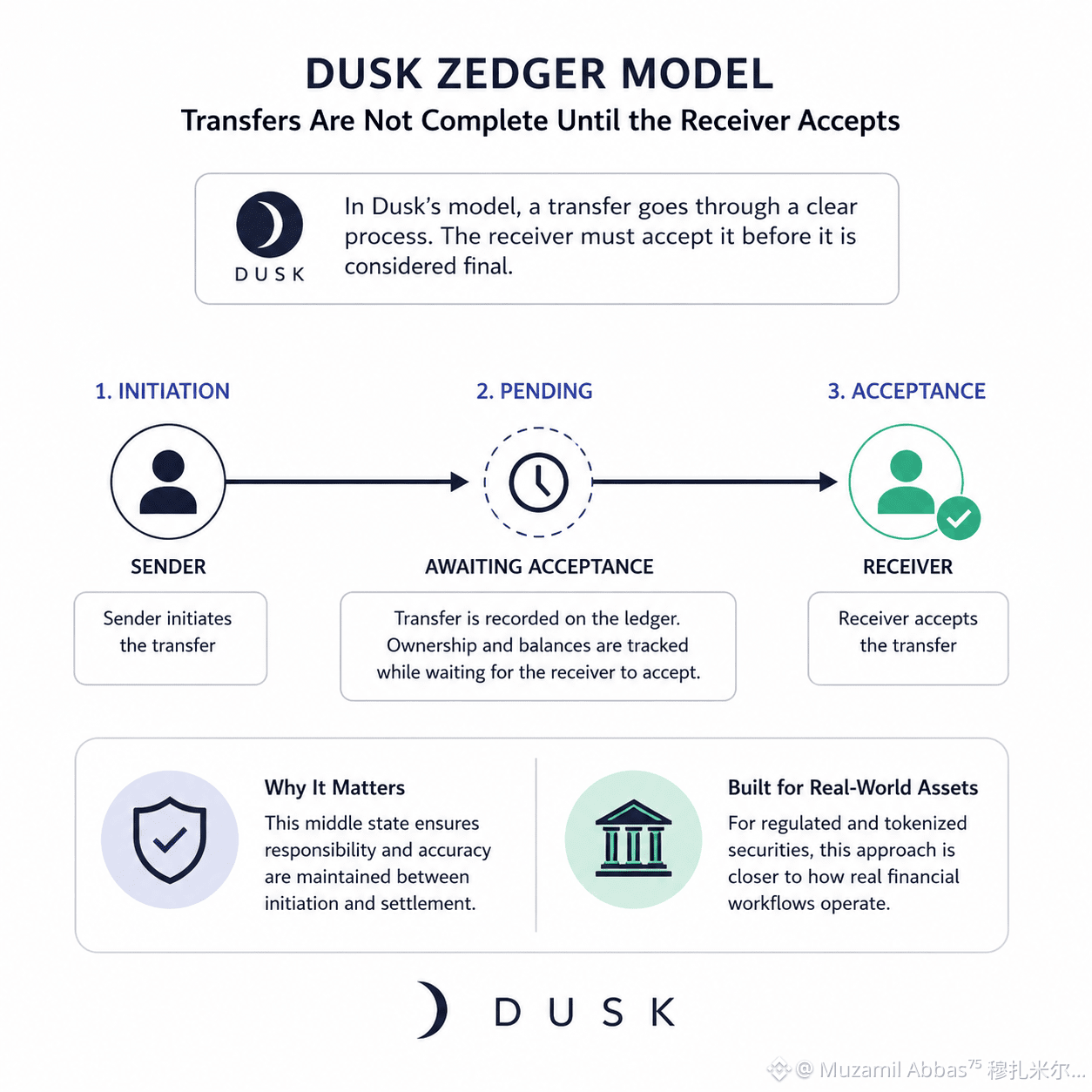
In Dusk’s Zedger model, a transfer is not automatically complete the moment it is sent. The receiver must explicitly accept it first. Until that happens, the transferred amount still needs to be accounted for correctly. That sounds like a small design choice, but it solves a surprisingly difficult problem.
I started thinking about situations where one side of a transaction is ready before the other. Maybe the sender has already initiated the transfer, but the receiver has not approved it yet. Traditional crypto systems usually focus on moving value as fast as possible. Dusk seems more focused on tracking responsibility during the period between initiation and settlement.
What I find interesting is that this middle state is treated as part of the process rather than an exception. The system keeps track of ownership and balances while waiting for the final approval step.
For tokenized securities and regulated assets, that feels much closer to how real financial workflows actually operate. The question is whether more blockchain systems will eventually need similar settlement logic as tokenization grows.
I was reading through Dusk’s approach to security tokenization and one detail kept pulling my attention. Most blockchain transfers feel instant from the outside. Assets move, balances change, and the transaction is considered finished. But regulated assets do not always work that way.
In Dusk’s Zedger model, a transfer is not automatically complete the moment it is sent. The receiver must explicitly accept it first. Until that happens, the transferred amount still needs to be accounted for correctly. That sounds like a small design choice, but it solves a surprisingly difficult problem.
I started thinking about situations where one side of a transaction is ready before the other. Maybe the sender has already initiated the transfer, but the receiver has not approved it yet. Traditional crypto systems usually focus on moving value as fast as possible. Dusk seems more focused on tracking responsibility during the period between initiation and settlement.
What I find interesting is that this middle state is treated as part of the process rather than an exception. The system keeps track of ownership and balances while waiting for the final approval step.
For tokenized securities and regulated assets, that feels much closer to how real financial workflows actually operate. The question is whether more blockchain systems will eventually need similar settlement logic as tokenization grows.