Last week I was wondering what an institution is supposed to do when compliance requires transparency, but its customers never agreed to make their entire financial life public.
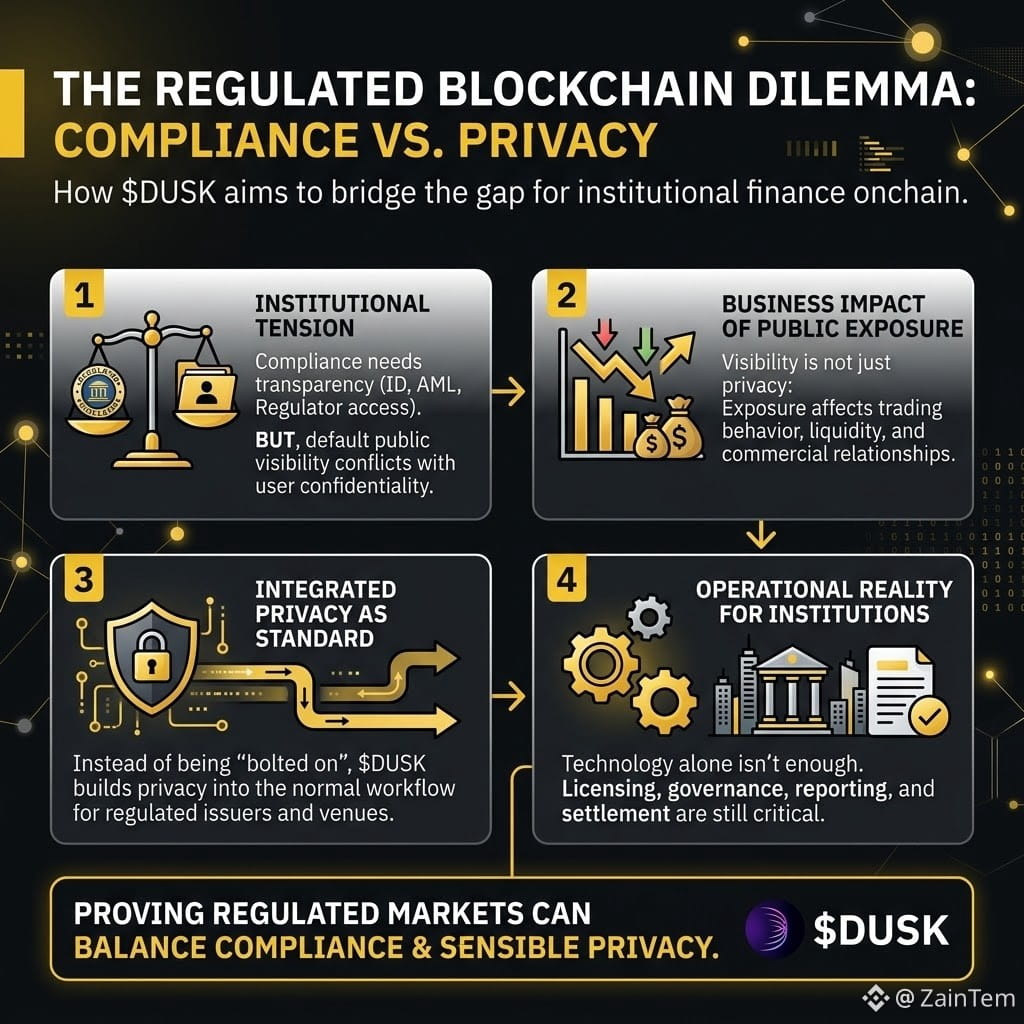
That tension gets harder once regulated assets move onchain. A lender may need to verify identity. A venue may need AML controls. A regulator may need access to records. None of that means every trader should be able to inspect someone’s portfolio, counterparties, or transaction history.
Yet many blockchain systems treat public visibility as the default and privacy as something to bolt on later. That can work for certain markets, but it feels awkward for regulated finance. The problem isn’t only privacy. Public exposure can affect trading behavior, liquidity, commercial relationships and even how institutions manage risk.
This is why I find Dusk interesting from an infrastructure perspective. The question I care about is whether $DUSK can support financial activity where compliance remains verifiable while sensitive information is not unnecessarily exposed.
I’m deliberately cautious here. Better cryptography doesn’t automatically create regulatory certainty. Institutions still need licensing, governance, reporting processes and reliable settlement. If using private infrastructure makes those processes harder or more expensive, the theoretical advantage may not survive contact with real operations.
But if Dusk can make privacy part of the normal workflow rather than a special exception, I can see a genuine use case for regulated issuers, venues and financial institutions.
For me, DUSK is worth watching for one reason: #dusk could prove that regulated markets don’t have to choose between compliance and sensible privacy.
@Dusk
That tension gets harder once regulated assets move onchain. A lender may need to verify identity. A venue may need AML controls. A regulator may need access to records. None of that means every trader should be able to inspect someone’s portfolio, counterparties, or transaction history.
Yet many blockchain systems treat public visibility as the default and privacy as something to bolt on later. That can work for certain markets, but it feels awkward for regulated finance. The problem isn’t only privacy. Public exposure can affect trading behavior, liquidity, commercial relationships and even how institutions manage risk.
This is why I find Dusk interesting from an infrastructure perspective. The question I care about is whether $DUSK can support financial activity where compliance remains verifiable while sensitive information is not unnecessarily exposed.
I’m deliberately cautious here. Better cryptography doesn’t automatically create regulatory certainty. Institutions still need licensing, governance, reporting processes and reliable settlement. If using private infrastructure makes those processes harder or more expensive, the theoretical advantage may not survive contact with real operations.
But if Dusk can make privacy part of the normal workflow rather than a special exception, I can see a genuine use case for regulated issuers, venues and financial institutions.
For me, DUSK is worth watching for one reason: #dusk could prove that regulated markets don’t have to choose between compliance and sensible privacy.
@Dusk