Everyone’s join this compgin @Dusk

نشر


--

Baby_Crypto
·
--
I kept thinking about how easy it is to confuse “using a privacy-focused chain” with actually having a private transaction.
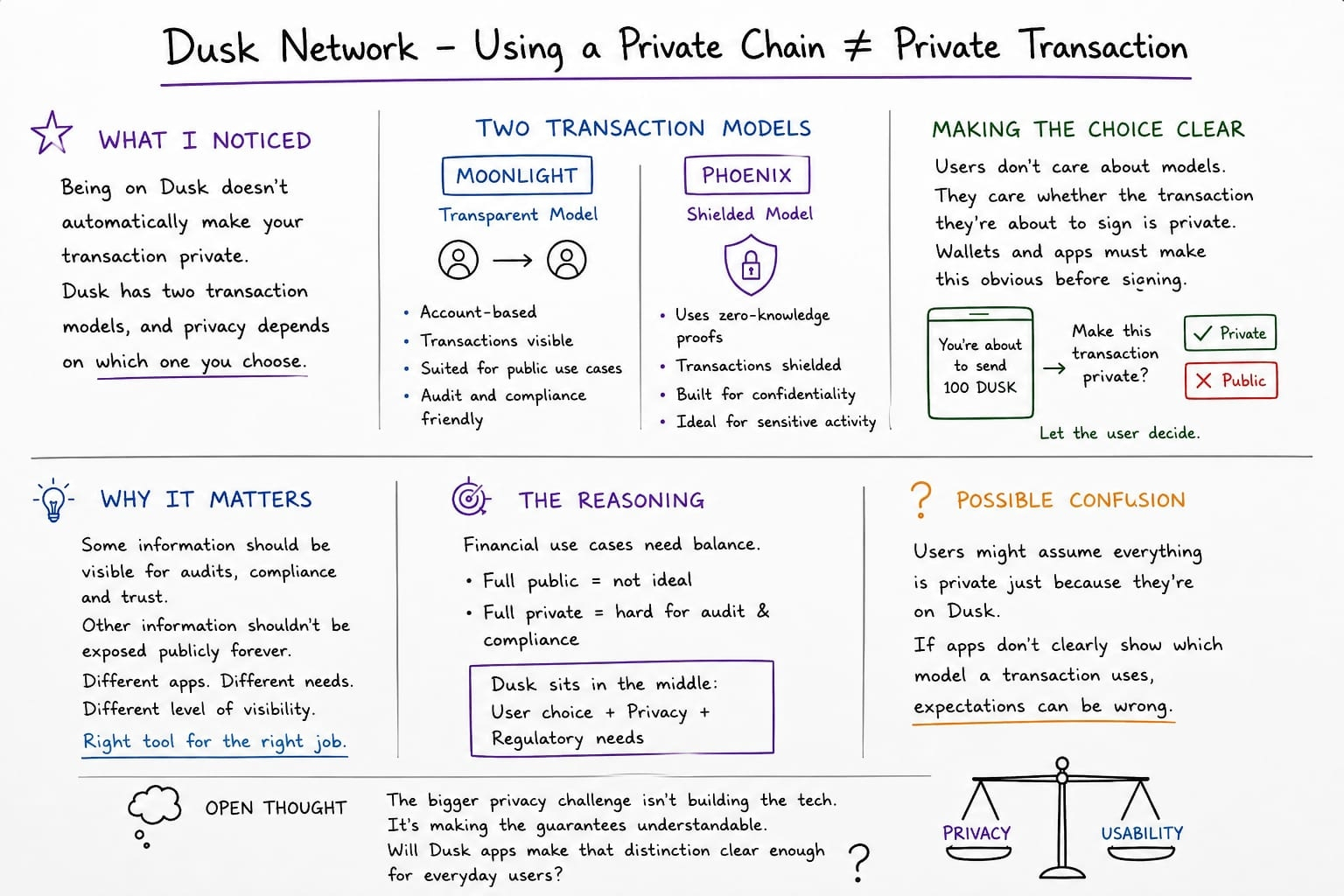
The more I looked into Dusk, the less obvious that assumption became. Dusk separates transactions into Moonlight, where activity is transparent, and Phoenix, which uses zero-knowledge proofs for shielded transactions. So privacy isn’t simply switched on by being on the network.
That distinction actually feels important for financial apps. Some information may need to remain visible for audits or compliance, while other details probably shouldn’t be exposed publicly forever.
But it also creates a UX problem. Most users won’t care which transaction model sits underneath. They’ll care whether the transaction they’re about to sign is private.
That makes wallets and Dusk apps part of the privacy design too. If they make that choice obvious before signing, the model could feel natural. If not, users may assume protection they never actually had.
Maybe the bigger privacy challenge is making the guarantees understandable.
Will Dusk apps make that distinction clear enough for everyday users?
#dusk @Dusk $DUSK
The more I looked into Dusk, the less obvious that assumption became. Dusk separates transactions into Moonlight, where activity is transparent, and Phoenix, which uses zero-knowledge proofs for shielded transactions. So privacy isn’t simply switched on by being on the network.
That distinction actually feels important for financial apps. Some information may need to remain visible for audits or compliance, while other details probably shouldn’t be exposed publicly forever.
But it also creates a UX problem. Most users won’t care which transaction model sits underneath. They’ll care whether the transaction they’re about to sign is private.
That makes wallets and Dusk apps part of the privacy design too. If they make that choice obvious before signing, the model could feel natural. If not, users may assume protection they never actually had.
Maybe the bigger privacy challenge is making the guarantees understandable.
Will Dusk apps make that distinction clear enough for everyday users?
#dusk @Dusk $DUSK
إخلاء مسؤولية: يتضمن آراء جهات خارجية. لا تُعدّ نصيحة. يُمكن استخدام Binance AI دون أي ضمان. اطلع على الشروط والأحكام.