@Dusk #dusk $DUSK
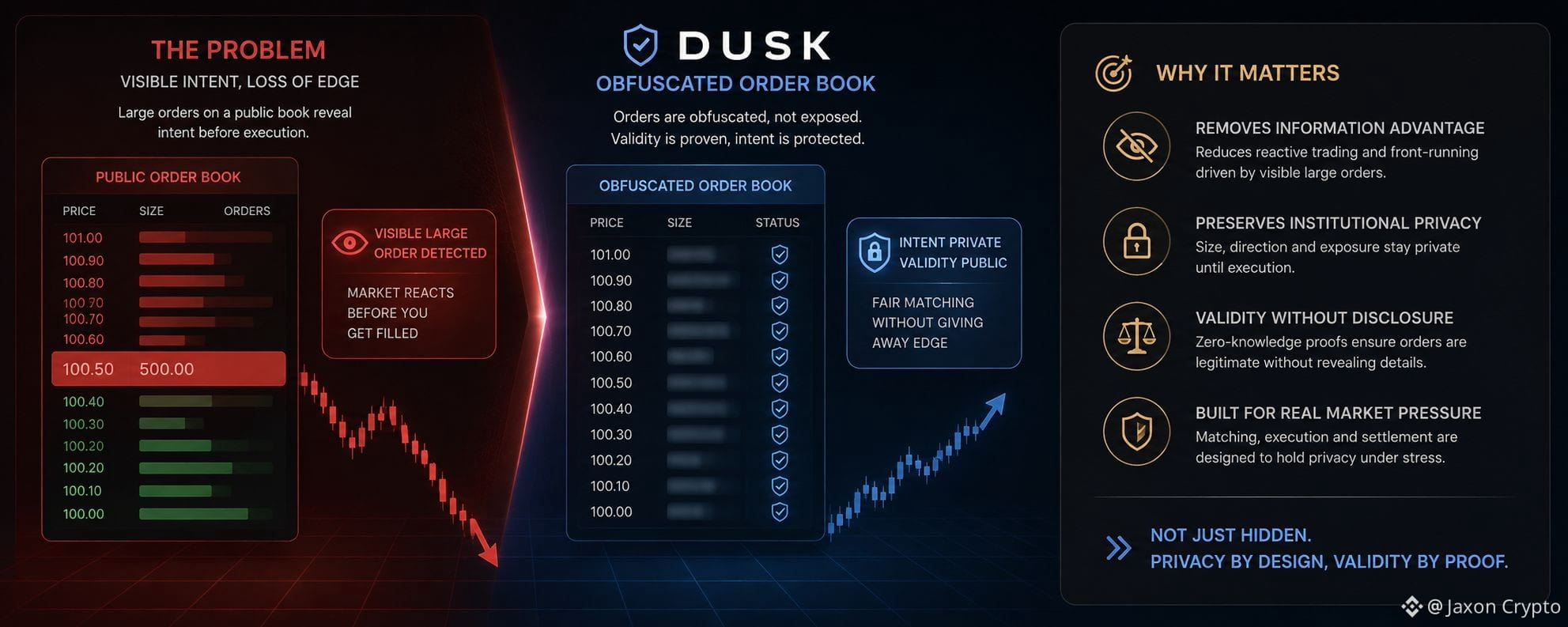
I keep coming back to a simple problem with traditional order books: the moment a large order becomes visible, the market can start reacting to your intent before you ever get filled.
A friend of mine who worked as a junior trader at a hedge fund once told me how frustrating that could be. He’d hesitate before placing size because showing too much direction or depth often meant other players could react first. The order wasn’t even executed yet, but the market had already started trading against the information it revealed.
That’s what made @Dusk ’s obfuscated order book design interesting to me.
Instead of hiding institutional intent with workarounds like iceberg orders or dark pools, the idea is to keep the order itself obfuscated while still enforcing validity underneath. Size, direction and exposure aren’t openly broadcast, but the system can still verify that the trade is legitimate.
And maybe that’s the more important distinction.
The problem with public order books isn’t simply that everyone can see them. It’s that visibility can become information, and information can become an advantage for whoever reacts fastest.
So I’m wondering: if the intent stays private until execution, are we actually removing that source of manipulation rather than just moving it somewhere else?
Because once real institutional size enters the system, the real test won’t be whether privacy looks good on paper.
It’ll be whether matching, execution and settlement can preserve that privacy under actual market pressure.
$DUSK
I keep coming back to a simple problem with traditional order books: the moment a large order becomes visible, the market can start reacting to your intent before you ever get filled.
A friend of mine who worked as a junior trader at a hedge fund once told me how frustrating that could be. He’d hesitate before placing size because showing too much direction or depth often meant other players could react first. The order wasn’t even executed yet, but the market had already started trading against the information it revealed.
That’s what made @Dusk ’s obfuscated order book design interesting to me.
Instead of hiding institutional intent with workarounds like iceberg orders or dark pools, the idea is to keep the order itself obfuscated while still enforcing validity underneath. Size, direction and exposure aren’t openly broadcast, but the system can still verify that the trade is legitimate.
And maybe that’s the more important distinction.
The problem with public order books isn’t simply that everyone can see them. It’s that visibility can become information, and information can become an advantage for whoever reacts fastest.
So I’m wondering: if the intent stays private until execution, are we actually removing that source of manipulation rather than just moving it somewhere else?
Because once real institutional size enters the system, the real test won’t be whether privacy looks good on paper.
It’ll be whether matching, execution and settlement can preserve that privacy under actual market pressure.
$DUSK