#dusk $DUSK @Dusk
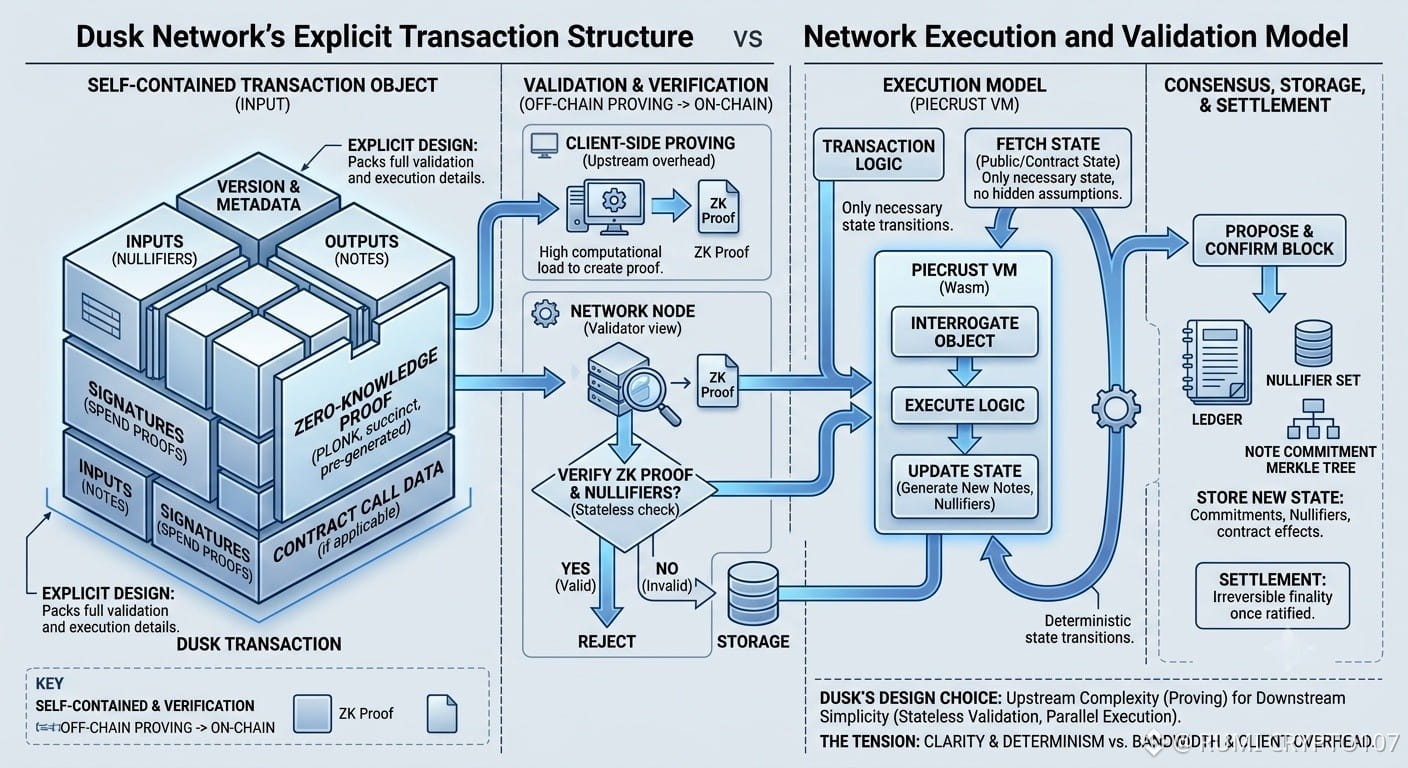
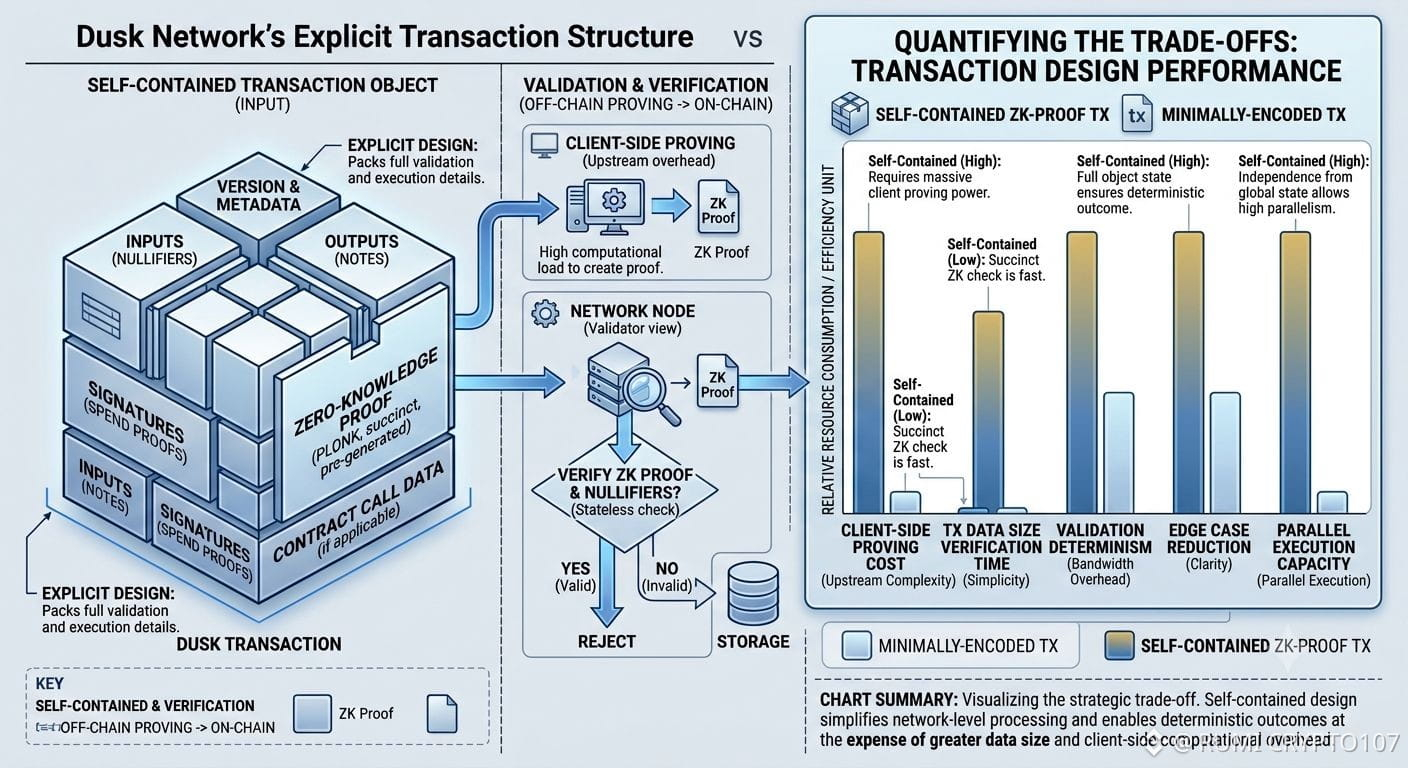
I keep circling back to how much of any blockchain’s real behavior is locked in by the shape of its transactions. In Dusk a transaction is never just a simple instruction to move value. The format itself packs the full set of details the network needs for both validation and execution—inputs, outputs, signatures, and all the accompanying metadata. That design choice feels deeper than pure implementation detail.
When the structure is this explicit, the network receives a complete, self-contained object it can interrogate before anything else happens. The rules become easier to follow because the transaction already carries every piece the protocol requires to process it. You no longer have to hunt through scattered assumptions; the object itself declares what must be checked.
The trade-off is real. Every field exists for a reason, and every extra slice of transaction state becomes something the entire network has to validate, store, and maintain over time. Surface area grows. Versioning gets harder. Edge cases multiply.
So the open question remains: does this more explicit transaction structure genuinely make Dusk’s execution model easier to reason about, or does the act of carrying so much protocol state inside every transaction simply introduce unnecessary complexity? The answer sits somewhere in the tension between clarity and overhead.
I keep circling back to how much of any blockchain’s real behavior is locked in by the shape of its transactions. In Dusk a transaction is never just a simple instruction to move value. The format itself packs the full set of details the network needs for both validation and execution—inputs, outputs, signatures, and all the accompanying metadata. That design choice feels deeper than pure implementation detail.
When the structure is this explicit, the network receives a complete, self-contained object it can interrogate before anything else happens. The rules become easier to follow because the transaction already carries every piece the protocol requires to process it. You no longer have to hunt through scattered assumptions; the object itself declares what must be checked.
The trade-off is real. Every field exists for a reason, and every extra slice of transaction state becomes something the entire network has to validate, store, and maintain over time. Surface area grows. Versioning gets harder. Edge cases multiply.
So the open question remains: does this more explicit transaction structure genuinely make Dusk’s execution model easier to reason about, or does the act of carrying so much protocol state inside every transaction simply introduce unnecessary complexity? The answer sits somewhere in the tension between clarity and overhead.