#dusk $DUSK @Dusk
I remember thinking “compliant by design” meant most of the important controls would eventually live inside the protocol.
Then I looked closer at how Dusk handled the bridge situation.
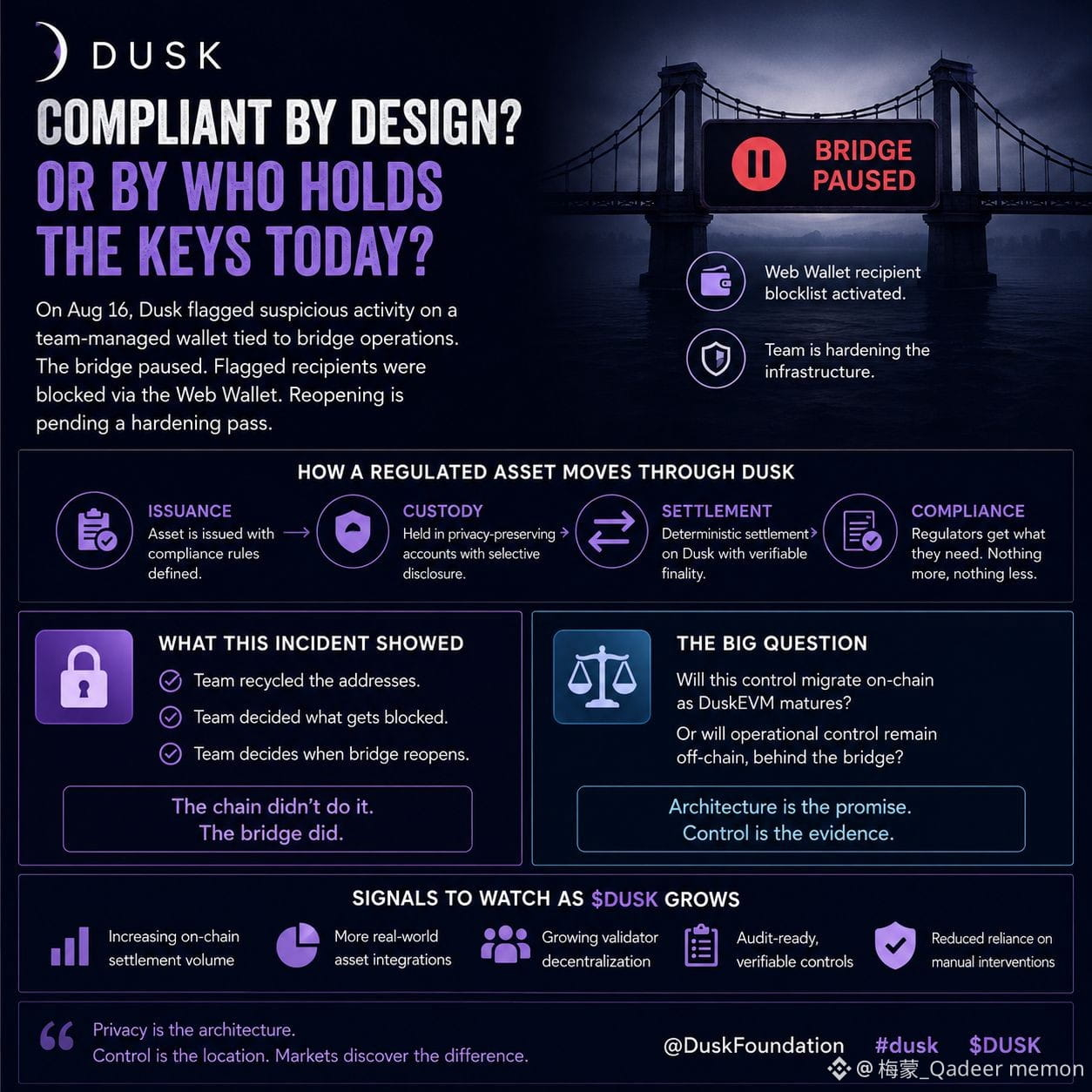
The interesting part wasn’t the suspicious activity itself. It was the response: operations paused, flagged destinations could be blocked through the wallet layer, and reopening depended on a hardening process.
That made me pause.
Because there are really two different kinds of infrastructure here.
Protocol rules decide what the network can enforce.
Operational controls decide what people can stop when reality gets messy.
For regulated assets, both may matter. A system can offer privacy and selective disclosure at the settlement layer while still relying on teams to manage bridges, wallets, and emergency decisions.
The real question is what happens over time.
Does operational control gradually move into transparent, deterministic rules?
Or does the human-controlled layer remain the real safety switch?
As $DUSK develops, that's what I'd watch: more on-chain enforcement, repeat settlement activity, and whether critical infrastructure becomes less dependent on manual intervention.
Privacy is an architecture.
Control is a location.
And markets eventually discover where that location really is.
@Dusk #dusk $DUSK
I remember thinking “compliant by design” meant most of the important controls would eventually live inside the protocol.
Then I looked closer at how Dusk handled the bridge situation.
The interesting part wasn’t the suspicious activity itself. It was the response: operations paused, flagged destinations could be blocked through the wallet layer, and reopening depended on a hardening process.
That made me pause.
Because there are really two different kinds of infrastructure here.
Protocol rules decide what the network can enforce.
Operational controls decide what people can stop when reality gets messy.
For regulated assets, both may matter. A system can offer privacy and selective disclosure at the settlement layer while still relying on teams to manage bridges, wallets, and emergency decisions.
The real question is what happens over time.
Does operational control gradually move into transparent, deterministic rules?
Or does the human-controlled layer remain the real safety switch?
As $DUSK develops, that's what I'd watch: more on-chain enforcement, repeat settlement activity, and whether critical infrastructure becomes less dependent on manual intervention.
Privacy is an architecture.
Control is a location.
And markets eventually discover where that location really is.
@Dusk #dusk $DUSK