
#dusk $DUSK @Dusk
One part of regulated tokenization gets surprisingly little attention: who prepares an asset for listing after the code is finished?
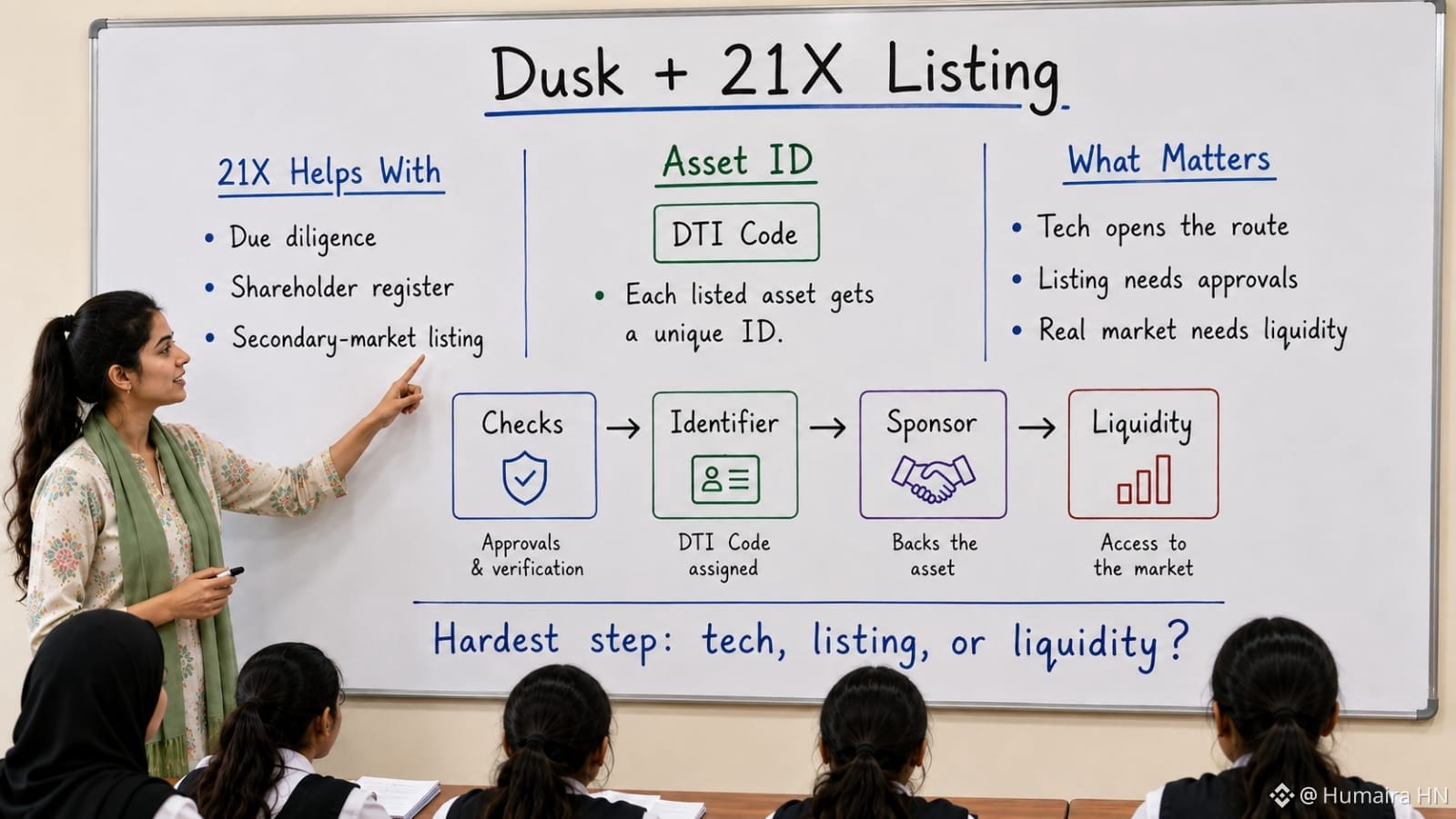
21X’s issuer services include due diligence, shareholder register management and secondary market listing. It also works with accredited listing sponsors and market makers that can support order-book depth.
Then there is identification. In April 2025, 21X adopted the ISO 24165 Digital Token Identifier standard. A listed digital asset can receive a unique nine character code, giving trading systems and regulators a consistent way to identify it. On 21X, that includes tokenized financial instruments on the asset side and stablecoins on the cash side.
For Dusk, the useful question is whether a Dusk-linked issuer can complete this entire listing chain. Network compatibility may open the technical route, but due diligence, identification, sponsorship and liquidity help determine whether an instrument can reach an active market.
This is the evidence I would watch for: a Dusk-based security receiving its identifier, passing admission checks, securing a sponsor and receiving live quotes from a market maker.
Which step is hardest for a tokenized security the technology, the listing process or finding real liquidity?
$TUT $SPK
One part of regulated tokenization gets surprisingly little attention: who prepares an asset for listing after the code is finished?
21X’s issuer services include due diligence, shareholder register management and secondary market listing. It also works with accredited listing sponsors and market makers that can support order-book depth.
Then there is identification. In April 2025, 21X adopted the ISO 24165 Digital Token Identifier standard. A listed digital asset can receive a unique nine character code, giving trading systems and regulators a consistent way to identify it. On 21X, that includes tokenized financial instruments on the asset side and stablecoins on the cash side.
For Dusk, the useful question is whether a Dusk-linked issuer can complete this entire listing chain. Network compatibility may open the technical route, but due diligence, identification, sponsorship and liquidity help determine whether an instrument can reach an active market.
This is the evidence I would watch for: a Dusk-based security receiving its identifier, passing admission checks, securing a sponsor and receiving live quotes from a market maker.
Which step is hardest for a tokenized security the technology, the listing process or finding real liquidity?
$TUT $SPK