
A wallet address can show who owns a token.
But for a financial security ownership is only the starting point.
The harder question is what happens when something changes around that asset.
An issuer may need to execute a corporate action. An asset may need to be created or removed. A transfer could require specific controls. Authorized participants may also need a reliable way to verify the asset’s history.
This is where Zedger gets interesting to me.
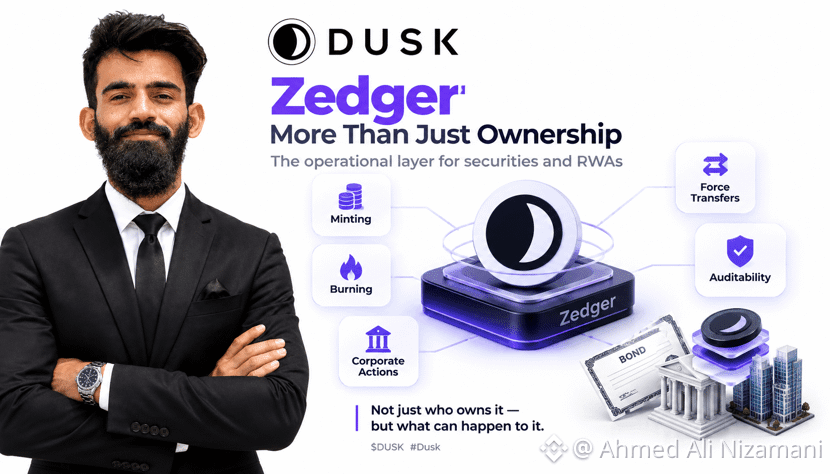
Dusk describes Zedger as infrastructure for securities and RWAs, with capabilities including minting, burning, corporate actions, force transfers and auditability.
To me those functions point to a broader idea
A financial asset needs more than a balance. It needs operational rules.
That distinction matters for RWAs.
Simply representing a bond fund or other financial instrument as a token doesn’t automatically recreate the processes surrounding the real-world asset.
Zedger is designed around this missing layer, providing mechanisms for actions that can occur throughout an asset’s lifecycle.
So instead of asking only
“Who owns it?”
We can also ask
“What can happen to it, who can trigger it and how can that activity be verified?”
That’s the part of @Dusk I find compelling.
$DUSK #Dusk
But for a financial security ownership is only the starting point.
The harder question is what happens when something changes around that asset.
An issuer may need to execute a corporate action. An asset may need to be created or removed. A transfer could require specific controls. Authorized participants may also need a reliable way to verify the asset’s history.
This is where Zedger gets interesting to me.
Dusk describes Zedger as infrastructure for securities and RWAs, with capabilities including minting, burning, corporate actions, force transfers and auditability.
To me those functions point to a broader idea
A financial asset needs more than a balance. It needs operational rules.
That distinction matters for RWAs.
Simply representing a bond fund or other financial instrument as a token doesn’t automatically recreate the processes surrounding the real-world asset.
Zedger is designed around this missing layer, providing mechanisms for actions that can occur throughout an asset’s lifecycle.
So instead of asking only
“Who owns it?”
We can also ask
“What can happen to it, who can trigger it and how can that activity be verified?”
That’s the part of @Dusk I find compelling.
$DUSK #Dusk