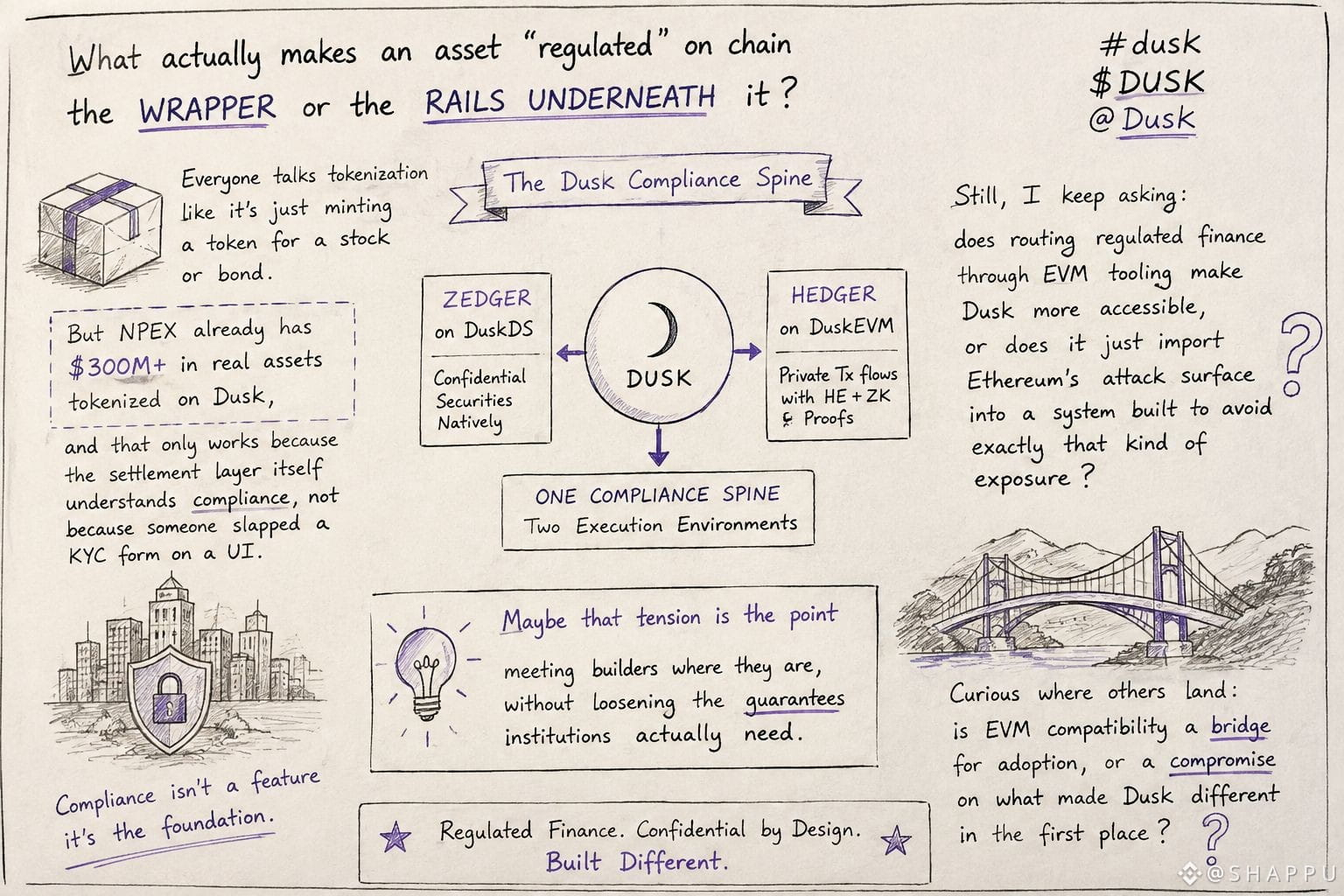
#dusk $DUSK @Dusk Today I sat with a simple question: what actually makes an asset "regulated" on chain the wrapper, or the rails underneath it? Everyone talks tokenization like it's just minting a token for a stock or bond. But NPEX already has $300M+ in real assets tokenized on Dusk, and that only works because the settlement layer itself understands compliance, not because someone slapped a KYC form on a UI.
That's where Zedger and Hedger click for me. Zedger runs natively on DuskDS for confidential securities. Hedger extends that same logic to DuskEVM, letting Solidity developers execute private transaction flows with homomorphic encryption and ZK proofs without rebuilding compliance logic from scratch. Two execution environments, one compliance spine.
Still, I keep asking: does routing regulated finance through EVM tooling make Dusk more accessible, or does it just import Ethereum's attack surface into a system built to avoid exactly that kind of exposure?
Maybe that tension is the point meeting builders where they are, without loosening the guarantees institutions actually need. Curious where others land: is EVM compatibility a bridge for adoption, or a compromise on what made Dusk different in the first place?
$STORJ $MarsCoin
That's where Zedger and Hedger click for me. Zedger runs natively on DuskDS for confidential securities. Hedger extends that same logic to DuskEVM, letting Solidity developers execute private transaction flows with homomorphic encryption and ZK proofs without rebuilding compliance logic from scratch. Two execution environments, one compliance spine.
Still, I keep asking: does routing regulated finance through EVM tooling make Dusk more accessible, or does it just import Ethereum's attack surface into a system built to avoid exactly that kind of exposure?
Maybe that tension is the point meeting builders where they are, without loosening the guarantees institutions actually need. Curious where others land: is EVM compatibility a bridge for adoption, or a compromise on what made Dusk different in the first place?
$STORJ $MarsCoin