
#dusk $DUSK @Dusk
I went deeper into Dusk’s recent activity, and the part that stayed with me wasn’t the cryptography.
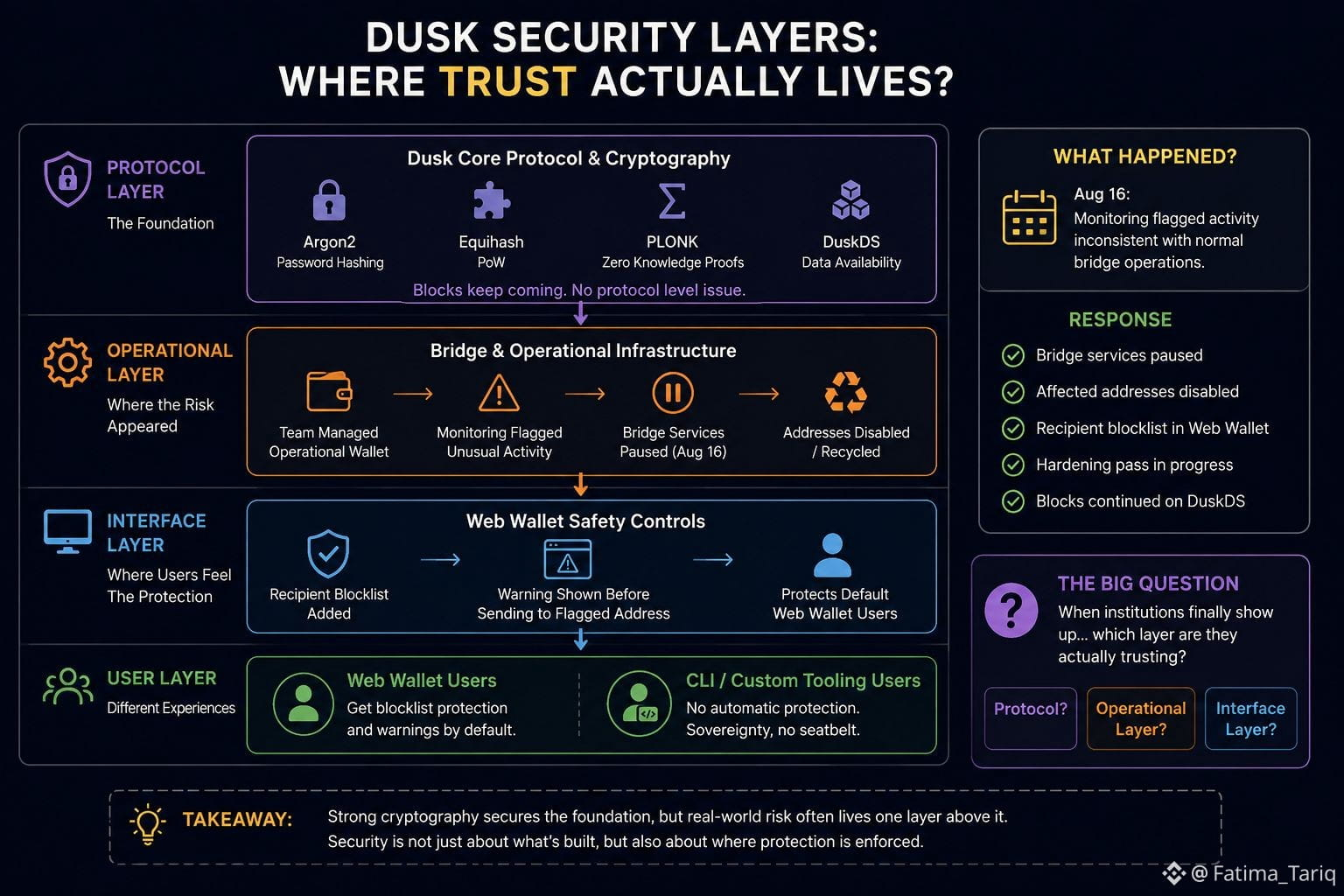
Argon2, Equihash, PLONK, and the work around privacy-focused infrastructure are interesting. But the recent bridge incident showed a very different kind of risk.
On Aug 16, monitoring flagged activity that didn’t match normal bridge operations.
The response was straightforward:
• Bridge services were paused
• The affected operational addresses were disabled/recycled
• A recipient blocklist was added to the Web Wallet
• Hardening work continued before reopening
And DuskDS blocks kept coming the whole time.
That creates an interesting contrast.
The system can have serious cryptography underneath, yet the risk users actually face may still sit around the operational layer.
The blocklist protects the default Web Wallet experience, but users running their own tooling don’t automatically inherit that safety net.
That’s where I think the bigger question is:
When institutions evaluate Dusk, are they trusting the protocol, the operational layer, or the interface sitting between the two?
Because strong cryptography only solves one part of the security story.
$DUSK
I went deeper into Dusk’s recent activity, and the part that stayed with me wasn’t the cryptography.
Argon2, Equihash, PLONK, and the work around privacy-focused infrastructure are interesting. But the recent bridge incident showed a very different kind of risk.
On Aug 16, monitoring flagged activity that didn’t match normal bridge operations.
The response was straightforward:
• Bridge services were paused
• The affected operational addresses were disabled/recycled
• A recipient blocklist was added to the Web Wallet
• Hardening work continued before reopening
And DuskDS blocks kept coming the whole time.
That creates an interesting contrast.
The system can have serious cryptography underneath, yet the risk users actually face may still sit around the operational layer.
The blocklist protects the default Web Wallet experience, but users running their own tooling don’t automatically inherit that safety net.
That’s where I think the bigger question is:
When institutions evaluate Dusk, are they trusting the protocol, the operational layer, or the interface sitting between the two?
Because strong cryptography only solves one part of the security story.
$DUSK