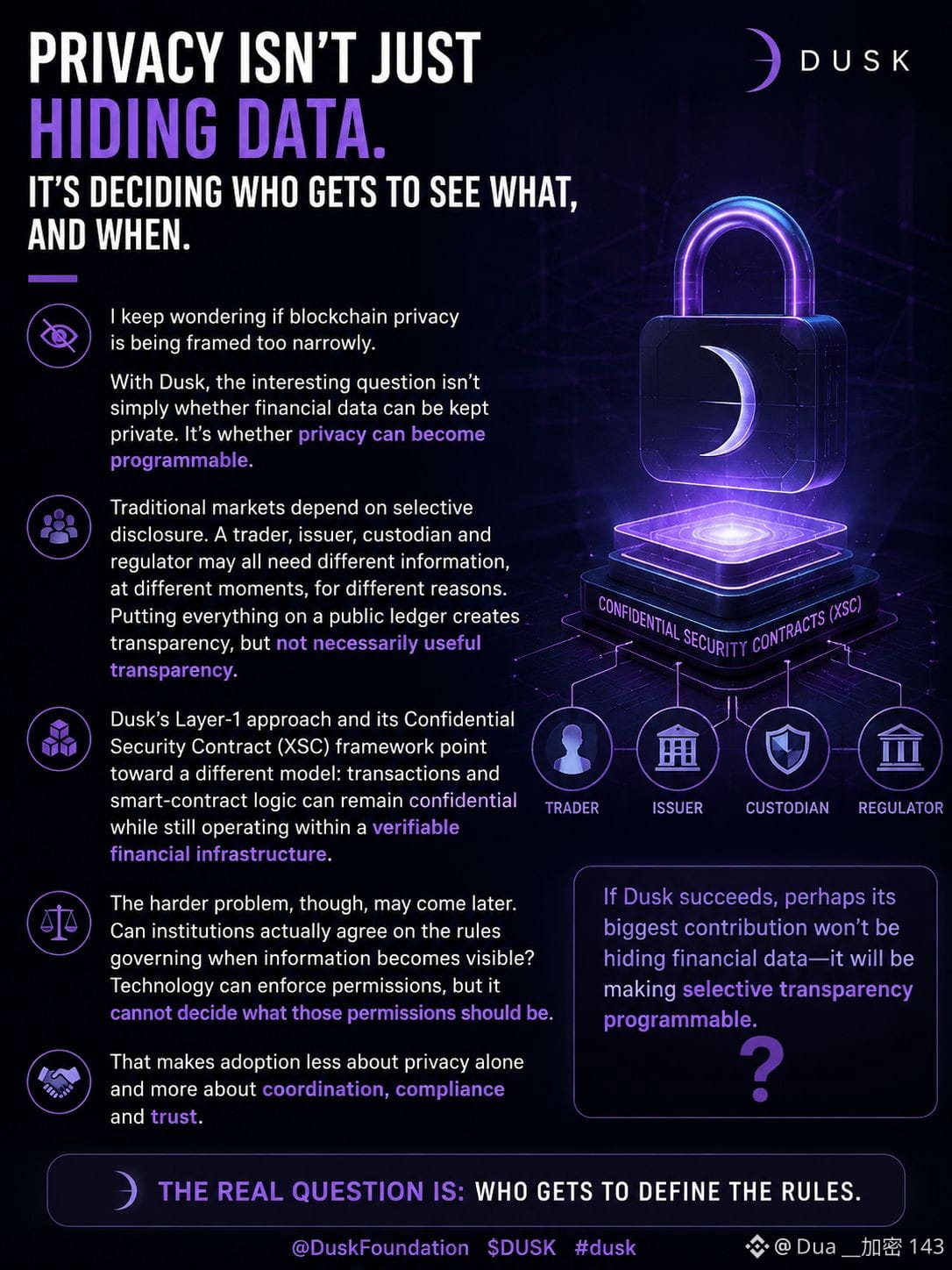
I keep wondering if blockchain privacy is being framed too narrowly.
With Dusk, the interesting question isn’t simply whether financial data can be kept private. It’s whether privacy can become programmable.
That distinction matters.
Traditional markets depend on selective disclosure. A trader, issuer, custodian and regulator may all need different information, at different moments, for different reasons. Putting everything on a public ledger creates transparency, but not necessarily useful transparency.
Dusk’s Layer-1 approach and its Confidential Security Contract (XSC) framework point toward a different model: transactions and smart-contract logic can remain confidential while still operating within a verifiable financial infrastructure.
The harder problem, though, may come later.
Can institutions actually agree on the rules governing when information becomes visible? Technology can enforce permissions, but it cannot decide what those permissions should be.
That makes adoption less about privacy alone and more about coordination, compliance and trust.
If Dusk succeeds, perhaps its biggest contribution won’t be hiding financial data—it will be making selective transparency programmable.
The real question is who gets to define the rules.
@Dusk $DUSK #Dusk
With Dusk, the interesting question isn’t simply whether financial data can be kept private. It’s whether privacy can become programmable.
That distinction matters.
Traditional markets depend on selective disclosure. A trader, issuer, custodian and regulator may all need different information, at different moments, for different reasons. Putting everything on a public ledger creates transparency, but not necessarily useful transparency.
Dusk’s Layer-1 approach and its Confidential Security Contract (XSC) framework point toward a different model: transactions and smart-contract logic can remain confidential while still operating within a verifiable financial infrastructure.
The harder problem, though, may come later.
Can institutions actually agree on the rules governing when information becomes visible? Technology can enforce permissions, but it cannot decide what those permissions should be.
That makes adoption less about privacy alone and more about coordination, compliance and trust.
If Dusk succeeds, perhaps its biggest contribution won’t be hiding financial data—it will be making selective transparency programmable.
The real question is who gets to define the rules.
@Dusk $DUSK #Dusk