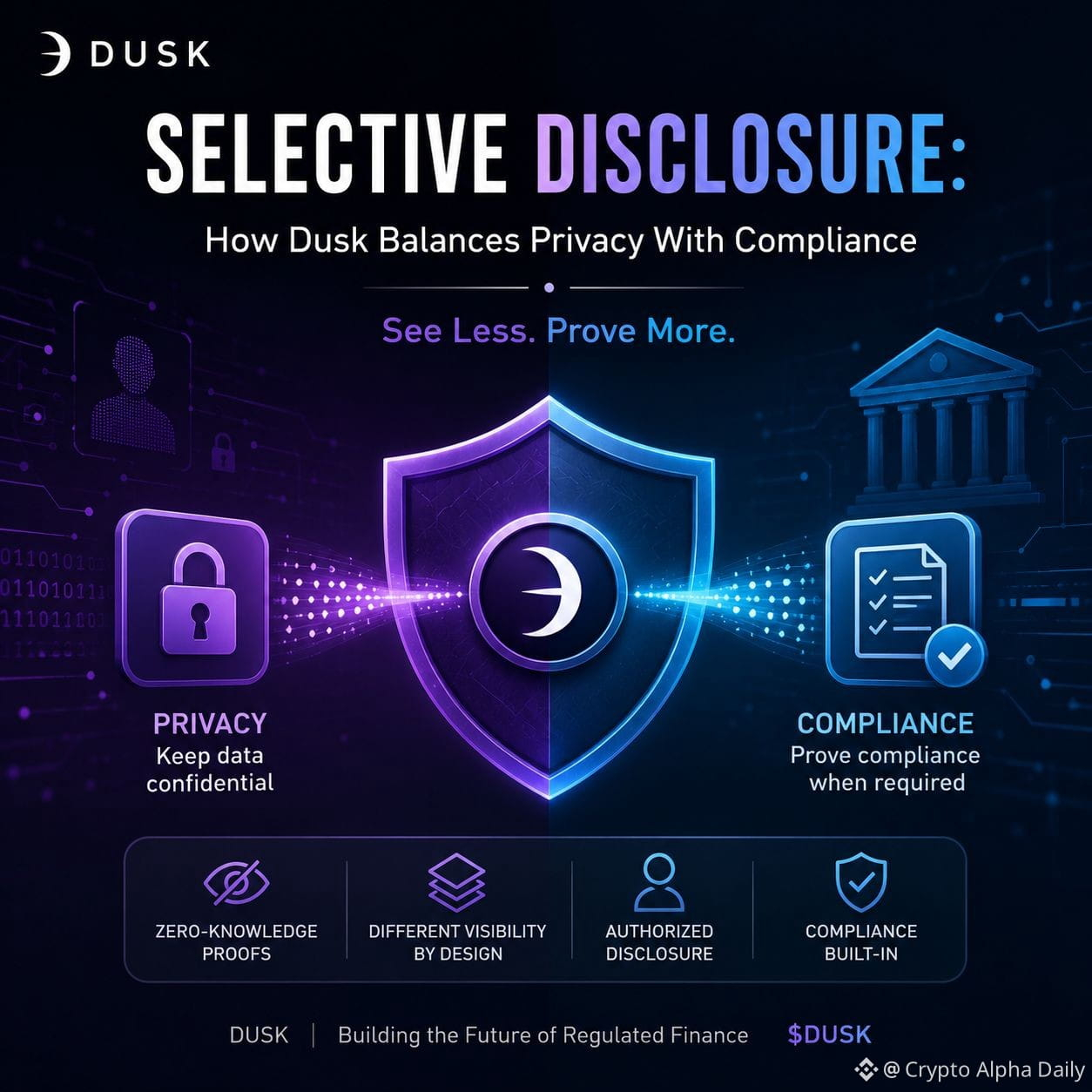
What if financial data didn’t have to be fully public to remain verifiable?
@Dusk approaches this through privacy with selective disclosure:
• Private by default: Confidential transfers can protect sensitive balances and transaction details.
• Controlled visibility: Authorized parties can receive the specific information or evidence they need, without exposing everything.
• ZK-powered compliance: Zero-knowledge capabilities can help prove eligibility or required attributes without unnecessarily revealing personal data.
• Built for regulated finance: This model fits tokenized assets and financial workflows where privacy, compliance, and auditability must coexist.
The key idea is simple: compliance doesn’t necessarily require complete transparency. Could selective disclosure become a better foundation for regulated on-chain finance?
$DUSK #dusk
Hashtags: #DUSK #BlockchainPrivacy #RegulatedFinance
Engagement question: Would you trust a financial blockchain more if it revealed only the information that regulators actually need?
@Dusk approaches this through privacy with selective disclosure:
• Private by default: Confidential transfers can protect sensitive balances and transaction details.
• Controlled visibility: Authorized parties can receive the specific information or evidence they need, without exposing everything.
• ZK-powered compliance: Zero-knowledge capabilities can help prove eligibility or required attributes without unnecessarily revealing personal data.
• Built for regulated finance: This model fits tokenized assets and financial workflows where privacy, compliance, and auditability must coexist.
The key idea is simple: compliance doesn’t necessarily require complete transparency. Could selective disclosure become a better foundation for regulated on-chain finance?
$DUSK #dusk
Hashtags: #DUSK #BlockchainPrivacy #RegulatedFinance
Engagement question: Would you trust a financial blockchain more if it revealed only the information that regulators actually need?